Blog
AI for Tech Enabled Services Companies in Healthcare and Life Science
AI splits technology-enabled healthcare services companies into two strategies, selling the tool or selling the work. Sell the tool and you race the model. Sell the work and you take on the outcome directly, closing the books, adjudicating the claim, processing the prior auth.
By Kevin Riley
The last competitive advantage for healthcare services companies is selling the work, not the tool. A question keeps coming up in every conversation I have with leaders of technology-enabled services companies in healthcare. It goes something like this: "We've spent years building proprietary software on top of our services operation. Now AI can do most of what our software does. What happens to us?"
It's the right question. And the answer, I believe, separates the companies that will define the next decade of healthcare services from those that won't survive it.
“The next $1T company will be a software company masquerading as a services firm.” Julien Bek, Partner at Sequoia Capital, March 2026, Services: The New Software
Two ways to play — and only one wins long-term
Let's be clear about what's happening. AI is splitting every knowledge-intensive services business into two distinct strategies. The first is selling the tool: you build software that makes your clients — law firms, accounting shops, healthcare revenue cycle teams — more productive. The tool is the product. The second is selling the work: you take on the outcome directly. You close the books. You adjudicate the claim. You process the prior auth. The work is the product.
If you sell the tool, you are in a race against the model. Every new version of Claude, GPT, and Gemini makes your product thinner. If you sell the work, every improvement in the model makes your service faster, cheaper, and harder to compete with. In healthcare services, that distinction is existential.
"A company might spend $120K on a billing team and $10K on a coding platform. The next legendary healthcare services company will just close the revenue cycle."
Think about where outsourced healthcare spending is concentrated. Revenue cycle management (meaning medical coding, claims adjudication, and prior authorization) runs $50–80B in the US alone. People hear "healthcare" and assume the work is judgment-heavy, too nuanced for automation. But the billing and coding layer is almost pure intelligence work. Translating clinical notes into ICD-10 codes is a complex ruleset, but it is a ruleset. The companies that recognize this first and rebuild their operating model around AI-native delivery will capture an outsized share of that market.
The wedge hiding in plain sight
For tech-enabled services companies in healthcare, the playbook is more accessible than it looks. The reason is that outsourcing is already the norm. If work is already outsourced, three things are true: 1) the client has accepted external delivery, 2) a budget line exists and can be substituted cleanly, and 3) the buyer is purchasing an outcome, not headcount. Replacing your own manual operation with an AI-native one is not a renegotiation. It's an upgrade.
The highest-value wedge in healthcare services right now is the outsourced, intelligence-heavy task: prior authorization workflows, medical coding, claims triage, and compliance documentation. These are defined processes with verifiable outputs. AI can do them. The risk isn't about capability; it's about safety, compliance, and trust.
That's exactly where tech-enabled services companies have an advantage over pure software vendors. You already own the outcome relationship with the client. You already carry the accountability. The question is whether your internal operating model is ready to deliver those outcomes at the cost structure enabled by AI.
The infrastructure problem that most companies underestimate
Here is where I want to be honest about what we've seen. Healthcare services executives understand the opportunity. What they underestimate is the complexity of deploying autonomous agents in a regulated, clinically adjacent environment.
Building an agent that can code a claim is not the same as building a general-purpose AI assistant. It requires safety testing against payer policy libraries. It requires audit trails for compliance reviewers. It requires guardrails against hallucinations that could introduce billing errors or trigger payer audits. It requires a feedback loop so the agent gets better with every case it touches — without drifting.
Most tech-enabled services companies are not AI infrastructure companies. They shouldn't have to be. But if they try to build all of this from scratch, they face 18–24 months of development before a single agent is in production. That is not a competitive strategy; that is a slow surrender.
How Actava.ai helps tech-enabled service companies
We built Actava.ai as a specialized AI infrastructure to solve exactly this problem: transforming healthcare and life sciences services companies from software-enabled operations into autonomous, agent-powered workforces, without requiring them to become AI infrastructure companies themselves. Think of us as the Agent Factory. A high-speed assembly line for safe, compliant, ever-improving agents.
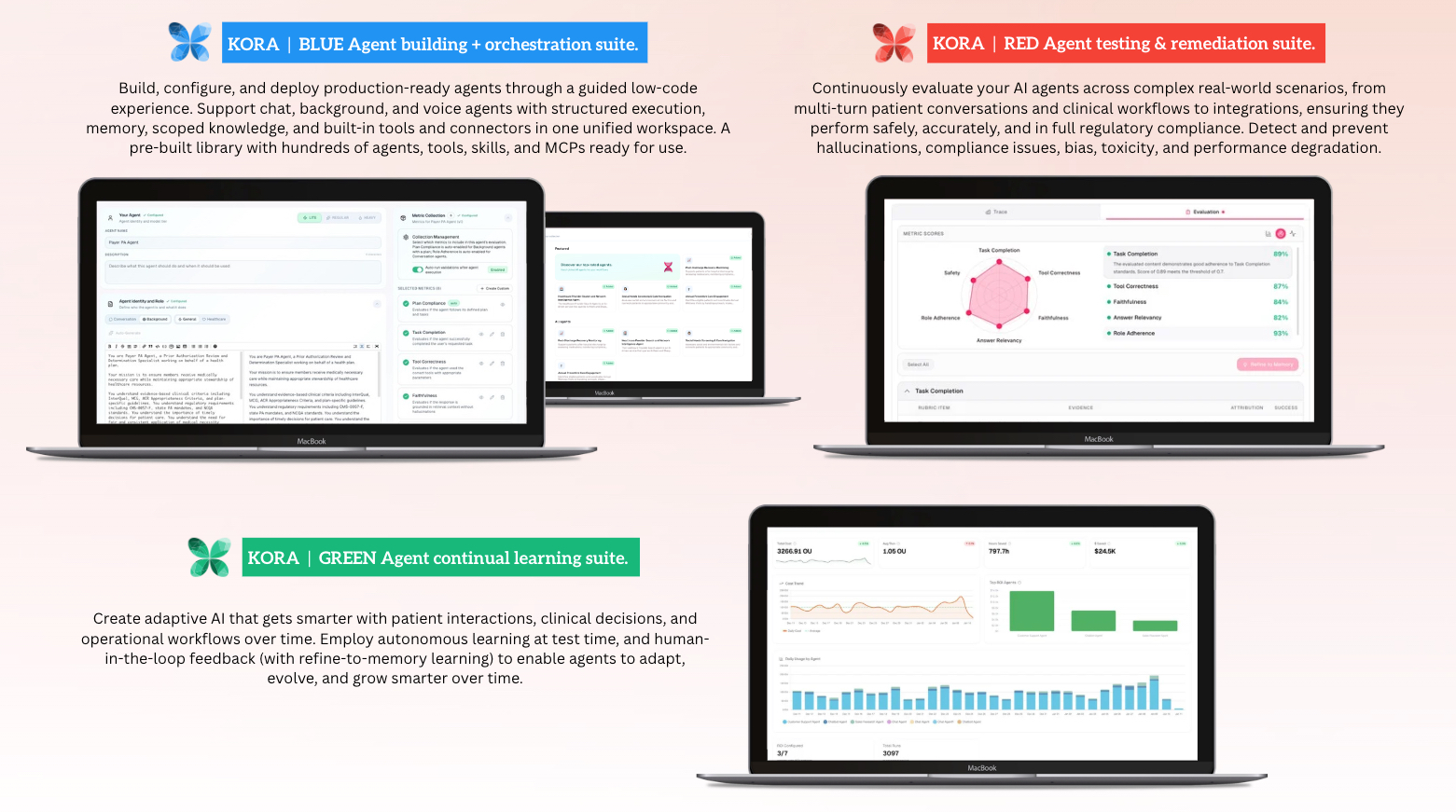
Our agents go beyond task automation. They reason, plan, learn, and take complex multi-step actions with a high degree of autonomy, much like a skilled human specialist would. A coding agent doesn't just look up ICD-10 codes. It reads a clinical note, identifies all billable events, cross-references payer-specific rules, flags ambiguities for human review, and submits a clean claim, while building a case-by-case record that makes it smarter on the next one.
For a healthcare revenue cycle services company, that agent is not a productivity tool for your coders. It is a coder. One that works at the speed of compute, at the cost of inference, with an audit trail your compliance team can actually use.
The implication for your business model is direct. You stop selling software seats to hospital systems. You start selling coded encounters, clean-claim rates, and days-to-collect. You move from tool to outcome. Your gross margin improves as agent efficiency compounds. Your competitive moat deepens because your agents are trained on your proprietary case history — a dataset no new entrant can replicate.
Safety is not a feature. In healthcare, it's the product.
I want to be direct about something that gets glossed over in conversations about AI in healthcare. Deploying autonomous agents in revenue cycle, compliance, or clinical operations without built-in safety infrastructure is not a calculated risk. It is an unacceptable one.
Bias in a coding agent can lead to claim denials being concentrated in specific patient populations. A hallucinating prior auth agent can introduce coverage gaps. A model that drifts over time without monitoring can fail silently for months before anyone notices. These are not hypothetical failure modes. They are the failure modes that will end healthcare AI deployments — and the companies behind them.
Actava.ai builds safety in at the infrastructure level. Every agent deployed through our platform comes with built-in governance, continuous audit trails, risk detection, and active safeguards against bias, hallucinations, and compliance violations. Our solution includes an enterprise-level AI Policy Suite, Training System, and Agent Registry built to meet real, accepted standards, including NIST AI RMF, HIPAA, CMS HEI, and ONC HT1. Our agents don't just improve, they improve with confidence, using reinforcement learning frameworks designed for high-stakes regulated environments. We don't believe safety and speed are a trade-off. We believe safety is what makes speed possible at enterprise scale.
The window is open — but not indefinitely
In 2025, the fastest-growing AI companies in healthcare were copilots: tools that made existing clinical and administrative professionals more effective. In 2026, the most important transition across the industry is from copilot to autopilot —from selling the tool to selling the work.
Tech-enabled services companies are uniquely positioned to make this transition. They already own the client relationship. They already carry outcome accountability. They already have proprietary operational data that can train domain-specific agents. What they need is the infrastructure to build, deploy, and continuously improve those agents at the speed the market now demands.
The companies that move first will compound a data advantage that becomes structurally unbeatable. The companies that wait will find themselves competing against services operations running at a cost structure they can't match — with agents trained on millions of cases they'll never have access to.
The question isn't whether AI transforms healthcare services. It already is. The question is whether your company is building the workforce that delivers it — or buying a tool that helps someone else do so.
If you're leading a tech-enabled services company in healthcare or life sciences and thinking about how to accelerate this transition, I'd welcome the conversation.

Written by
Kevin Riley
CEO & Co-Founder
Health-tech executive who builds and scales AI-driven software across healthcare, life sciences, and enterprise markets. Over 25 years launching and scaling solutions for healthcare and life sciences, Kevin led the healthcare and government business at Vlocity (acquired by Salesforce), growing it from $300K to more than $40M, and later served as GM of Salesforce's global Health & Life Sciences portfolio, a $4.5B business. He has also served as CEO of multiple software companies spanning AI, care management, regulatory science, and provider revenue. He created the award-winning modelH framework and was named a Top Healthcare Software Executive.