News

Healthcare IT News
FeaturedWhy Johns Hopkins is benchmarking AI agents before deployment
Health system leaders say reliable benchmarking, governance and workflow design must come before scaling agentic AI across administrative operations. Johns Hopkins Medicine is taking a deliberately cautious approach to agentic AI, focusing first on proving reliability and governance before expecting measurable financial returns.
Blog
Building an AI-Native Health Organization From Day One
An AI-native health organization is designed so machine intelligence can take part in the ordinary work of care and operations from the beginning. Five principles for building against that definition, from machine-legible knowledge to governance installed on day one. Plus why redesigned work beats a bigger model budget.
Video
ACTAVA | Agentic Workforce | Agents With a Changelog Worth Reading
Version notes are for the person who inherits this. Every versioning system shows what changed. The useful field explains why: the reason that triggered the change, the evidence someone can inspect, and the risk the change was meant to control. Six months later, the diff can show what moved. Only the note can explain what it was for. Write why, not what. Learn more about ACTAVA: https://www.actava.ai/
Video
ACTAVA | Agentic Workforce | Agents Whose Work Is Visible to the Team
A surprising amount of agent work is invisible—not because it is secret, but because it happened inside somebody's private browser session. In this ACTAVA Agentic Workforce concept, shared workspaces, live monitoring, shared threads, and open run history make the work legible to the team. That creates three practical advantages: handover, review, and reuse. Someone else can pick up the work, colleagues can inspect what happened without screenshots, and strong runs can become examples instead of disappearing with the tab. Shared thread beats private tab. Learn more about ACTAVA: https://www.actava.ai/
Video
ACTAVA | Agentic Workforce | Operational Work That Runs Without Anyone Waiting
Most operational work should not make a person wait. When an agent runs in the background, it can gather evidence, check every case, batch work efficiently, and stop at a real approval gate without holding a chat window open. In this ACTAVA Agentic Workforce concept, the workflow starts from an event or schedule, runs independently, and returns a result when it is ready. Design the work around the operation—not the spinner. Learn more about ACTAVA: https://www.actava.ai/
Video
ACTAVA | Voice Agents | Post-Discharge Call Demo
This ACTAVA Voice Agent demo shows a post-discharge follow-up call as part of a governed healthcare workflow. The agent speaks with the patient, captures structured responses, follows the approved conversation path, and escalates to designated staff when a person is needed. The call is one controlled step connected to scheduling, documentation, and follow-up inside ACTAVA KORA. Learn more about ACTAVA: https://www.actava.ai/
Video
ACTAVA | Agentic Workforce | One Governed Workflow
A governed workflow makes responsibility visible from intake through completion. In this ACTAVA Agentic Workforce concept, each step has a defined input, output, owner, tool boundary, and approval point. The workflow can move across agents and systems without losing context, while run history preserves what happened and why. One workflow. Clear gates. Traceable execution. Learn more about ACTAVA: https://www.actava.ai/
Video
ACTAVA | Agentic Workforce | Agents That Are Allowed to Be Slow
Not every workflow is a chat window. When nobody is waiting on a spinner, an agent can retrieve more, check more, batch work more efficiently, and pause at a real approval gate. Background work is not a lesser mode; it is where most operational work belongs. Ask whether anybody is actually waiting. Usually nobody is. Background work can take its time. Learn more about ACTAVA: https://www.actava.ai/
Video
ACTAVA | Agentic Workforce | Agents That Show the Plan Before Doing the Work
Agents should not begin with silent execution. A visible plan lets the operator inspect the steps, confirm assumptions, and catch an unsafe path before tools are called. In this ACTAVA Agentic Workforce concept, the plan becomes an approval surface: the agent says what it intends to do, which systems it will use, and where it will pause. Show the plan. Then do the work. Learn more about ACTAVA: https://www.actava.ai/
Blog
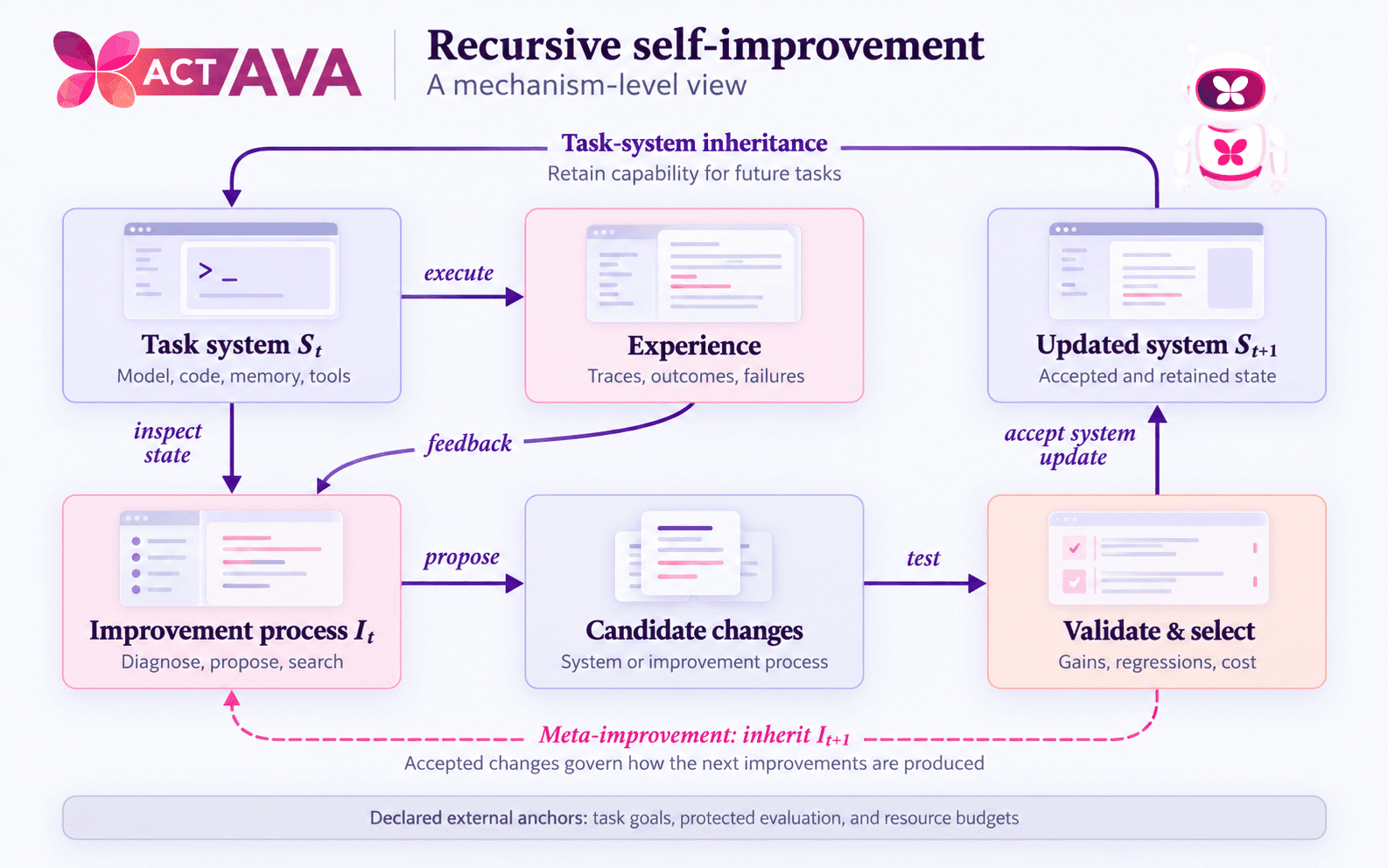
Can AI Improve Its Own Ability to Improve? A New Survey Grades the Evidence
Can AI improve its own ability to improve? A new 57-page survey, co-authored by Actava.ai co-founder Weiran Yao and researchers from Tsinghua, Peking University, CMU, UC Berkeley, and other teams, reviews 404 works and offers a careful answer. Sometimes, in limited settings. The paper separates 3 claims that usually get blurred together (task gain, retention, and improver gain) and names feedback quality, interacting updates, and independent validation as the constraints on every improvement loop. This post walks through the framework, grades our own CURA training loop against it, and gives healthcare leaders 3 questions for any vendor that says "self-improving."

Blog
Meet Bill Achenbach
Bill Achenbach is a senior AI sales executive with over 20 years of experience driving revenue growth for AI-powered technology solutions across healthcare and enterprise sectors. Throughout his career at KMS Technology, LexisNexis, Reuters, and Nova Medical Centers (acquired by Concentra in 2025), Bill built strategic client relationships that turned emerging AI capabilities into signed enterprise partnerships and widely adopted clinical solutions. He now brings this extensive track record to Actava.ai, guiding healthcare organizations through their AI transformation journeys. As healthcare transitions from initial AI experimentation to core operational infrastructure, organizations face critical integration challenges, including data readiness, model governance, regulatory risk, and clinical adoption. As an AI Sales Executive at Actava.ai, Bill works directly with healthcare and enterprise leaders to evaluate and implement agentic AI solutions tailored to their specific workflows. He brings deep fluency in complex compliance standards—including HIPAA, FHIR, HL7, SOC 2, eCOA, and FDA regulations such as 21 CFR Part 11—ensuring that AI adoption aligns with rigorous security and regulatory expectations.
Blog
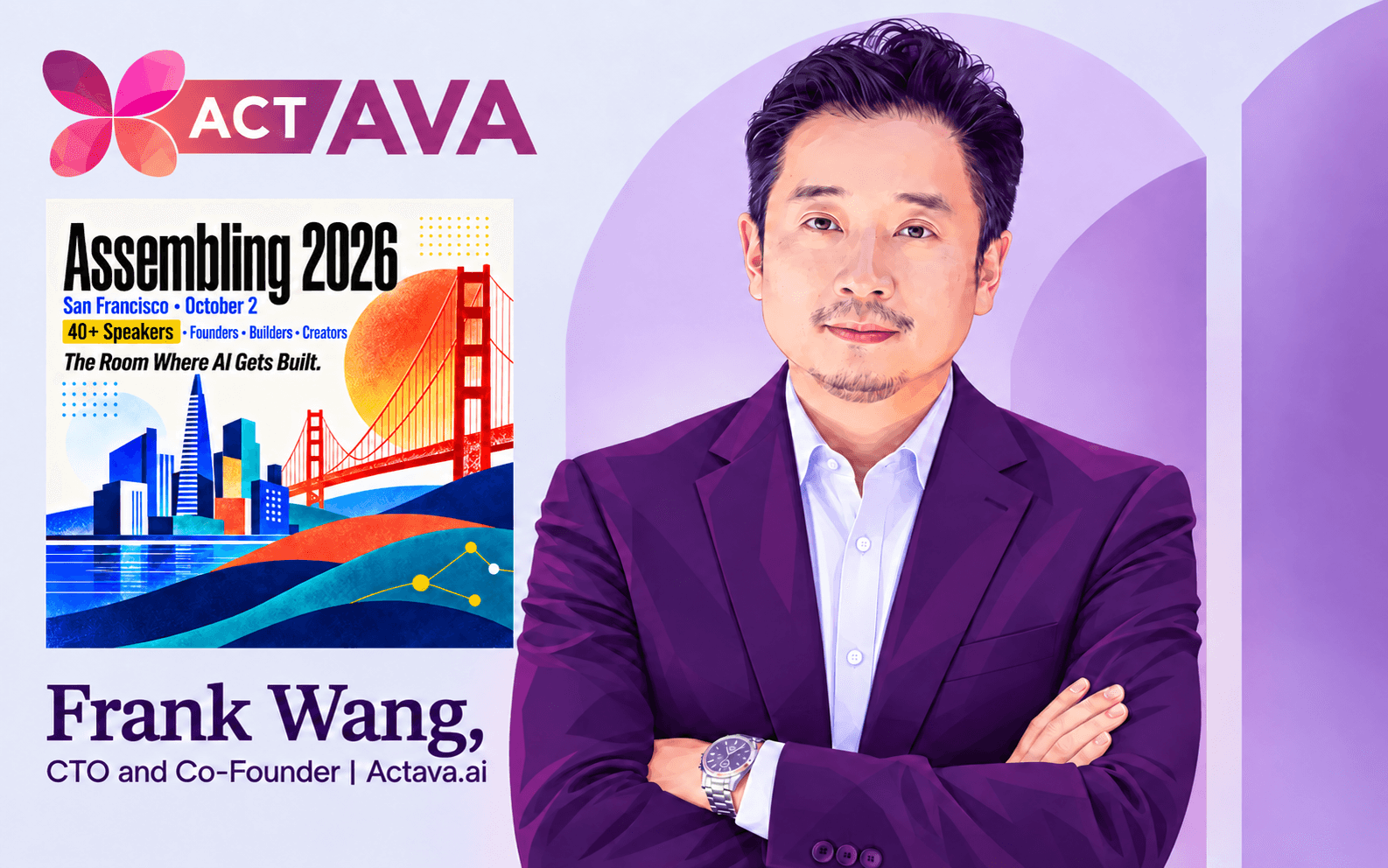
Frank Wang Takes the Stage at Assembling 2026 in San Francisco
Frank Wang, our founder and CTO, speaks at Assembling 2026 on Friday, October 2, at TERRA Gallery in San Francisco. Assembling is a one-day AI summit from GenAI Assembling, a community that started in Silicon Valley in July 2024. Founders, builders, researchers, operators, and investors share one room from 8:30 AM to 5:00 PM. More than 750 people had registered when we wrote this. He'll join them to discuss how hard the test is for agents and how our χ-BENCH results show the best frontier agents completing 28% of complex healthcare workflows.
Video
ACTAVA | Agentic Workforce | Agents That Respect Where Data Lives
The quietest compliance failure in an agent pipeline is data ending up somewhere nobody planned for it to be. Ordinary engineering convenience creates uncontrolled copies: full records pasted into prompts, generated documents that replicate source content, and handoffs that pass data instead of references. Each copy creates another set of logs, caches, traces, permissions, and retention rules to govern. Reference it. Don’t relocate it. Every copy is a new thing to govern. Make fewer of them.
Showing 1–13 of 260 results
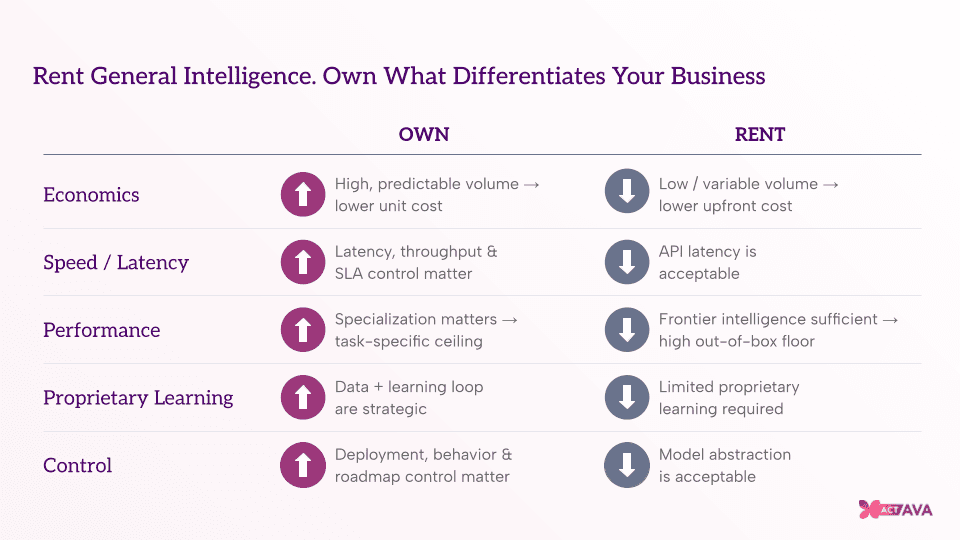
From production workflows to customer-controlled intelligence.
Don't give your agentic future away to a single model provider. Don't mistake consumer tools for real, safe Enterprise Agentic Tools. Enable your citizen developers to create and manage the AI Agents they need to run their part of your business.
Build complex agents. Test their reliability. Learn from every workflow. Own your intelligence.