Blog
The Data Tollbooth: AI will allow you to do more with your data; should you have to pay the App Vendor and the Inference Vendor for it?
Your SaaS vendors are charging you to access your own data. Slowly, quietly, and with increasing confidence. How can you avoid double-paying for what is yours, and avoid adding more point-solution AI to your operations? This post is about why their defensive play won't hold, what the market already knows, and how healthcare organizations can restructure their AI spending to stop paying three times for the same intelligence.
By Kevin Riley
Part 3 — ROI and Agentic AI Series
Your SaaS vendors are charging you to access your own data. Slowly, quietly, and with increasing confidence. How can you avoid double-paying for what is yours, and avoid adding more point-solution AI to your operations? This post is about why their defensive play won't hold, what the market already knows, and how healthcare organizations can restructure their AI spending to stop paying three times for the same intelligence.
For this third post in our series, I asked Nate Gagne, Managing Partner at our partner Empactful Studios, to help think through the SaaS "data tollbooth" concept we are now seeing so much of.
Salesforce raised prices on apps that tap into its data in late 2025. ServiceNow, Workday, and Epic are following the same script. Industry analysts now have a term for it: the data toll. Pay to connect. Pay again for the AI add-on that runs on top. Pay again at renewal when the vendor has bundled its AI features into a tier you didn't ask for and can't easily opt out of.
SaaS app vendors are doing this purposefully and reactively — because of AI. They are pricing defensively against a clear threat: AI agents that can access their systems, extract what a workflow needs, and take action without requiring a human user to log in, navigate a UI, or hold a seat license. The data toll is their answer. It does make it expensive to access the data programmatically, and the economics of replacing their UI with an AI agent get harder.
The Stock Market Has Already Repriced This
Markets priced this shift before most enterprise IT budgets did. In April 2026, the software sector repriced sharply on what analysts called "AI agent fears" — the concern that seat-based SaaS revenue is structurally threatened by AI agents doing the work that previously required human users. Cloudflare fell 12%, Snowflake fell 9%, ServiceNow fell 7% in a single session. Across the sector, AI agents erased an estimated $2 trillion in SaaS market value as investors repriced the long-term revenue durability of the seat model.
The valuation logic is straightforward. When an AI agent calls a Salesforce API to read contact records and update deal stages, Salesforce risks becoming a database — a system of storage, valued at a fraction of a system of action. Seat-based revenue assumes a human at the interface. Remove the human, and the pricing model loses its anchor. The market is pricing that risk now. Enterprise IT budgets are slower to catch up.
You Are Paying for AI Twice — and Neither Purchase Is Optimal
The typical enterprise AI portfolio today looks like this: a base SaaS contract, plus an AI add-on from each vendor, plus a renewal bump to cover the AI features the vendor bundled whether you asked for them or not. Every major SaaS platform now has a branded AI offering. Salesforce has Einstein. ServiceNow has Now Assist. Epic has Cognitive Computing. Workday has Illuminate. Each one is priced as a premium feature, locked to that vendor's preferred model choices, useful only within that vendor's system.
The problem is not that these tools are bad. Some of them are reasonably capable within their native environments. The problem is the architecture. You are buying point AI solutions as part of a point solution stack — a different AI add-on for every system, each one trained on that vendor's data model, each one requiring its own administrative overhead, each one generating a separate ROI story that no one is tying together. You are not building an AI capability. You are assembling a collection of AI subscriptions.
If an Agent Does the Work, Who Needs the Seat?
Seat licenses were priced on a simple premise: each human user who accesses the system costs a license. That model made sense when humans were the only entities doing the work. It makes progressively less sense as AI agents perform tasks that previously required human logins — reading data, updating records, triggering workflows, generating reports.
The question to ask about every significant seat count in your portfolio is: how many of these seats are being used primarily to move data between systems, execute repetitive workflows, or perform tasks that follow consistent decision logic? Because those are exactly the tasks AI agents handle well. A care manager who spends 60% of her time re-entering data across payer portals and documenting UM decisions in three systems is not using her clinical judgment for 60% of her shift — she is performing data entry that an agent could execute faster, with a more consistent audit trail, and without a seat license in every system it touches.
The vendors know this, which is why the data toll exists. If API access is cheap, the seat reduction math becomes immediately compelling. Making API access expensive is how they defend against it. The right response is not to pay the toll indefinitely — it is to build the business case, run the ROI analysis for each workflow, and make the seat-reduction decision deliberately rather than absorbing the cost because it's easier than the conversation.
| Question to ask | Point AI add-on (vendor) | Unified AI harness (ACTAVA) |
|---|---|---|
| Which systems does it access? | Only the vendor's own system | Any connected system via MCP or API |
| Which model does it use? | Vendor's chosen model, no flexibility | Best model for each task; A/B tested; swappable |
| Can it cross system boundaries? | No — siloed to one platform | Yes — workflows span systems natively |
| Governance & audit trail? | Within the vendor's own logs only | Single audit log across all agents and systems |
| ROI visibility? | Vendor-defined metrics, no cross-platform view | Per-agent spend, hours saved, cost per outcome |
| Pricing model | Add-on premium per system + seat licenses | Orchestration units per outcome; seats reduced |
AI Is AI Is AI. The Intelligence Doesn't Belong Inside Each App.
Here is the principle that the SaaS vendors do not want your procurement team to think clearly about: the AI is the same regardless of which system it's reading from. A frontier model reasoning over a Salesforce CRM record and a frontier model reasoning over an Epic clinical note are running the same underlying intelligence. The model does not care which system stored the data. What changes is the connector, the context, and the workflow — not the intelligence itself.
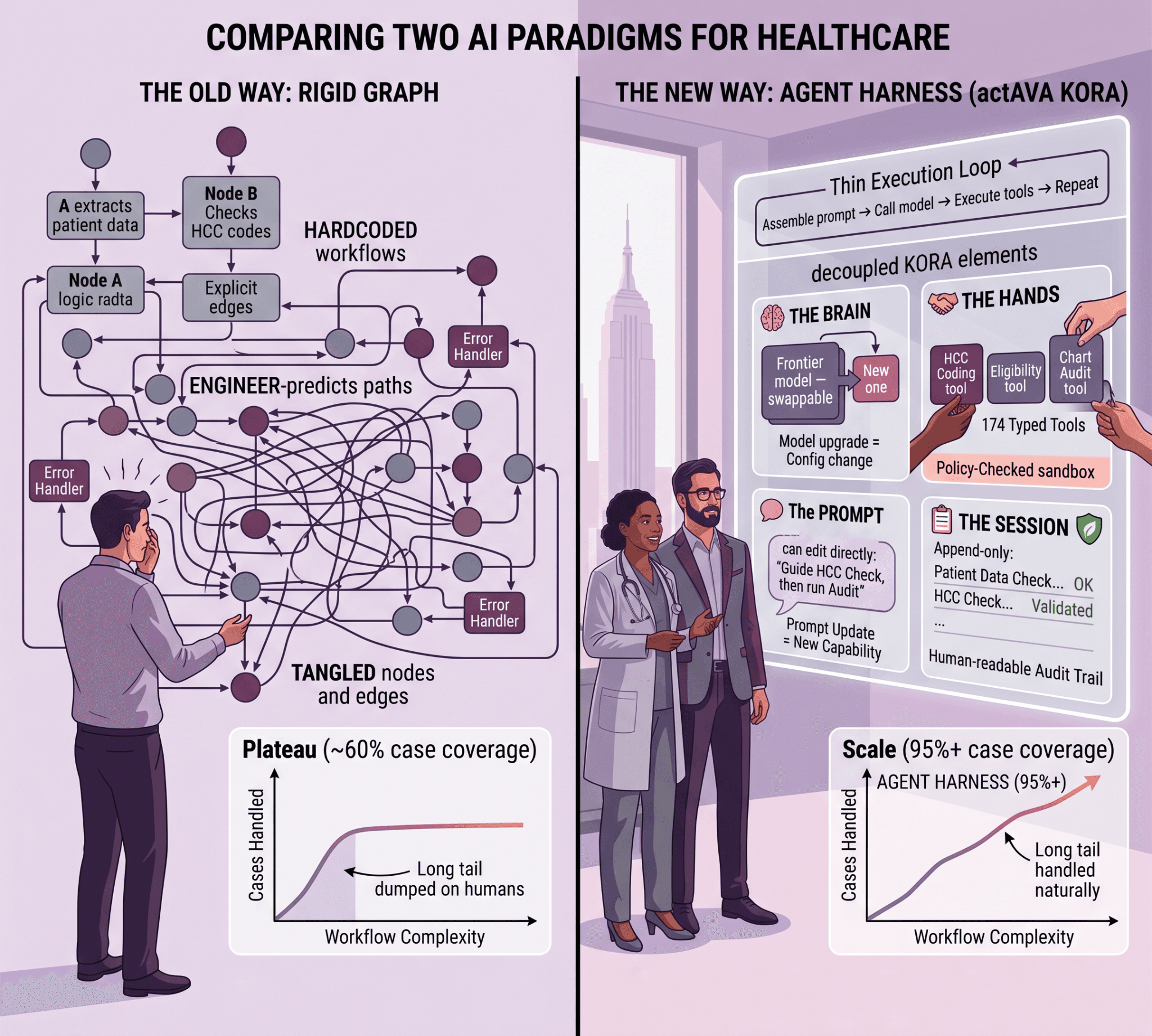
This means there is no architectural reason to buy a separate AI for every system you run. You are not buying AI from Salesforce or Epic or ServiceNow — you are buying access to their version of AI, locked to their platform, at their price, with their model choices, running workflows that stop at their system boundary. The alternative is one AI harness — a single governed platform that connects to all of your systems, runs the best available model for each task, coordinates across system boundaries, and produces a single audit trail, a single ROI dashboard, and a single compliance posture.
You probably do not need every one of your current vendors' AI solutions. You probably need fewer seats than you have today. And you almost certainly do not need to pay a data toll to access data that was created by your own operations, for your own business purposes, in a system you are already paying to use.
In Healthcare, This Dynamic Is More Acute
Healthcare SaaS has an additional dimension that makes the vendor lock-in problem worse: HIPAA data residency requirements and interoperability mandates create the illusion that each healthcare system's data must stay inside that system's AI tools. Epic Cognitive Computing for clinical data. Availity's AI tools for payer connectivity. Each payer portal's proprietary workflows. The reality is that FHIR APIs, CMS-0057-F interoperability mandates, and well-architected MCP connectors make cross-system AI orchestration fully achievable without violating a single HIPAA requirement — if the platform is built to healthcare compliance standards from the ground up.
For payers and health systems, the economic stakes are high. Healthcare organizations are already operating on margins that leave no room for redundant AI subscriptions at 20–37% renewal premiums. A mid-size payer running a dozen enterprise SaaS contracts in its operations stack — EHR access, payer portals, credentialing systems, care management platforms — is looking at meaningful spend on AI add-ons that each solve one workflow and cannot talk to each other.
The alternative: a single AI harness, connected to all of those systems, running purpose-built agents for each workflow, with the governance architecture that regulated healthcare requires — and a continuous ROI measurement that tells you, agent by agent, whether the spend is justified. That is what ACTAVA | KORA is built to be.
The question is not whether your organization needs AI. The question is whether you are going to buy fifteen vendor-specific AI subscriptions and call that a strategy, or build one governed layer that makes all of your systems more intelligent at once.
The market has already answered the question about where value is accumulating. Revenue is migrating from the app layer to the intelligence layer — from the SaaS seat to the AI outcome. The organizations that recognize this shift in their procurement decisions before their next renewal cycle are the ones that will own their AI cost curve rather than fund their vendors' defensive pricing strategies.
Want a better answer to this dilemma?
ACTAVA is a model-independent agent harness that ensures you own your agentic roadmap and allows you to control costs. Connect your existing systems, deploy governed agents, and measure ROI at the agent level — without buying a separate AI add-on from every vendor you use.
Contact the ACTAVA team →More from our ROI and Agentic AI Series
- → Before You Pick an AI Model, Know What You're Paying For
- → Spend on Purpose: Controlling AI Cost in the Agent Era
Sources: AI Agents Just Erased $2T in SaaS Value · SaaS Stock Meltdown: ServiceNow, Salesforce, Cloudflare, Benzinga · The Market Just Repriced the Entire Software Sector on AI Agent Fears, 24/7 Wall St. · SaaS vendors must adjust pricing models as agentic AI transforms the industry, RSM US · Enterprise SaaS in the Agentic AI Era, VaaSBlock

Written by
Kevin Riley
CEO & Co-Founder
Health-tech executive who builds and scales AI-driven software across healthcare, life sciences, and enterprise markets. Over 25 years launching and scaling solutions for healthcare and life sciences, Kevin led the healthcare and government business at Vlocity (acquired by Salesforce), growing it from $300K to more than $40M, and later served as GM of Salesforce's global Health & Life Sciences portfolio, a $4.5B business. He has also served as CEO of multiple software companies spanning AI, care management, regulatory science, and provider revenue. He created the award-winning modelH framework and was named a Top Healthcare Software Executive.