News

Healthcare IT News
FeaturedWhy Johns Hopkins is benchmarking AI agents before deployment
Health system leaders say reliable benchmarking, governance and workflow design must come before scaling agentic AI across administrative operations. Johns Hopkins Medicine is taking a deliberately cautious approach to agentic AI, focusing first on proving reliability and governance before expecting measurable financial returns.

Blog
Agent ROI Begins at the Fabric Level
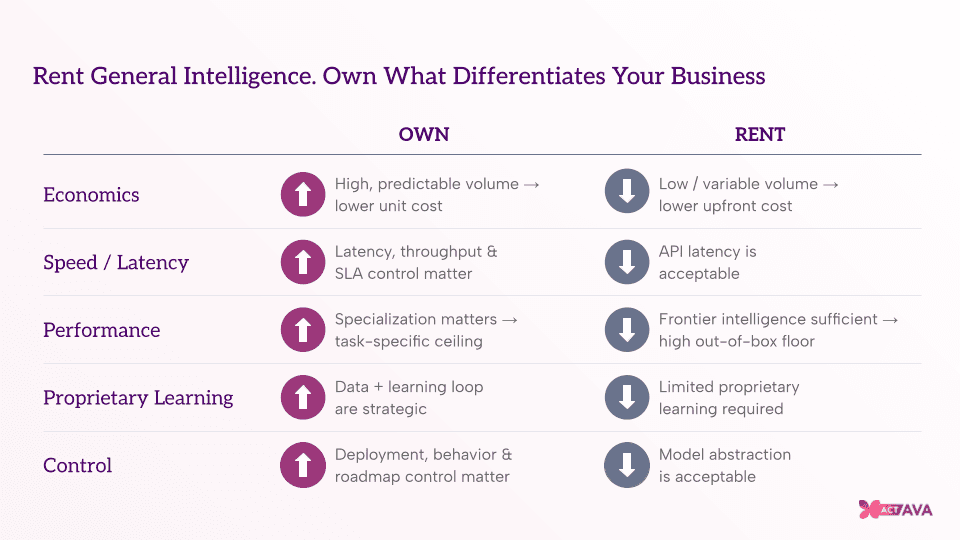
Most enterprises measure AI return at the wrong altitude. Project-level ROI adds up hours saved and declares victory, while token waste, model drift, and API cost spikes stay buried under the estimate. Real, defensible return starts at the agent, with cost per execution and accuracy against real workflows, and gets captured at the fabric layer that routes each step to the right model and keeps the audit trail. Part of our "AI Capacity Doctrine" series, Actava.ai argues that if you can't swap models, you're building someone else's ROI story, and that before you pick your next model, you should own the layer above it.
Video
ACTAVA | Agentic Workforce | Enrollment That Doesn't Lose People Halfway Through
Enrollment drop-off isn't apathy. It happens when a form asks a policy question nobody explained. This ACTAVA Agentic Workforce concept shows how a benefits-enrollment assistant can resolve qualifying life events, dependent eligibility, and deadlines using approved policy sources, then route changes for HR sign-off before anything is final. Answer the eligibility question before they abandon the form over it. Learn more about ACTAVA: https://www.actava.ai/
Blog
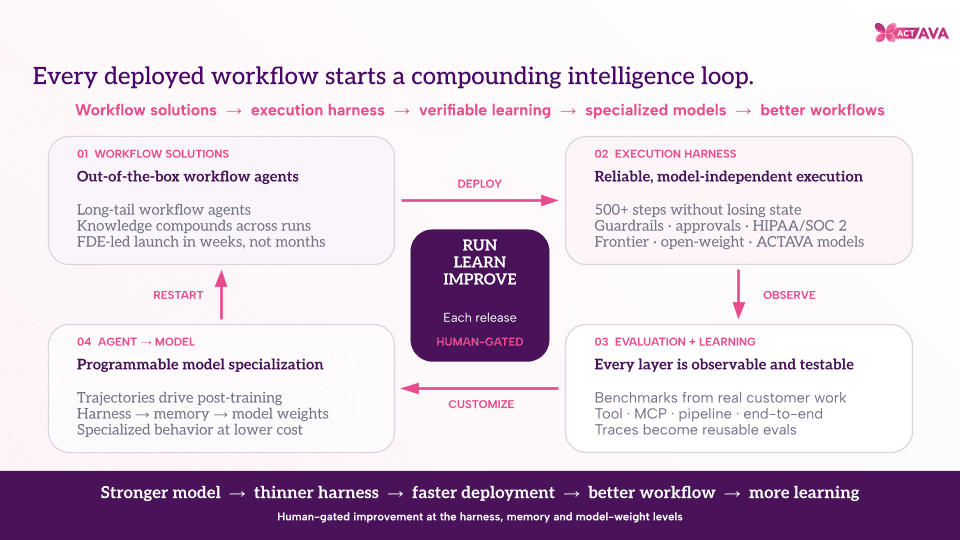
Orchestration Is Commoditizing. The Learning Loop Is Where Healthcare AI Advantage Lives.
Ask 6 vendors what orchestration means, and you'll get 6 answers, each one a confession about where that vendor came from. Process, control plane, hyperscaler, frontier lab, outcome, domain. Every lens is good at something, and analysts now agree the routing layer is commoditizing fastest. In healthcare, coordination gets you performance. The advantage goes to whoever learns from each run and keeps what it learned. Sri Pang lays out six lenses, three verticals where every step finished and the workflow still failed, and three tests that tell you whether you're buying a conductor or a conservatory.
Release Notes
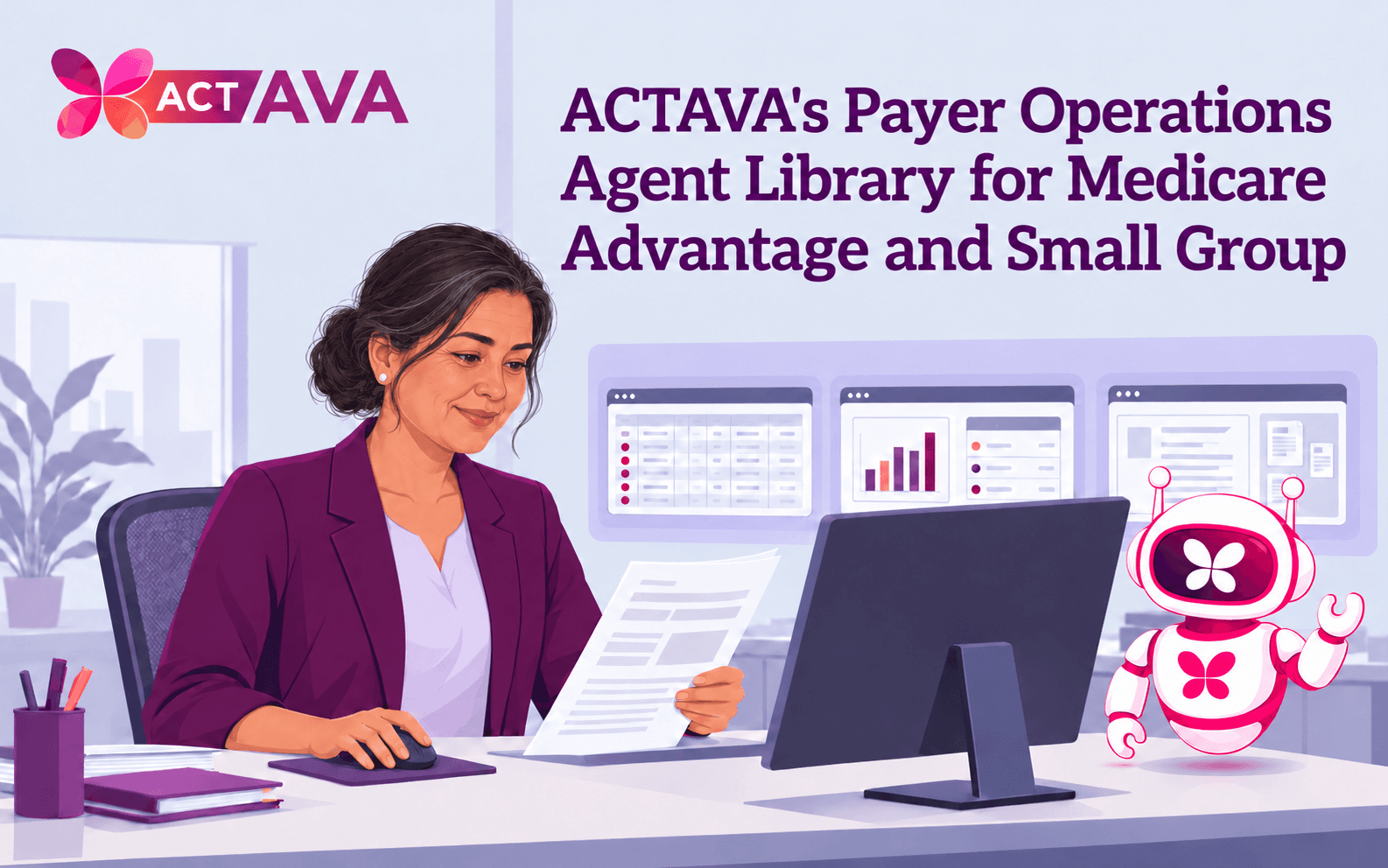
ACTAVA's Payer Operations Agent Library for Medicare Advantage and Small Group
The Actava.ai Payer Operations Agent Library includes 13 new agents 🤖 covering 𝗠𝗲𝗱𝗶𝗰𝗮𝗿𝗲 𝗔𝗱𝘃𝗮𝗻𝘁𝗮𝗴𝗲 enrollment, authorization, and claims, plus 𝗦𝗺𝗮𝗹𝗹 𝗚𝗿𝗼𝘂𝗽 quoting, installation, service, appeals, and renewals.

Blog
Meet our Advisors: Dr. Qingsong Wen
Qingsong Wen joins Actava.ai as a Strategic Advisor. He is the Chief Scientist at Squirrel Ai Learning and a PhD Supervisor at the University of Oxford. His research interests include machine learning, data mining, and signal processing, especially LLMs and AI agents for Education, Finance, and Time Series. His honors include recognition among Forbes China’s Top 100 Most Influential Chinese Elites, the INNS Aharon Katzir Young Investigator Award, and the AAAI Innovative Application Award. He holds editorial roles at leading AI journals, including IEEE TPAMI, IEEE TSP, and JAIR. He also serves as Associate Vice President for Cybernetics of the IEEE SMC Society, Vice Chair of the INNS AI for Education Section, and Chair of the IEEE CIS Task Force on AI for Time Series and Spatio-Temporal Data. In this blog, he explains why agent reliability has to be measured across the whole task, not one convincing step. He also shares what time series research teaches us about reading a patient's trajectory instead of a single snapshot.
Blog
Building an AI-Native Health Organization From Day One
An AI-native health organization is designed so machine intelligence can take part in the ordinary work of care and operations from the beginning. Five principles for building against that definition, from machine-legible knowledge to governance installed on day one. Plus why redesigned work beats a bigger model budget.

Video
ACTAVA | Agentic Workforce | Agents That Make the Next Agent Easier
The real test of an agent platform is not the first agent. It’s whether every agent makes the next one faster and easier to build. This ACTAVA video shows how reusable connections, shared knowledge, skills, agent libraries, and governance let the tenth agent inherit what the first nine already established.

Video
ACTAVA | Agentic Workforce | A Billing Answer That Doesn't Need a Callback
Most billing confusion isn’t about the amount—it’s whether the explanation actually answers the question and matches the plan document behind it. This ACTAVA video shows how reusable benchmark datasets, repeatable experiments, grounded knowledge, and defined reviewer groups turn billing explanations into responses members can trust—without the callback.

Video
ACTAVA | Agentic Workforce | One Governed Workflow
A governed workflow makes responsibility visible from intake through completion. In this ACTAVA Agentic Workforce concept, each step has a defined input, output, owner, tool boundary, and approval point. The workflow can move across agents and systems without losing context, while run history preserves what happened and why. One workflow. Clear gates. Traceable execution. Learn more about ACTAVA: https://www.actava.ai/
Video
ACTAVA | Agentic Workforce | Agents That Are Allowed to Be Slow
Not every workflow is a chat window. When nobody is waiting on a spinner, an agent can retrieve more, check more, batch work more efficiently, and pause at a real approval gate. Background work is not a lesser mode; it is where most operational work belongs. Ask whether anybody is actually waiting. Usually nobody is. Background work can take its time. Learn more about ACTAVA: https://www.actava.ai/
Video
ACTAVA | Agentic Workforce | Agents That Show the Plan Before Doing the Work
Agents should not begin with silent execution. A visible plan lets the operator inspect the steps, confirm assumptions, and catch an unsafe path before tools are called. In this ACTAVA Agentic Workforce concept, the plan becomes an approval surface: the agent says what it intends to do, which systems it will use, and where it will pause. Show the plan. Then do the work. Learn more about ACTAVA: https://www.actava.ai/

Video
ACTAVA | Voice Agents | Post-Discharge Call Demo
This ACTAVA Voice Agent demo shows a post-discharge follow-up call as part of a governed healthcare workflow. The agent speaks with the patient, captures structured responses, follows the approved conversation path, and escalates to designated staff when a person is needed. The call is one controlled step connected to scheduling, documentation, and follow-up inside ACTAVA KORA. Learn more about ACTAVA: https://www.actava.ai/
Showing 1–13 of 266 results
From production workflows to customer-controlled intelligence.
Don't give your agentic future away to a single model provider. Don't mistake consumer tools for real, safe Enterprise Agentic Tools. Enable your citizen developers to create and manage the AI Agents they need to run their part of your business.
Build complex agents. Test their reliability. Learn from every workflow. Own your intelligence.