Blog
Control the Tokens, Control the Future: Why Consulting Firms Should Hold the Center
Controlling tokens in a consulting stack means owning token generation, which keeps the client relationship and the methodology on your side. Most leading model providers now build their own services, putting a firm and its core supplier on shared territory. Actava.ai KORA generates tokens and routes them to whichever provider fits the task.
By Kevin Riley
AI Strategy · Healthcare
Control the tokens, control the future.
For the firms building their advisory practices on AI, one architecture choice quietly shapes everything that follows: who sits at the center of the stack, you or the model provider.
The large consulting and advisory firms are moving fast on AI, and they should. Client demand is real, the technology is ready enough, and the firms that build fluency now will lead the next decade of services. The question worth pausing on isn't whether to adopt. It's where to put the dependency.
A lot of teams are wiring a frontier model directly into the heart of their delivery: agents that run client workflows, draft deliverables, and encode the firm's methodology. It works beautifully on day one. The part that's easy to miss is what you hand over while it works.
A quieter consideration worth raising
Most of the leading model providers are also building their own services, accelerators, and agent products. Some are funding startups that compete directly with traditional advisory work. None of that is hostile. It's the natural shape of the market. But it means the firm and its core supplier increasingly play in overlapping territory.
When a provider sits at the center of your delivery, two things gradually move toward them: your workflows, which start to look like usage patterns they can study, and your flexibility, which narrows every time the methodology gets tuned to one model's quirks. The dependency compounds slowly, then becomes hard to unwind.
The model you build on is a choice you should be able to revisit, again and again, without rebuilding the firm around it.
A more durable pattern
A growing number of firms are keeping a control plane of their own between the practice and the providers: a layer that decides which model handles which job, and on what terms. The frontier models stay valuable. They just stop being the foundation everything else depends on.
That arrangement keeps the important things on the firm's side of the table. The client relationship, the proprietary methodology, and the freedom to switch or blend providers as pricing, accuracy, and regulation shift. The firm sets the terms instead of inheriting them.
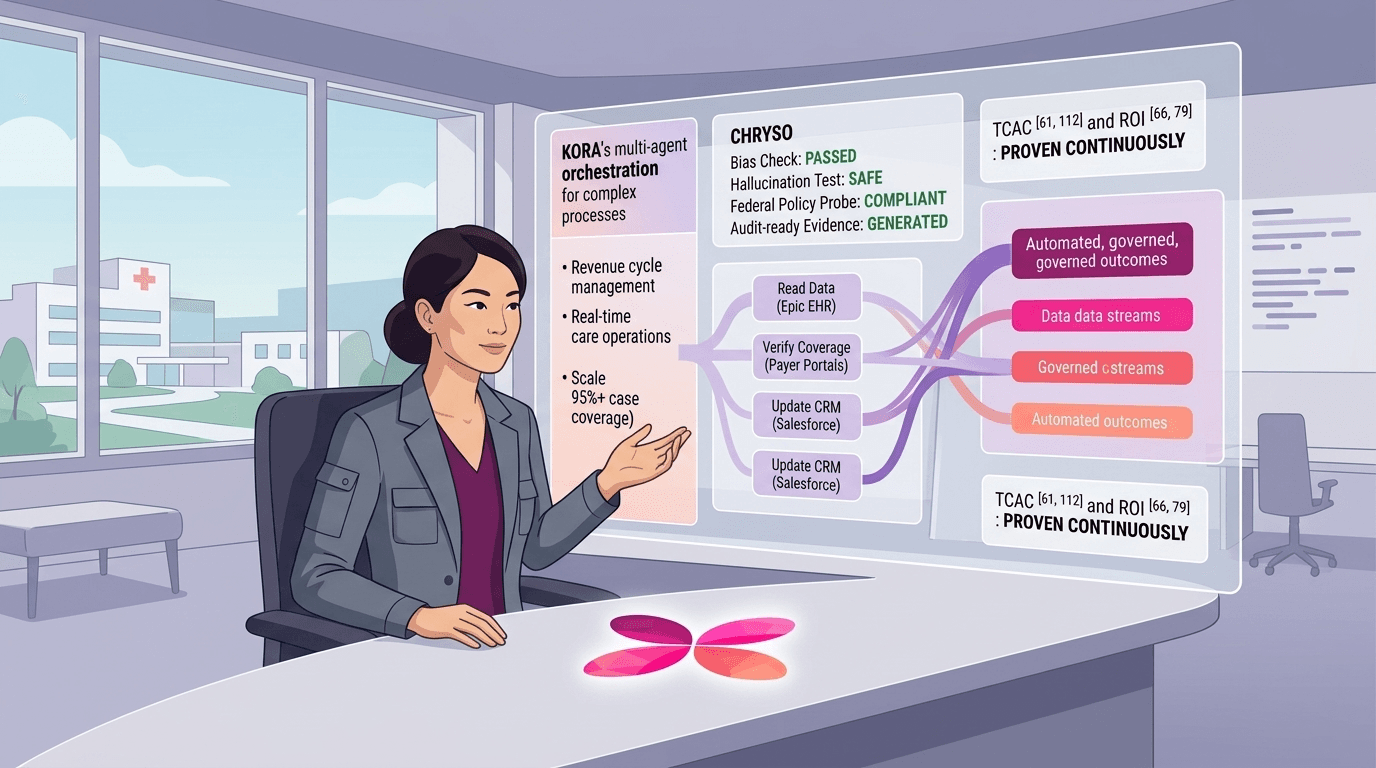
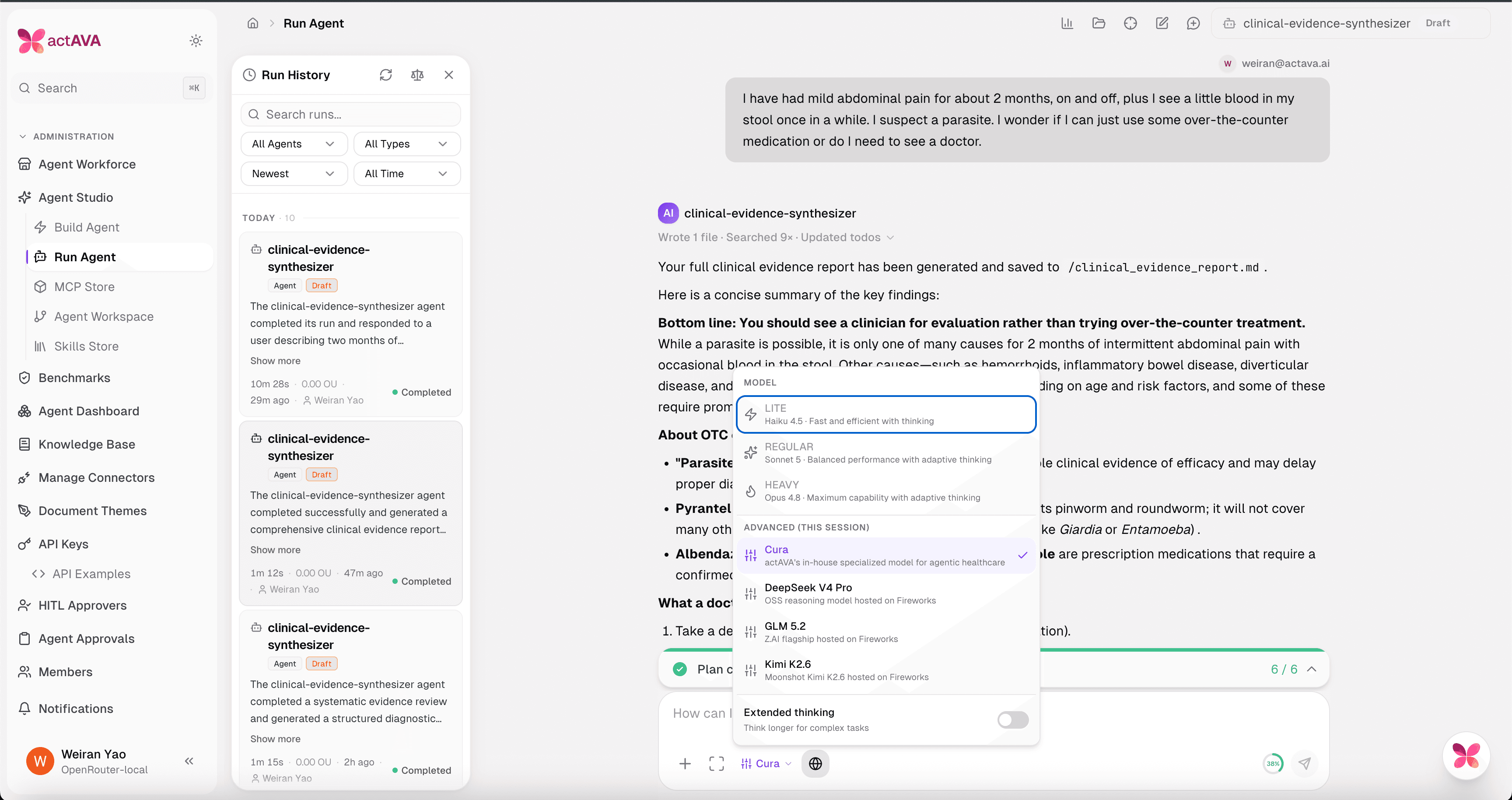
This is one of the ideas KORA is built around, and it runs in production today. KORA owns token generation and routes those tokens to whichever model provider fits the task. Orchestration, governance, and routing live in our layer, which leaves the underlying model as a component you can change without disturbing everything above it.
In healthcare, that flexibility earns its keep quickly. A model that clears compliance review this quarter may not be the one you trust next quarter. Frontier models keep arriving, pricing keeps moving, and regulation keeps tightening. A control plane lets a firm absorb all of that without re-architecting delivery or deepening a single dependency each time.
An invitation, not a warning
None of this is a case against the frontier labs. Their models are remarkable, and any serious healthcare AI practice will use several of them. The suggestion is simply to keep a layer of your own in the middle, so adoption and independence grow together rather than trading off.
Firms that hold that center keep their options open as the market shifts under everyone. They get to steer the disruption instead of being carried by it, and that posture tends to age well.
Control the tokens. Control your future.
Keep your options open
See how Actava.ai KORA sits between your practice and the model providers, so you route tokens on your terms and revisit the choice whenever the market moves.
Explore KORA Request a Demo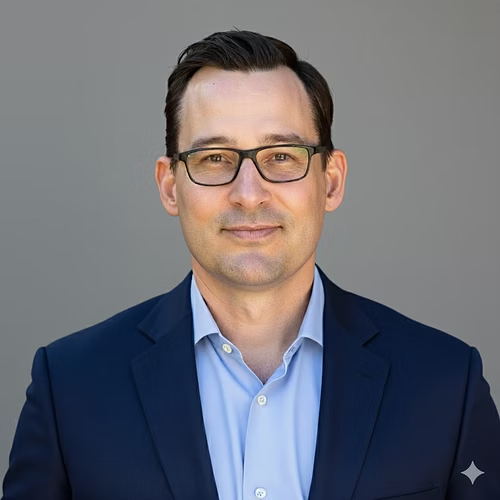
Written by
Kevin Riley
CEO & Co-Founder
Health-tech executive who builds and scales AI-driven software across healthcare, life sciences, and enterprise markets. Over 25 years launching and scaling solutions for healthcare and life sciences, Kevin led the healthcare and government business at Vlocity (acquired by Salesforce), growing it from $300K to more than $40M, and later served as GM of Salesforce's global Health & Life Sciences portfolio, a $4.5B business. He has also served as CEO of multiple software companies spanning AI, care management, regulatory science, and provider revenue. He created the award-winning modelH framework and was named a Top Healthcare Software Executive.