Blog
Meet Srinivas Pang, VP of Delivery at Actava.ai
Srinivas Pang is a Product & Services Executive with 20+ years of experience leading enterprise technology transformation across Healthcare, Financial Services, and Applied AI. More recently, his focus has centered on product and services delivery for health payer organizations, with particular emphasis on Applied AI, Agentic AI platforms, professional services, GTM, customer success, and payer transformation.
Previously, Srinivas (“Sri”) Pang worked at Vlocity/Salesforce with many of the Actava.ai Team. There, he helped grow the Health Practice and led the Health Global Competency Center, shaping GTM strategy, delivery models, implementation methodologies, enablement, and consistency in delivery across payer and payvider initiatives.
His career spans leadership roles at SimplifyX, Salesforce/Vlocity, Toyota Financial Services, and JPMorgan Chase, combining deep enterprise delivery experience with an increasing focus on production-grade AI and measurable business outcomes.
We took this Friday to interview Sri about his new role at Actava.ai and his vision for the future of agentic AI in healthcare
Question 1: Why did you decide to join Actava.ai now?
I have previously worked with the founders of Actava.ai at Vlocity and Salesforce, and I have always respected both their track record and the rigor with which they build. What excites me about Actava.ai is the combination of several things seldom found together: proven founders, deep industry-specific payer expertise, a strong AI research pedigree, and a production-grade mindset clearly reflected in the platform and solutions they are bringing to market. Just as importantly, the company has resonated with customers from the outset.
Since the Fall of 2023, I have spent considerable time engaging with payer organizations and have had a front-row seat to what I call “Wave 0” of AI adoption: early mobilization, governance, tinkering, pilots, and point solutions. The next frontier is very different. Payers are now moving toward governed, observable, production-grade agentic workflows that can execute complex business processes deep within the enterprise.
I believe the companies that will lead this next wave will be those that truly understand the payer business fabric, its nuances, end-to-end processes, regulatory realities, and operational complexities while bringing equal rigor to AI engineering, governance, and, most importantly, measurable business outcomes. That intersection is exactly what I see in Actava.ai. That’s why I’m here.
Question 2: What is unique about delivering agentic solutions in healthcare compared to other industries?
I have had visibility into the application of AI across several industries, including Retail, Financial Services, and Asset Lifecycle Management. Across these sectors, the use cases often fall into familiar categories such as productivity improvement, friction/drudgery removal, product recommendations, revenue acceleration, and better customer experiences.
Of course, healthcare shares many of those opportunities, but the stakes are fundamentally higher. AI in healthcare can influence not just operational efficiencies or revenue prospects, but disease management, access to care, patient outcomes, and ultimately quality of life. That creates both an extraordinary opportunity and a much higher bar for delivery.
Healthcare organizations also operate within a highly regulated environment, with significant obligations around privacy, security, policy compliance, explainability, and clinical or operational accountability. In many other industries, an AI error may create inconvenience or lost revenue. In healthcare, the consequences are far more significant.
That is why delivering agentic solutions into healthcare requires more than a compelling demo or a capable model. It requires production-grade engineering, strong governance, observability, auditability, human oversight, and a deep understanding of the healthcare workflows in which the technology operates.
Healthcare organizations need AI platforms and solutions they can deploy with confidence and operate without regret. That, to me, is what makes delivering agentic AI into healthcare both uniquely challenging and meaningful.
Question 3: What are some of the challenges healthcare companies face in their AI transformation journey?
My experience has been primarily on the payer side, particularly in operations, sales operations, product, and administrative workflows, rather than in clinical care and related processes. From that vantage point, I see several recurring challenges in the AI transformation journey.
First, payers operate within very real business and regulatory cycles. As Open Enrollment approaches, organizational capacity gets consumed by readiness activities, deployment windows narrow, technology changes are often frozen, and discretionary initiatives can slow down. Even compelling AI projects can be pushed aside by immediate operational priorities.
Second, much of the business logic that AI needs to work with remains fragmented across legacy systems, spreadsheets, SOPs, policy documents, and institutional knowledge. Core platforms were not necessarily designed for modern AI access, while underlying data can be incomplete, inconsistent, stale, or difficult to reconcile. That creates substantial work before AI can reliably automate a process.
Third, payers already have a complex technology landscape. Many incumbent platforms are introducing their own AI capabilities, forcing organizations to decide what to build, what to buy, what to extend, and where a new AI platform genuinely adds differentiated value.
There is also an organizational maturity challenge. Some technology organizations still approach AI initiatives through traditional software-delivery models, while AI requires a somewhat different mindset around experimentation, evaluation, observability, iteration, and ongoing model or agent performance. At the same time, many organizations are still translating enterprise AI governance principles into practical controls that individual business units can actually use.
Finally, transformation competes with everything else. Budget constraints, regulatory deadlines, modernization programs, legacy-system initiatives, and delayed dependencies can all delay AI projects, including relatively focused efforts capable of delivering fast, measurable business value.
So, to me, the challenge is rarely a lack of interesting AI use cases. The harder problem is creating the organizational, data, technology, governance, and delivery conditions that allow those use cases to move quickly from compelling ideas into dependable production capabilities.
Bonus Round: What is your prediction for the biggest AI trend impacting your customers in 2026?
2026 will be the year that sees the industrialization of agentic workflows.
We are moving from experimentation and isolated use cases toward factory-built, industry-specific agentic workflows that can go the distance in production, deeply integrated into enterprise processes, with built-in compliance, governance, observability, and human oversight.
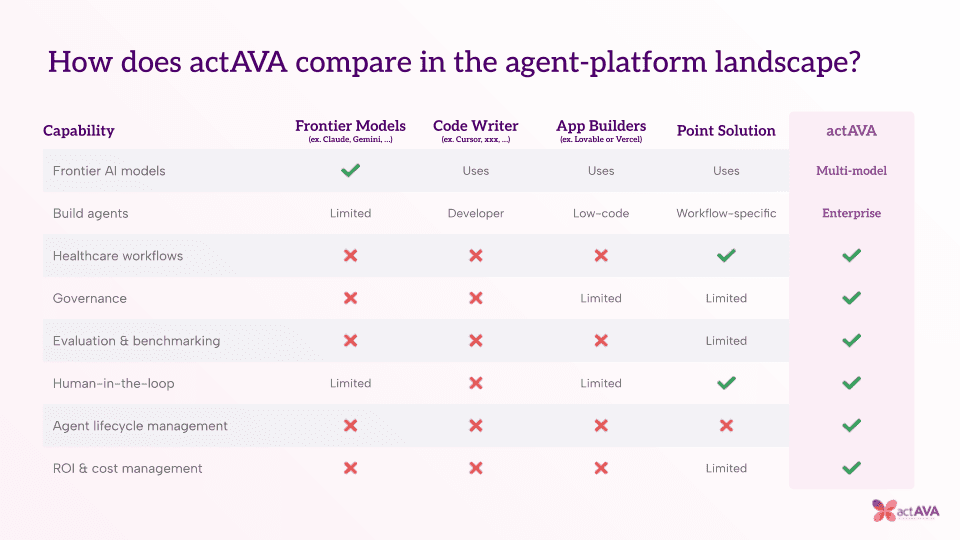
Just as importantly, I believe we will see much more rigor around delivery. The winners won't simply have the best models or the most impressive demos. They will have hardened, repeatable delivery methodologies that can take AI from promise to production quickly, safely, and predictably and demonstrate measurable business outcomes.
In healthcare especially, that combination of deep domain intelligence, production-grade rigor, and repeatable delivery will become a major differentiator.
Thanks for your time today, Sri.

Visit us at https://actava.ai/ to learn more.
Meet Sri Pang: View LinkedIn Profile