Four numbers explain the entire "real vs. hype" debate in healthcare AI.
AI works. Spectacularly, for about 20% of the market. For the other 80% it's expensive, underperforming, and increasingly first on the chopping block at budget time.
So the question worth asking is simple: what separates the 20% from the 80%, and are health systems building the infrastructure to land on the right side of that line?
The Wrong Debate
The ROI argument is being asked in the wrong units
Every AI budget conversation in healthcare walks through one of two doors. Behind the first is the FTE substitution argument: this agent does the work of three analysts, so the platform pays for itself in year one. Behind the second is the SaaS seat argument: route it through the software approval committee, it's another subscription line item. Both doors open into the same broken room.
The FTE argument cracks the moment an agent runs at 3am on a Sunday and processes 4,000 prior authorization requests in a quarter when last quarter it handled 600. Human salaries don't scale with task volume. Machine consumption does.
The SaaS argument cracks the first time an agent loop runs undetected for 264 hours and rings up a $47,000 bill. Subscriptions don't behave that way, and no finance team has built the muscle memory to govern it.
The Klarna warning, applied to healthcare. Klarna deployed AI agents projected to replace roughly 700 customer service staff and save $40M a year. By May 2025 they were rehiring humans, because satisfaction had degraded on complex interactions and the pure substitution architecture had no way to catch quality drift before it became brand damage. Healthcare's version is worse. In the long tail of complex cases, the failure mode is an adverse outcome, a liability exposure, a patient safety incident.
So should you budget healthcare AI as headcount substitution or as SaaS OpEx? Neither. The fact that we still frame the choice that way is the bug.
The Real Problem
Healthcare is the hardest place on earth to run ungoverned AI
Across enterprise sectors, roughly 15% of AI agent pilots reach production scale. In healthcare, that number drops to 8%.
That gap isn't a technology problem. Healthcare's clinical data is rich, its administrative workflows are well-defined, and the ROI math is verifiable. Prior authorization alone costs $12 to $40 per transaction done manually versus $3 to $4 electronically.
The pilot-to-production gap is a governance and measurement gap. Organizations with production-scale deployments weren't spending more on AI than the stalled ones in comparable sectors. They were spending it differently: proportionally more on evaluation infrastructure, monitoring, and operational staffing, and proportionally less on model selection and prompt tuning. Governance and measurement are the investment that makes a launch survivable, not an overhead you bolt on afterward.
No ROI defined before deployment
IBM's 2025 research flags this as the single most common root cause of AI ROI failure. Skip the pre-deployment process decomposition and you have no baseline to measure against later. If you don't know your starting point, you can't measure return.
No continuous measurement after launch
Only 29% of executives say they can confidently measure AI ROI today. The common pattern: measure at pilot, then go dark once it hits production. Stale data, as PwC puts it, suffocates ROI.
Costs governed with the wrong instincts
96% of enterprises report AI costs exceeding initial projections, and only 44% have financial guardrails in place. SaaS instincts produce surprise invoices. FTE instincts produce under-investment in the capacity that would have generated the return. Healthcare can't afford either.
Governance treated as overhead
Gartner predicts more than 40% of agentic AI projects will be cancelled by the end of 2027 on escalating costs, unclear value, or weak risk controls. In a regulated clinical setting, the liability attaches to your organization, not the vendor.
The New Mental Model
The Capacity Doctrine: stop trying to make agents into employees
We call the alternative the Capacity Doctrine. Agentic AI is cognitive utility infrastructure: a metered, on-demand cognition layer that scales with business activity the way electricity scales with manufacturing throughput, or broadband scales with traffic. It doesn't behave like labor, and it doesn't behave like software.
Think about your building's HVAC. You don't compute ROI per cooled hour. You don't run a quarterly review defending the marginal cost of climate control against alternative investments. You budget the envelope, meter the consumption, and govern the bill. Your agent fleet sits closer to the air conditioner than to your analyst. The CFO who masters consumption economics will eat the lunch of the CFO still building FTE-comparison spreadsheets.
This narrative shift has happened twice before, and both times the early movers compounded a decade of advantage.
CapEx datacenter to OpEx cloud
AWS changed the question from "buy the servers and depreciate them" to "why are you paying for capacity you aren't using?" It took a decade and a whole generation of cloud economists. The companies that moved first banked years of agility.
Buy-software to subscribe-SaaS
From perpetual licenses to monthly subscriptions, this rewrote balance-sheet treatment, cash-flow profiles, and procurement. Every health system navigated it. The ones who built FinOps practices early pulled ahead.
FTE and SaaS to cognitive utility
The next shift is underway now. Salesforce has shipped three concurrent pricing models for Agentforce in 18 months because no one has agreed on how to buy this category. The CFOs who learn the new vocabulary this cycle will set the cost frontier for everyone else.
The New Metric
TCAC: the number that replaces FTE-equivalent math
The Capacity Doctrine needs a new CFO metric. We call it Total Cost of Agent Capacity (TCAC): the all-in annualized cost of cognitive utility consumed, split into three layers finance can budget against and technology can optimize.
| Layer | What it is | How to think about it |
|---|---|---|
| Platform fixed cost | The runtime, the build environment, the safety and eval engine, the governance plane | Fixed OpEx. The one layer where SaaS-pricing instincts are correct. Budget it as a committed infrastructure subscription. |
| Consumption variable cost | Operation Units consumed by agent runs, human-in-the-loop routing, evaluation cycles, regulatory testing | Variable OpEx. Requires FinOps discipline: visibility, anomaly detection, unit economics, and pre-execution enforcement rather than post-hoc alerts. |
| Outcome attribution | Cost per business outcome: per claim adjudicated, per PA resolved, per ticket closed | The layer the prevailing narrative ignores, and the one that tells you whether your fleet is generating value or burning credits. This is what the board actually wants to hear. |
TCAC is a small dashboard the CFO and CTO co-own: reviewed monthly, governed continuously, reported to the board quarterly. The key derived ratio is the one number that ends the FTE argument for good.
When a health plan computes this for its prior authorization AI, the comparison is concrete: $1.97 per claim adjudicated (TCAC) versus $6.33 per claim with human-only processing. The yield is 3.2×, the math is defensible, and the board can approve the capacity envelope without an FTE spreadsheet that will be wrong by Q2.
What the Winners Do Differently
The 20% run a different playbook
PwC's 2026 AI Performance Study, drawn from 1,217 senior executive interviews across 25 sectors, segments the AI leaders, the top 20% capturing 74% of economic value, from everyone else. The differentiators are organizational and architectural, not technical.
The proof shows up in production numbers. IBM's AskHR agent automated more than 80 HR tasks and cut support tickets 75%. A Dun & Bradstreet procurement assistant saved an estimated 26,000 hours of manual work a year. UFC cut query generation time 40%. Every one of those started with a defined outcome and built toward it.
The pattern holds across IBM, McKinsey, PwC, and Bain. High performers beat the averages because they reclassified AI as infrastructure, budgeted it as utility, governed it continuously, and measured it at the outcome level. The playbook is public. It's just hard to run without the right architecture underneath.
Where the Return Actually Lives
Why healthcare workflows reward end-to-end transformation
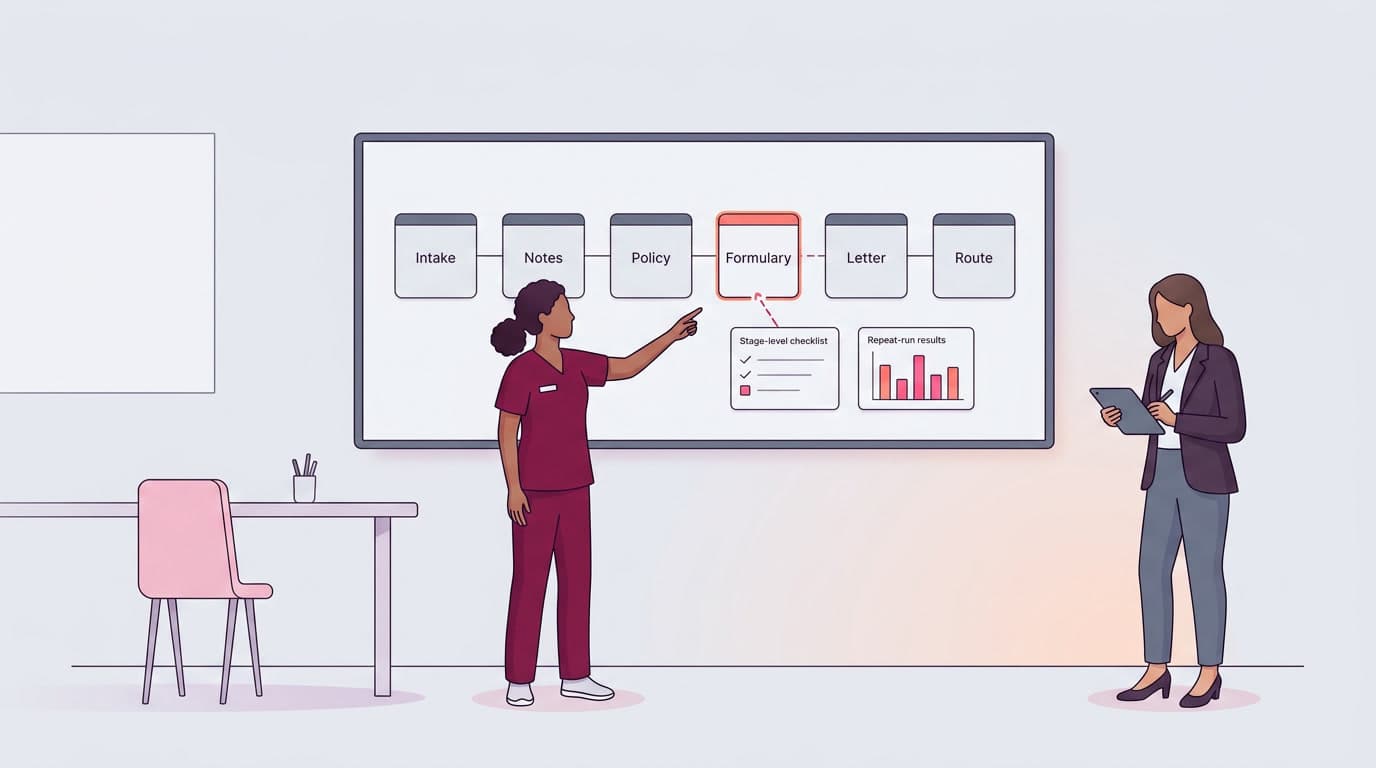
Healthcare processes are long, multi-step, and full of handoffs across teams, systems, and facilities. That's exactly where isolated task automation underperforms and orchestrated workflows pull ahead.
Take prior authorization again. A single PA request can touch a clinician, a coder, a billing specialist, a payer portal, and a patient communication system, sometimes over days. Automate one step and you save a few minutes. Move the whole process, surface the right clinical evidence, route to the right reviewer, and track status across systems, and you change the economics of the department.
The same logic runs through care gap identification, discharge coordination, referral management, and coding accuracy. Each one is multi-step, data-intensive, and handoff-heavy. Each one rewards workflow transformation over point automation. PwC has a name for the alternative: agent sprawl, a pile of disconnected agents that don't share context and don't compound value.
The Healthcare-Specific Argument
In healthcare, governance is the product
Every sector faces the governance challenge. Healthcare faces it with the highest stakes attached. An agent that runs without an audit trail, without documented decision logic, without a human approval gate on consequential calls, is exposed financially, clinically, and legally: to every state-level AI law now on the books in Texas, Illinois, Utah, and Colorado, and to whatever comes next from the 43 other states that introduced AI legislation in 2025.
Federal deregulation doesn't fix this. HHS relaxing health IT certification guardrails doesn't make healthcare AI less regulated. It makes the regulation fifty different things in fifty states with no common baseline, which is harder to navigate, not easier. The organizations that built governance into their AI infrastructure, rather than leaning on federal rules to enforce it, are positioned to move fast without manufacturing new risk.
- What's the fixed-platform cost and the variable-consumption cost, separately, with consumption forecast at three confidence intervals?
- What's the unit of consumption, and how does it scale with model choice and agent depth?
- What share of variable consumption is governance overhead: evaluation, compliance testing, human handoff?
- What's the cost per business outcome, and how is that outcome attributed and audited?
- What are the per-agent consumption caps, the anomaly thresholds, and the rollback path if a deployment degrades?
A vendor who can't answer those five is selling you a hope wrapped in a spreadsheet, not agentic AI capacity.
This is what Actava.ai KORA was built on: governance as the architectural premise, not a feature bolted on afterward. The approval lifecycle, the human-in-the-loop gates, the versioned audit log, agent-level ROI attribution, and the Scale, Fix, or Stop health classification that continuously flags which agents to expand, remediate, or retire. Those are the conditions for running cognitive utility in a regulated clinical environment. They're what make the capacity defensible.
Agentic cognition is the first true variable-cost knowledge work in the history of the corporation. Salaried labor is fixed cost. Software is fixed cost per seat. This is a new category, and it needs a new mental model.
Forrester projects that 25% of planned AI spend will be deferred by 2027 over ROI concerns. Some of that deferral is warranted; pilots that can't show measurable impact probably shouldn't scale. The organizations that do the foundational work now, defining outcomes, cleaning the data, building governance into the base, designing workflows end to end, won't be in that 25%.
Closing the gap between 25% ROI realization and 75% is a matter of strategy more than technology. In healthcare, it matters more than almost anywhere else.
Contact Actava.ai
Ready to budget AI like the 20% do?
Actava.ai KORA is a model-independent, governed agent platform built for healthcare. Connect your systems, deploy governed agents, and measure TCAC and outcome-level ROI agent by agent, without the FTE-comparison spreadsheet.
Contact the Actava.ai team