News

Healthcare IT News
FeaturedWhy Johns Hopkins is benchmarking AI agents before deployment
Health system leaders say reliable benchmarking, governance and workflow design must come before scaling agentic AI across administrative operations. Johns Hopkins Medicine is taking a deliberately cautious approach to agentic AI, focusing first on proving reliability and governance before expecting measurable financial returns.
Blog
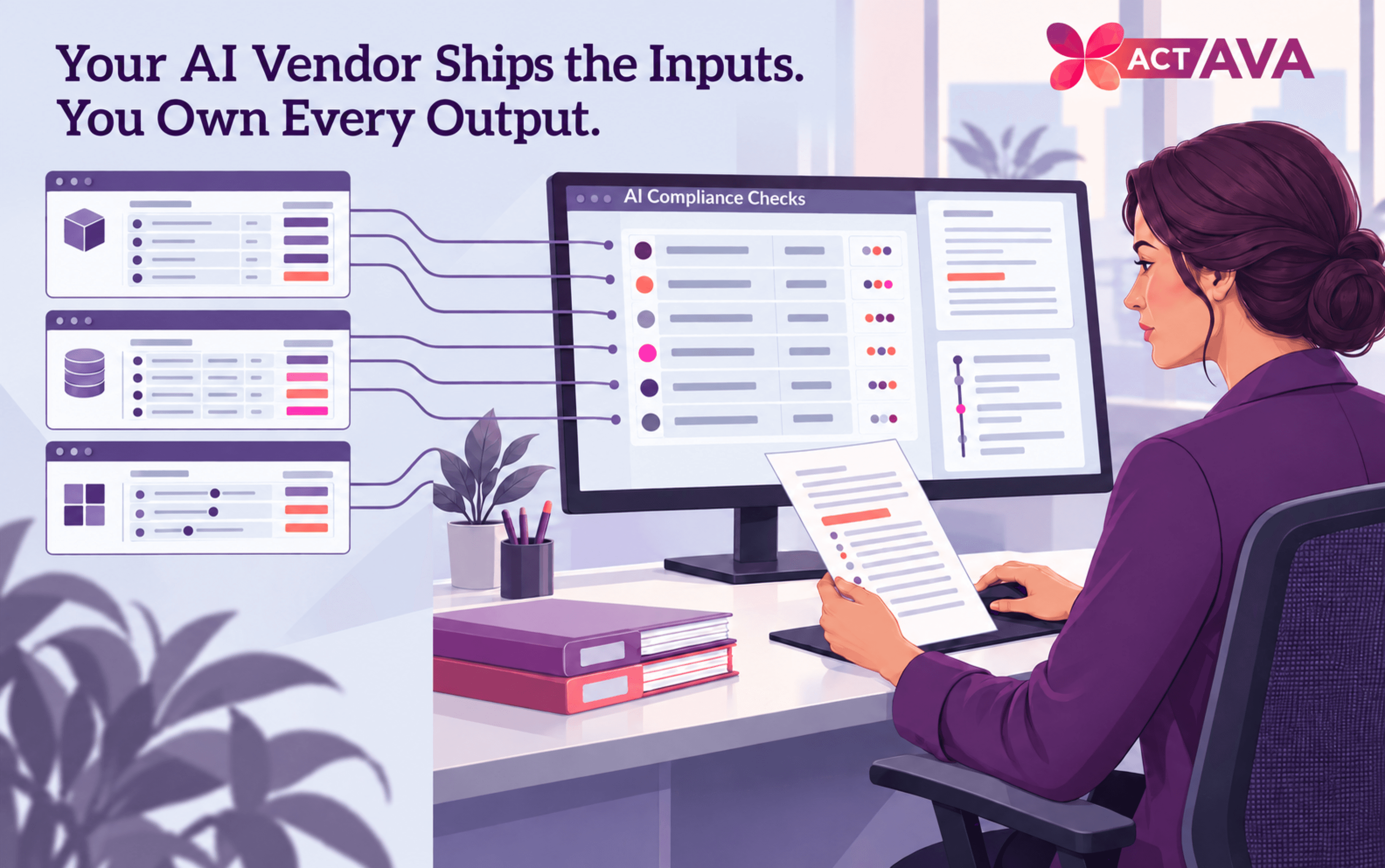
AI and Compliance: Your AI Vendor Ships the Inputs. You Own Every Output.
Every AI vendor contract splits the work in two. The vendor supplies the model, the training data, and the compute. Your organization owns the operations, the patients and members, and the regulatory exposure. Six risks cross that line, from accuracy validated on someone else's data to state laws that change before they take effect. Here's where each one lands, and the question to ask your vendor before you sign.
Blog
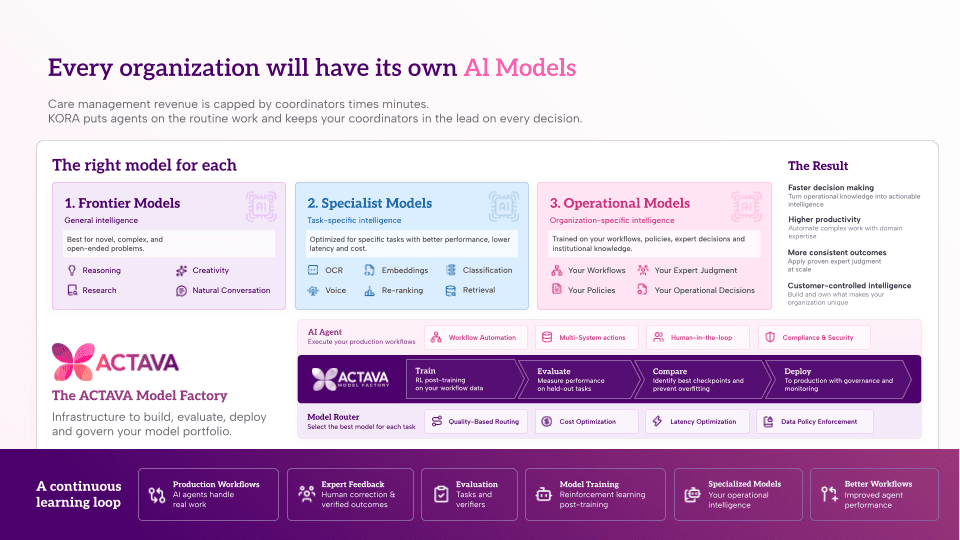
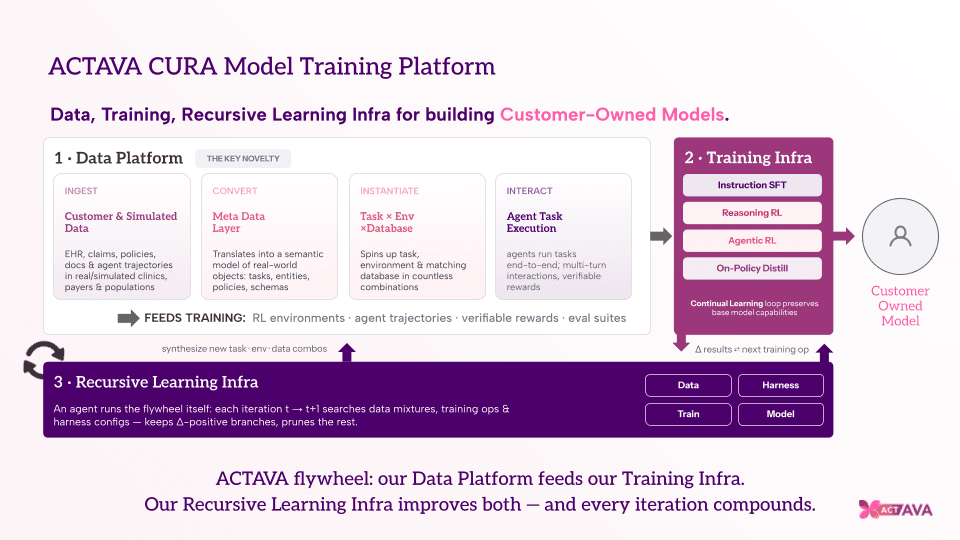
Why We Built ACTAVA Model Factory: Every Enterprise Will Eventually Have Its Own AI Models
Enterprises don't run every workload on one database, and they won't run every task on one AI model. ACTAVA Model Factory, now in customer preview, turns authorized workflows and expert corrections into specialized open-weight models, with held-out evaluation, checkpoint comparison, and deployment, so organizations control the intelligence that makes them unique.

Video
ACTAVA | Agentic Workforce | Referrals That Reach the Specialist and Come Back
Sending a referral doesn’t tell you what happened to it. When a handoff goes quiet, no one can say whether the case is moving or waiting, and that’s where care gaps begin. This ACTAVA video shows referral intake, coverage checks, and prior authorization drafting routed to human reviewers. Explicit approval states and a run history for every referral put paused cases in front of the team, so they don’t show up later as a missing outcome.
Video
ACTAVA | Agentic Workforce | Trial Work Without Duplicate Actions
A missing acknowledgment does not mean a request failed. In trial operations, sending it again can repeat an action that already succeeded. This ACTAVA video shows how shared completion state lets agents check what happened before acting again. Completed results are reused, work waiting on sign-off resumes where it paused, and failed rows can be retried without touching the ones that finished. The work moves forward without starting over. Learn more about ACTAVA: https://www.actava.ai/
Blog
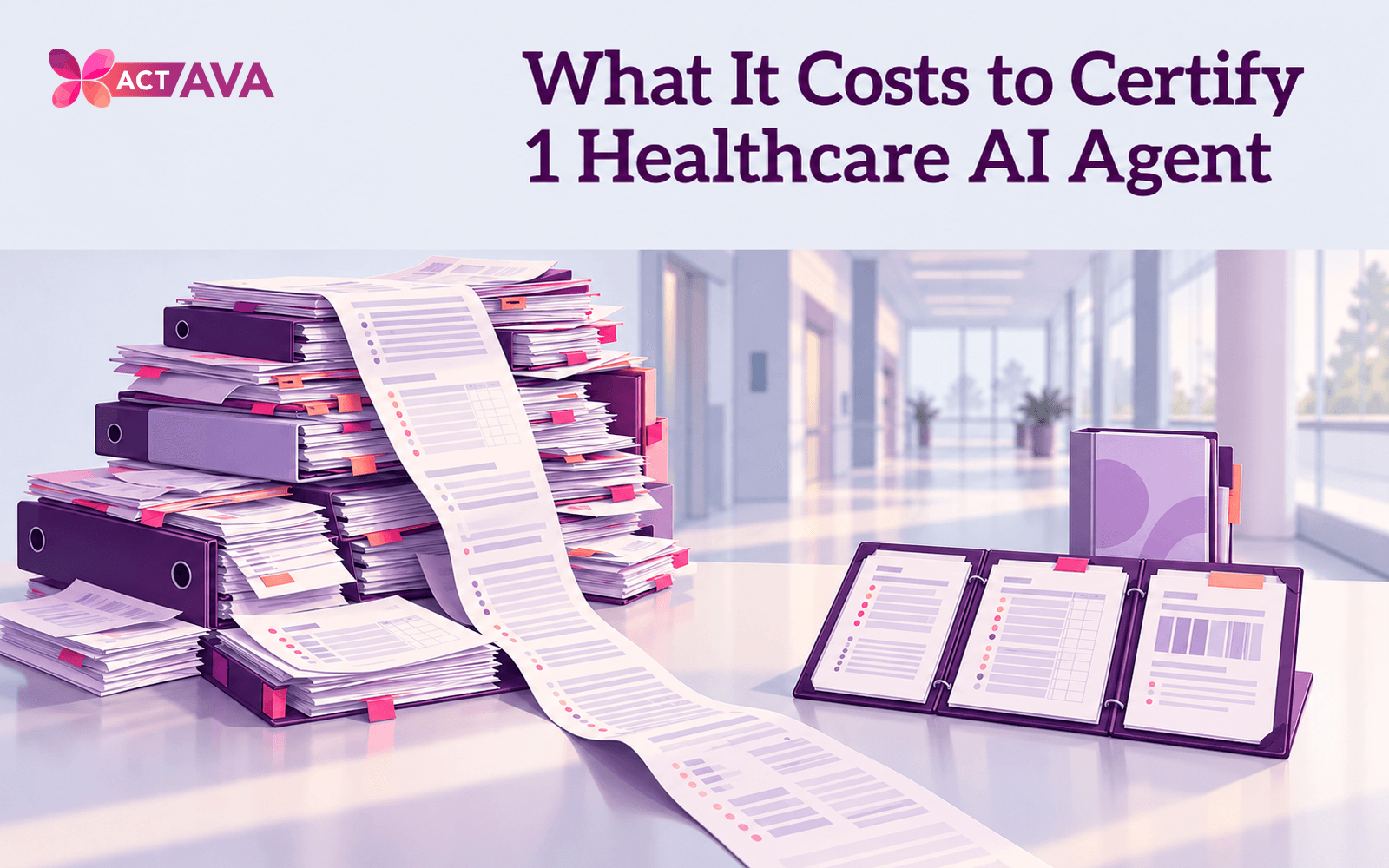
What It Costs to Certify One Healthcare AI Agent
By our estimate, certifying one healthcare AI agent the old way costs about $161,000, 800 labor hours, and 6 to 9 months. Here's the bill line by line, next to the same work on the ACTAVA Compliance path at $22,500 in year 1 and 4 to 8 weeks.
Blog
Going From Building AI to Running It
Most healthcare AI budgets fund building. Then the pilot succeeds, and query volume lands on the EHR, the claims platform, and an infrastructure budget nobody planned for. Drawing on Microsoft's Eduardo Kasner and the Silk webinar on AI inferencing, Frank Wang translates the six priorities for running AI into healthcare terms, explains why "more context" worsens the accuracy problem, and argues that isolation must happen at the workflow layer, not just the database.
Video
ACTAVA | Agentic Workforce | Eligibility Answered Before the Patient Arrives
A coverage surprise at check-in leaves little room to act. The same problem found ahead of the visit can be a correction instead of a billing scramble. This ACTAVA video shows how eligibility checks start when a referral or appointment arrives, or run on a schedule across the upcoming day's cases. A dedicated coverage step checks documented criteria and flags a no early, while there is still time to fix the problem. Learn more about ACTAVA: https://www.actava.ai/

Video
ACTAVA | Agentic Workforce | Going Live Without Risking Real Patients
A successful demo does not settle whether an agent is ready for real patients. That takes realistic testing and an explicit decision to let it act. This ACTAVA video shows synthetic cases with pass-fail criteria, production-like rehearsals, and scripted test conversations. When the workflow moves to live work, the finished plan stays in draft until a human approves it for patient contact. Building the workflow and authorizing it to act remain separate decisions. Learn more about ACTAVA: https://www.actava.ai/
Video
ACTAVA | Agentic Workforce | Prior Authorizations That Don't Stall in the Queue
Prior authorizations often stall after a step is finished, while the next one waits to begin. Faster typing does not fix a missed handoff. This ACTAVA video shows agents passing work from intake through coverage, packet drafting, and routing for review. A visible approval queue, paused runs that resume after sign-off, and approval policies with timeouts make the wait for human review explicit rather than leaving cases silently parked. Learn more about ACTAVA: https://www.actava.ai/
Blog
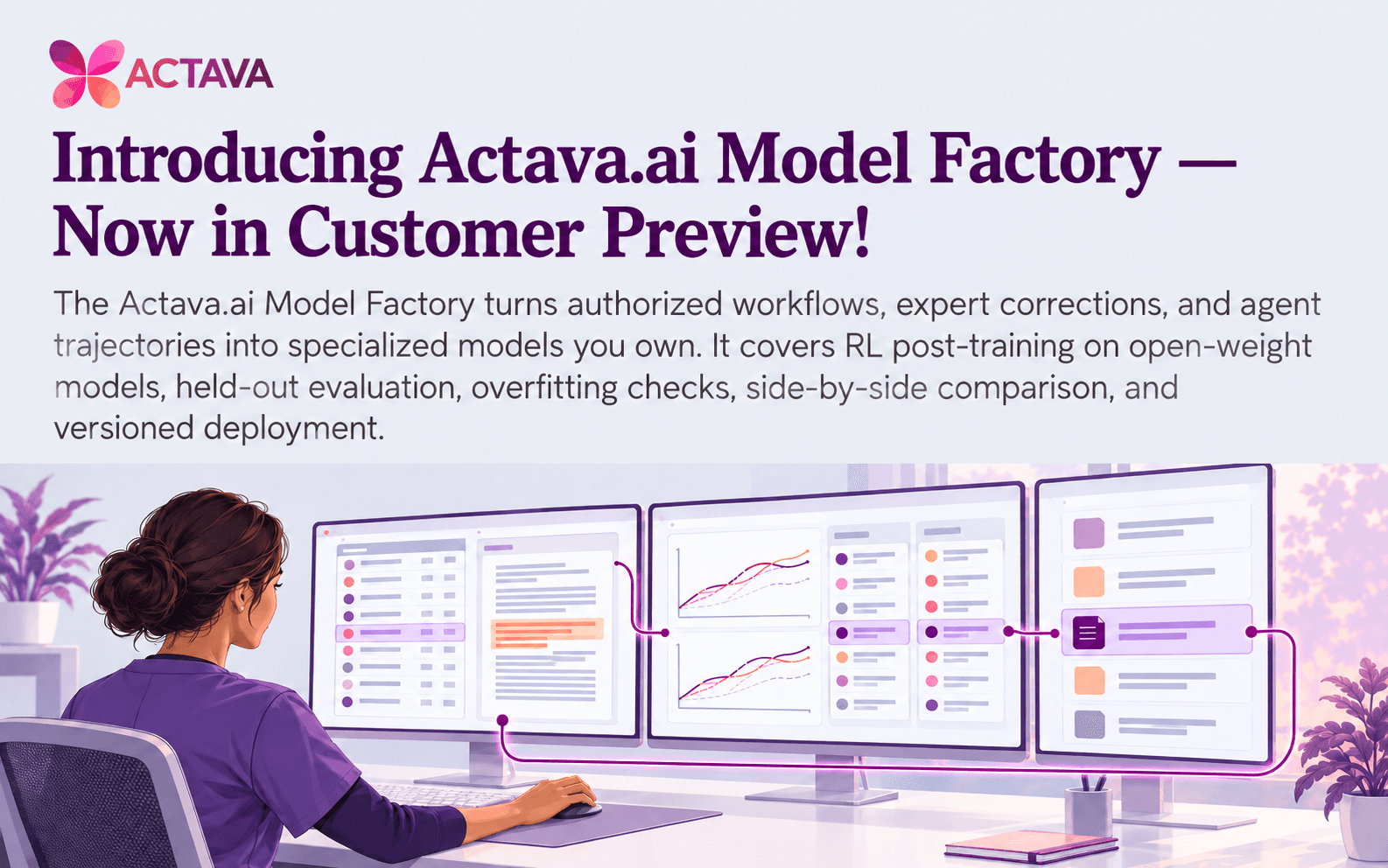
🚀 Introducing ACTAVA Model Factory — Now in Customer Preview!
The ACTAVA Model Factory turns authorized workflows, expert corrections, and agent trajectories into specialized models you own. It covers RL post-training on open-weight models, held-out evaluation, overfitting checks, side-by-side comparison, and versioned deployment.
Resource
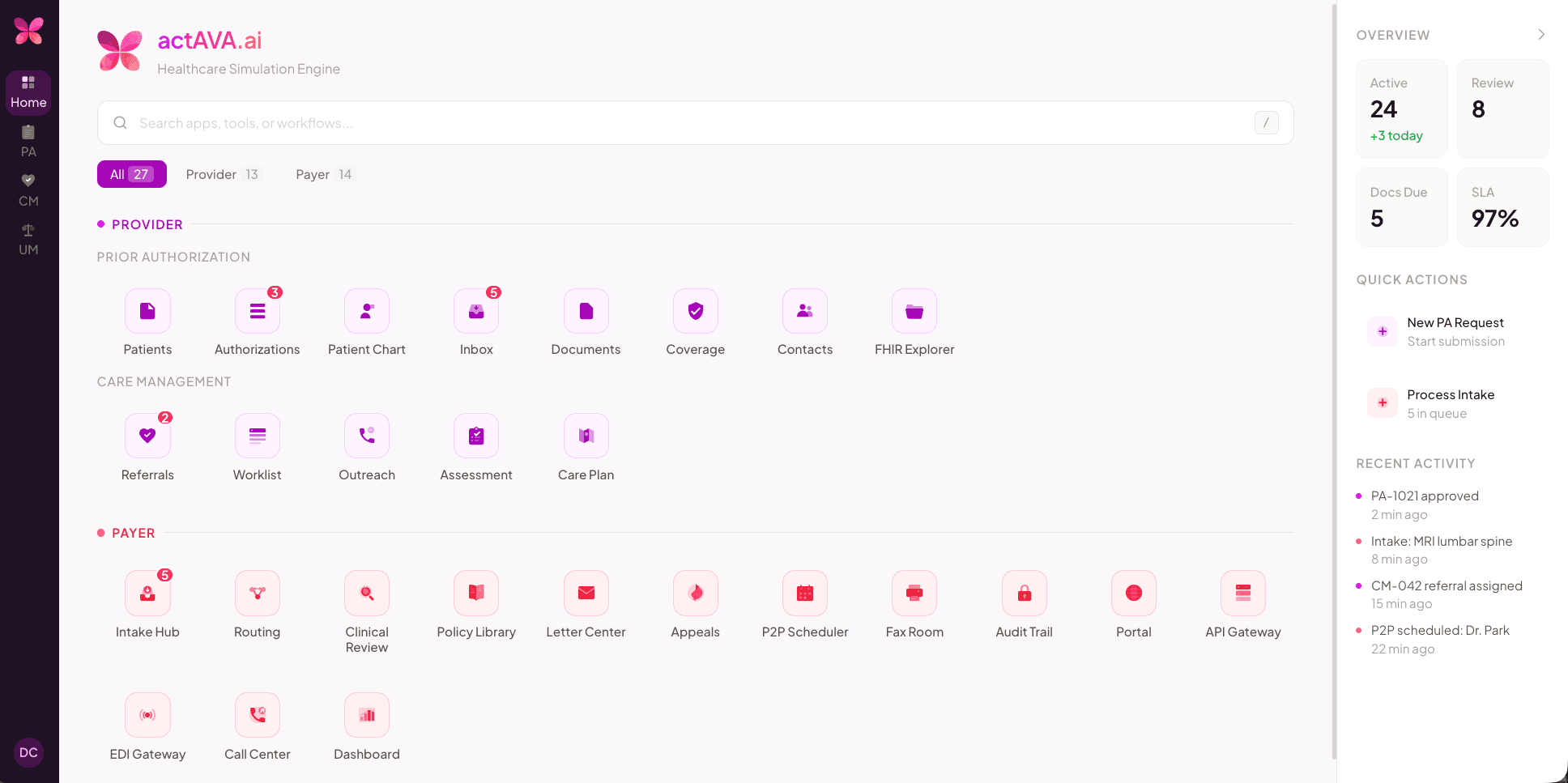
ACTAVA | Healthcare Simulation Engine (HealthVerse)
HealthVerse is ACTAVA’s healthcare simulation engine, a live environment of 27 interconnected apps spanning both sides of the care ecosystem. Provider tools cover patient charts, prior authorization, FHIR exploration, and care management. Payer tools cover intake, clinical review, policy library, appeals, peer-to-peer scheduling, and EDI/API gateways. Together, they give teams a realistic place to build, test, and demo healthcare AI agents.
Video
ACTAVA | Model Factory | Build AI You Can Own
Build AI you can own. ACTAVA Model Factory turns authorized workflows and recorded agent trajectories into domain-specific training environments. Teams can train specialized models, measure progress on held-out evaluation tasks, detect overfitting, compare specialized checkpoints with their base models, and deploy the selected version behind a stable API. ACTAVA Model Factory is currently in Customer Preview.
Showing 1–13 of 281 results
From production workflows to customer-controlled intelligence.
Don't give your agentic future away to a single model provider. Don't mistake consumer tools for real, safe Enterprise Agentic Tools. Enable your citizen developers to create and manage the AI Agents they need to run their part of your business.
Build complex agents. Test their reliability. Learn from every workflow. Own your intelligence.