Blog
AI and Compliance: Your AI Vendor Ships the Inputs. You Own Every Output.
Every AI vendor contract splits the work in two. The vendor supplies the model, the training data, and the compute. Your organization owns the operations, the patients and members, and the regulatory exposure. Six risks cross that line, from accuracy validated on someone else's data to state laws that change before they take effect. Here's where each one lands, and the question to ask your vendor before you sign.
By Deon Metelski
Every AI vendor contract draws a line down the middle of the page.
The vendor's side holds the model, the data it trained on, and the compute that runs it. Your side holds your operations, your patients and members, and your standing with regulators.
Six risks sit between those two columns. Every one of them crosses the line and lands on your side.
A contract can move money around after something breaks (indemnity caps, service credits, the usual). It can't move accountability. When an agent denies the wrong prior auth, the complaint lands on your desk, with your name on the letter.
We made that argument in "The Agent Acted on Its Own" Isn't a Defense. This piece is the practical follow-up. It maps where vendor risk turns into your risk, and the one question to ask at each crossing.
Six crossings, one direction
| Risk | Where it starts | Where it lands |
|---|---|---|
| Performance and accuracy | Validation on the vendor's context | Wrong answers in your workflows |
| Data and privacy | PHI in transit to vendor compute | Your HIPAA exposure |
| Continuity and dependency | Vendor service outages | Your backlog and turnaround times |
| Compliance and regulatory | Laws that change after you sign | Your regulatory standing |
| Bias and fairness | Testing on population averages | Unequal outcomes for your members |
| Intellectual property | Unclear training data and output ownership | Workflow logic you can't take with you |
1. Performance and accuracy
Your vendor validated the model. It validated it on someone else's context.
A strong public benchmark score says nothing about your fee schedules, your medical policy criteria, or the way your care managers write notes. When we built ACTAVA χ-BENCH, the best frontier agents completed 28% of complex, policy-rich healthcare workflows. Across 75 real workflows we mapped, the share agents could run end to end was 0%.
Those numbers measure the gap between a model and real work. Accuracy is a property of both, and only the model ships from the vendor.
2. Data and privacy
Every call to a hosted model is a data transfer. PHI leaves your boundary, travels to the vendor's compute, and sometimes keeps going to their sub-processors.
A signed BAA starts the check. The full check follows the data all the way down (where it's processed, how long it's retained, and whether any of it trains the next model version).
3. Continuity and dependency
A vendor outage becomes your backlog.
If your appeals team runs on one model endpoint and that endpoint goes dark for four hours, the appeals keep arriving. Pricing changes, deprecated model versions, and shifting usage policies do the same damage more slowly. We wrote about this in How to Protect High-Stakes AI Workflows From Vendor Turbulence, and the fix hasn't changed. Decouple the workflow from any single model.
4. Compliance and regulatory
The rules move after you sign.
Colorado passed the most comprehensive state AI law in the country in 2024, delayed it twice, and then replaced it in May 2026 with a narrower disclosure law before the original ever took effect. The replacement, SB 26-189, starts January 1, 2027, and the state attorney general is still writing the rules.
Your vendor can't tell you which of those laws apply to you. The law attaches to the decision, and your organization makes the decision. Our regulatory updates track the moving pieces, but the verification work sits with your team.
5. Bias and fairness
Vendors test on averages. Your members aren't average.
A model that performs well across a broad commercial population can behave differently on a Medicaid book, a Medicare Advantage population, or members who write in Spanish. The vendor's fairness report can't see your population. You can.
6. Intellectual property
Your team will spend months teaching agents how your organization works. The prompts, the policy logic, the fine-tunes, and the outputs all carry that knowledge.
If the contract is vague about who owns them, assume the answer favors the vendor. We covered the details in In the Era of AI, Who Owns the IP?
Govern your side of the line
Look at the right side of that diagram again. Operations, patients and members, regulators. You can't hand any of them to a vendor.
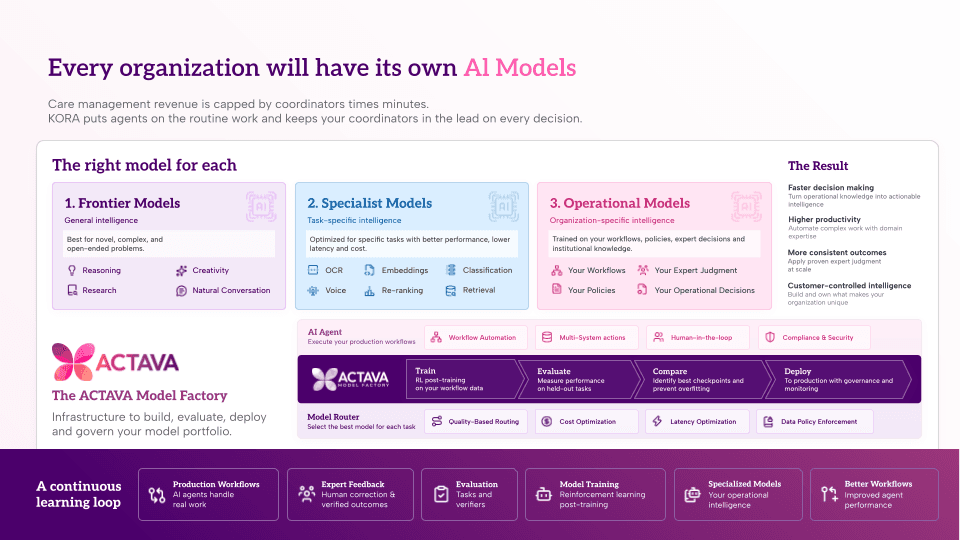
You can build the layer that governs how every vendor's model touches them. That layer is what ACTAVA builds.
ACTAVA KORA tests agents against your workflows and 85+ regulatory controls, including NIST AI RMF and HIPAA, before they reach production. ACTAVA COMPLIANCE keeps the audit trail, role-based access, and human-in-the-loop checkpoints your compliance team signs off on. ACTAVA χ-BENCH benchmarks agents on long-horizon healthcare workflows and shows you where they fail before your members do.
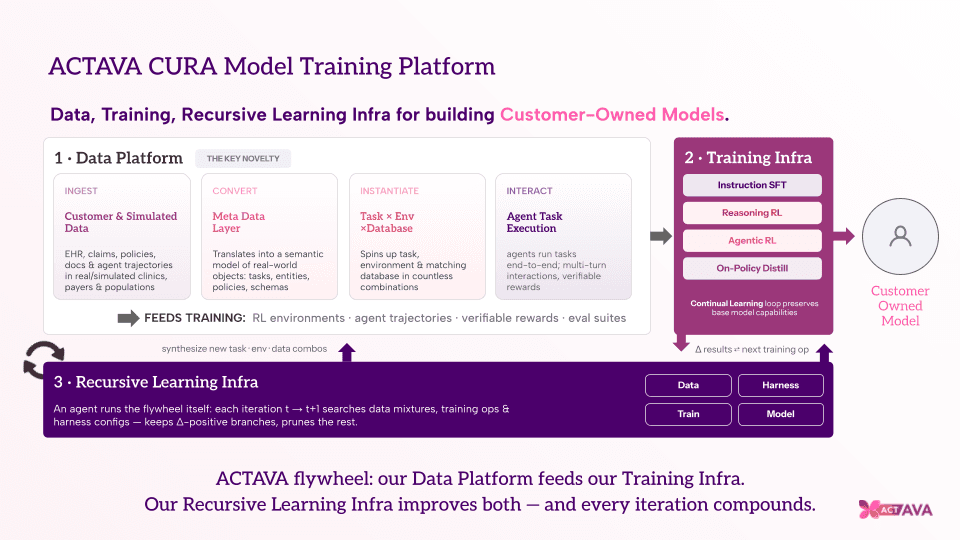
The platform routes across multiple frontier and open models, including ACTAVA CURA, our healthcare-native model. One vendor's outage or policy change doesn't stall your operations. And the platform runs on a SOC 2 Type II foundation, which hands your security team evidence on day one.
Buy the best model you can find. Then own everything it touches.
Map your six crossings with us
Bring one live AI use case. We'll walk it across all six risks and show you where your controls stop today.
Book a DemoSources
- ACTAVA, χ-BENCH: Can AI Agents Automate End-to-End, Long-Horizon, Policy-Rich Healthcare Workflows? arxiv.org/html/2605.16679v1
- Seyfarth Shaw, Colorado Enacts Artificial Intelligence Replacement Law (May 2026). seyfarth.com
- Hunton Andrews Kurth, Colorado AI Act Amended and Effective Date Delayed (May 2026). hunton.com
- STACK Cybersecurity, Colorado AI Act Compliance Guide (updated Sept. 15, 2026). stackcyber.com
- ACTAVA KORA actava.ai/kora · ACTAVA COMPLIANCE actava.ai/compliance · ACTAVA χ-BENCH actava.ai/benchmarks/chi-bench · ACTAVA CURA actava.ai/cura

Written by
Deon Metelski
Chief Product Officer
Product leader shaping agentic healthcare AI that feels human and interoperates across every clinical ecosystem. Previously a healthcare product leader at Zyter|TruCare, Deon has spent his career turning complex clinical and operational work into products clinicians trust. At ACTAVA he leads distributed teams to orchestrate safe, explainable AI agents across EHRs and connected ecosystems, translating clinical and operational needs into intuitive, dependable experiences. His work blends empathy with data, advancing healthcare AI through a product lens, and is driven by a commitment to access, interoperability, and measurable outcomes across the care continuum.