Video
Take an agent someone has already built, read it end-to-end, and make it yours in one click. Here's the fastest way to get an agent doing real work: don't build one. The hard part of starting was never writing a prompt. It's knowing what a good agent for this job looks like, and someone has already answered that. Agent Workforce is a catalog of existing agents, grouped by the work they perform and tagged with the roles that use them. Patient services. Care managers. Credentialing specialists. There is real depth behind it, with twenty-two agents for value-based care, eight for payer operations, and nine for behavioral health, and you can filter by the persona you are building for or by the challenge you are trying to solve. Say you're closing HEDIS and Stars gaps. A listing for a chronic disease management outreach agent tells you who it's for and the shape of the work it does: identify the cohort, segment it by language and channel, design the touch sequence, execute it, then triage every response and route each one to the right next action. Here is the part that matters most. Before you take it, you get to see it all. Every listing publishes the same blueprint view you get for agents you built yourself: the tool inventory, the MCP servers it calls, the step and task counts, and the rules it operates under. Fourteen tools. Five MCP servers. Four steps, thirty-one tasks, five rules. An analytics server for census and quality measures, prior-authorization and payer-directory lookups, and literature search. Reuse is only safe if you can audit what you are reusing, and you are not buying a black box with a price tag. You read the whole thing first. Then it's one button. Add to Agent Studio produces a real agent within your organization, not a link or a subscription. It arrives at version one, already promoted, with its full system prompt and its tools wired, carrying three operating rules as memory: always verify opt-out status before contacting anyone, include full context whenever it escalates to a care coordinator, and log every attempt for HIPAA auditing. It arrived knowing how to behave. From there, it's an ordinary agent you own. Rewrite the prompt, swap the tools, add your own approval gate, cut a new version. Everything downstream works exactly as it does for an agent you wrote. You just started from something that already worked.

Video
The controls behind PHI and HIPAA compliance. The ones you can point at when someone audits you. Any tool can recite HIPAA back at you. That is a checklist, and a checklist proves nothing. This walks the controls instead. Start with shared language, because the rest doesn't land without it. PHI is health data tied to an identifiable person. A control is a measure that protects it, or proves you are handling it correctly. Controls come in three kinds: administrative, technical, and physical. Software helps with the administrative and technical ones. The physical controls, your locked servers and your facility, are yours. We say so out loud rather than letting the boundary blur. From there, four controls you can open and inspect. Access is granted per agent to named members, roles, and groups pulled from your directory, not to everyone with a login, which turns "minimum necessary" from a principle into a page you can actually look at. Agent Approvals put an admin gate in front of release: nothing a developer builds reaches your staff until an administrator publishes it, so there is change control on the thing touching clinical workflows and no silent releases. Human Approval runs inside the work itself, where the agent pauses at a named task and waits for a named group, and declining the request stops the run. That is a gate enforced by the system, not a prompt asking a model to be careful. Then the receipts. Run history records what ran, when, how long, and what it cost. On voice runs, HIPAA mode keeps the full accounting, with cost split across speech-to-text, text-to-speech, and telephony, without storing the transcript. You get the audit trail without keeping the conversation. And Support Access answers the question people forget to ask a vendor: every time actAVA support signs in to your organization, it is listed, attributed, and recorded, so you can see whether anyone has. One thing worth stating plainly. This platform does not make you HIPAA compliant. Your policies, agreements, and oversight do that. What KORA provides are the technical and administrative controls your compliance program stands on: encryption, access logging, redaction, change control, and human gates.

Video
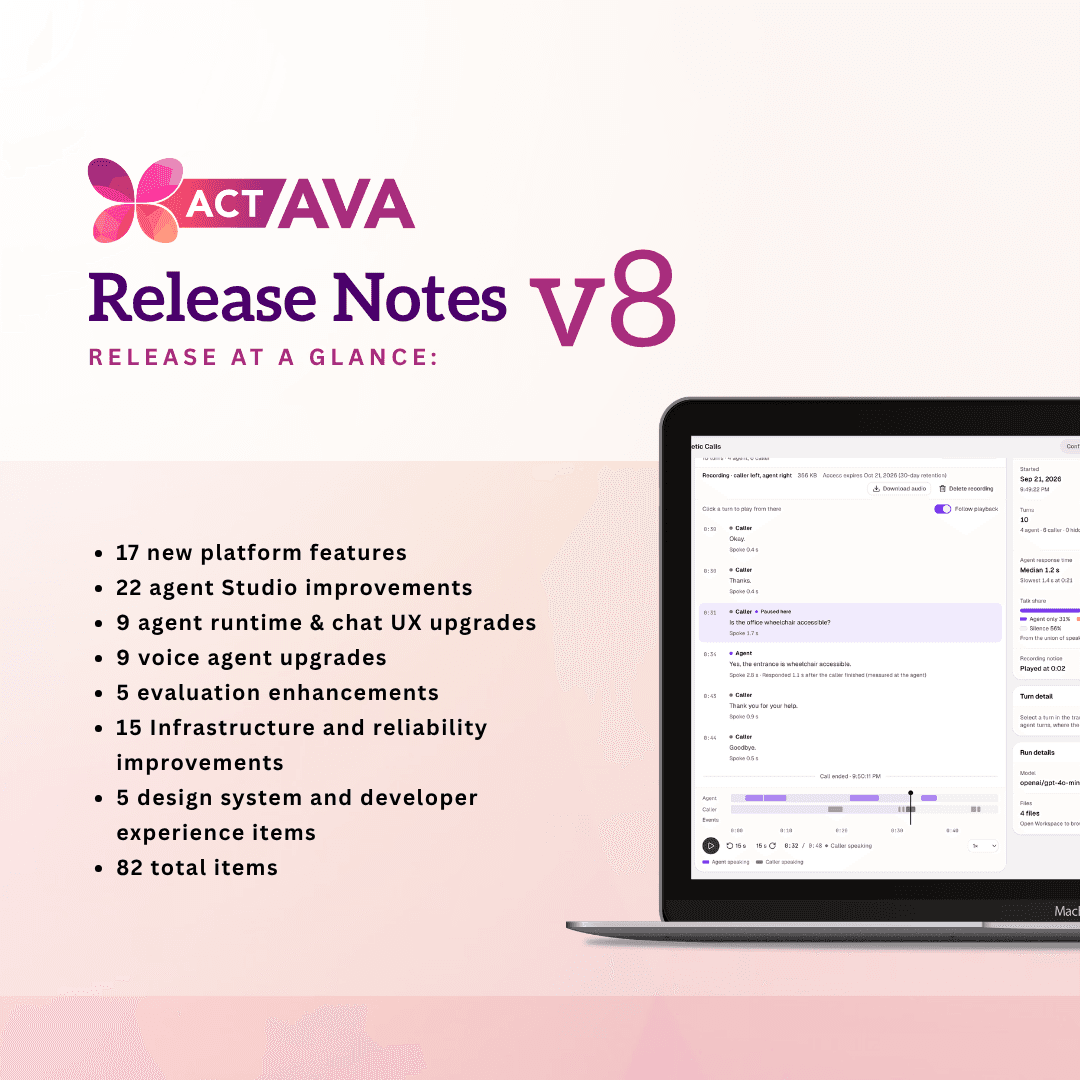
The follow-up call every high-risk patient should get: placed reliably, spoken like a clinician, and gone from memory the moment it ends. A nurse is supposed to call every high-risk patient forty-eight hours after they go home, somewhere between admissions, rounds, and everything else. Most of those calls are uneventful. Two minutes of "I'm fine." The problem was never the easy ones. It's that the hard one hides behind a hundred easy ones. A voice agent that makes the call every time is how the exception surfaces instead of slipping. What sets this apart isn't that it can talk. It's that it's built for the clinical moment. The agent is created from a Clinical Admin (HIPAA) preset rather than a blank assistant, so the compliance posture and clinical framing are set before anyone writes a word of instruction. From there you pick the model, the voice, and the language. Then you write who it is, not only what it asks. Warm, respectful of the patient's time, and instructed to gracefully accept "no" and end the call without pushing. To someone two days out of the hospital, tone matters more than anything technical on the configuration page. It also has to say the drug names right. A pronunciation library is built once and attached to the agent, with sacubitril valsartan, dapagliflozin, spironolactone, ivabradine, NT-proBNP, and echocardiogram respelled phonetically and the stressed syllable marked. Common cardiac and diabetes medications are handled automatically, and the library covers the ones that aren't, because an agent that mangles a medication name loses a recently discharged patient in the first ten seconds. The agent holds a real inbound number and can place outbound calls, so the same agent covers the patient who calls back and the patient you need to reach. Every call lands in a searchable, filterable run list, because follow-up at scale is only manageable if each call is accountable and findable. Open any run and you get complete accounting: duration, speech minutes, and cost split across speech-to-text, text-to-speech, and telephony. And the conversation itself? In HIPAA mode, the transcript is never stored. Full operational and cost accounting, zero retained patient conversation.

Video
The agent that starts working the moment your EHR posts an event. No one typing, no window open. Most agent demos start with someone at a prompt. Real healthcare doesn't wait for a human to open a chat window. A patient is discharged at six in the evening and the follow-up clock starts whether anyone is at a keyboard or not. This one starts with a discharge, and nobody typing anything at all. It begins with an honest answer to a simple question: what is actually plugged in? The connector inventory shows Google Workspace, Microsoft 365, Slack, Twilio SMS, and email in a single view, each wired once for the whole organization, each showing its real state as active, inactive, or needs setup, along with how many users have connected. Real states, not aspirations, so you can see what you are trusting before you trust anything to run. Then comes the way another system reaches in. A scoped API key carries its own permissions, concurrency limit, and daily token quota, and that key is the credential your EHR uses. Alongside it, a Remote Execution switch permits outside triggers on a background agent rather than a chatbot waiting for a window. The key plus the switch is the webhook, and external access stays bounded and governed instead of being a blank door into the platform. Then the event fires. The EHR posts a discharge summary, heart failure improved, high risk tier, two medication changes, echo pending, and the agent runs on its own. Here is the part that matters most. It doesn't recall the protocol, it retrieves it. Risk tier traces to the discharge summary. Timing rules trace to the practice's own follow-up protocol. Red flags and both medication changes trace to the red-flag symptom guide. Every clinical line in the output points at a document rather than a memory, which is what makes it defensible. And it stops. The follow-up plan is produced in DRAFT status, held for named human approval before any patient contact, because the protocol requires it and the agent read that requirement too. Autonomy ends exactly where the practice's own governance says it should.

Video
The whole loop: build, visualize, version, promote, then operate an agent like software. Most agent demos stop at the moment the prompt works. The interesting part starts after that, when someone else has to review it, when it changes, and when a business has to know what is running and what it costs. This follows one agent, a discharge follow-up coordinator, through that entire loop. It starts in the studio, as a draft. A system prompt with real responsibilities, a plan broken into steps, eight ordered tasks, and a memory the agent carries with it, which in this case says patient-facing communication needs explicit named human approval. Nothing is live yet. A wall of configuration is hard to check, so the platform draws it. One click renders the agent's blueprint: the trigger that starts it, the tools it can reach grouped by system, the execution plan down the middle, the output at the end, and its operating principles on the right, rendered as policy. Always cite the source document. Never send a Gmail message directly. Never assume a risk tier. Guardrails appear as guardrails. You can read the whole thing in about ten seconds and hand it to someone who doesn't write code. Then the vocabulary that makes an agent reviewable. Each save updates the draft. Creating a version snapshots it, with a note describing what changed so the next person knows why. Promoting a version makes it what runs by default. Version history keeps the draft and each version side by side with who saved them and when, and you can view either, compare them, or restore an old one straight back into the draft. That is what turns an agent from something one person edits into something a team can review, roll back, and account for. Worth being precise here: promoting and deploying are two different steps. A promoted version is what runs by default, and it is still one switch away from serving end users. Then the half most demos never show. The Agent Dashboard separates which agent versions are live for end users from what is still in development, each row carrying its version, run count, success rate, and owner, so nobody has to ask which agent is actually running. And because agents cost money, a usage view splits consumption by workload type, by project, by person, and by model. That is the operating half of the lifecycle, and it is where a pilot either earns its next quarter or doesn't. Build it. See it. Version it. Promote it. Then watch what it does, and what it costs. That's not a prompt in a notebook. That's an agent you can run a business on.

Video
Let a meta-agent write your agent's test set, then score every change against it. You shipped an agent that touches patient care. Then somebody edited a prompt. Does it still refuse the things it is meant to refuse? An agent's behavior is not fixed. Someone edits a prompt, swaps a tool, bumps a version, and the safety properties you were relying on may or may not still hold. Guessing isn't an answer. Benchmarking is how you find out instead of hoping. The part that makes it practical is that you don't write the tests. A meta-agent reads the target agent's own configuration, tools, and capabilities, and synthesizes an evaluation set with rubrics. You supply the intent. In this worked example, a discharge follow-up coordinator: synthetic data only and no PHI; anything outside the thirty-day window must be refused rather than drafted; every clinical fact must cite its source; and nothing patient-facing gets submitted without a named human approving it. Because the tests derive from the agent under test, they cover what it can actually do rather than what you remembered to write down. A couple of minutes later, the benchmark exists. Thirty-two rows, bound to the agent it was written for, and stamped with the version of the meta-agent that wrote it. It lands in your datasets with six columns you can see, and six more the platform derives, including decision points, testing path, and suggested tools. Then you read it, because a test set you cannot read is a test set you cannot trust. The row viewer shows all thirty-two generated cases, normal ones alongside counterfactuals. The counterfactuals are the hard cases, built specifically to break the rules you just named. Every row carries its own rubric stating what counts as a pass and what counts as a fail. And there is no patient data anywhere: every reference is synthetic, invented for the test. Then you run it. An experiment binds one dataset to one agent version, scores it, and keeps runs as history with an overall score and a per-metric breakdown showing which rows passed and which failed. That is the whole point. The score is attached to the version, so when somebody changes a prompt, you can see whether it moved, and a failure is a specific row for a specific reason that you can go and look at. Tests your agent writes for itself. Hard cases you'd never have thought to write. And a score that moves when your agent does. That's how you change an agent without crossing your fingers.

Video
Teach your agent what your company knows, and tell it exactly when to stop and ask a person. No code required. Two capabilities make an agent trustworthy in a regulated environment, and they answer different questions. A Knowledge Base grounds every response in your authoritative documents, so the agent retrieves and cites the actual policy rather than inventing eligibility, costs, or deadlines. A Human-in-the-Loop gate pauses the agent before any consequential action. Knowledge tells the agent what is true. The gate tells it when to stop. This video builds one end-to-end. Every open-enrollment season, HR teams get buried in benefits questions, and any change that touches someone's paycheck can't go out without a person signing off. So in Agent Studio, the plan summary, life-events policy, dependent eligibility rules, payroll schedule, and enrollment change procedures get uploaded as the agent's authoritative source, scoped to that agent. The Knowledge Base takes precedence over the model's guesses. Then the plan gets written in Instructions, and one step, the one that drafts a payroll change, gets marked with the HR Approvers approval group. That single mark is the entire safeguard. A read-only Human Approval panel rolls up which tasks pause for group sign-off, while authoring stays in Instructions, so there is exactly one place a gate can be armed and nothing gets bypassed by accident. Watch it run. An employee asks about adding a newborn and switching to the family plan. The agent checks the Knowledge Base for the 30-day window, confirms a newborn is an eligible dependent, pulls the exact family-plan deduction, cites the passages it retrieved, drafts the change, and then stops. It notifies the approval group on their own channels. An approver reviews a clean summary of the employee, the event, the new deduction, and the effective date, and clicks approve. The agent resumes where it left off, submits the change, and confirms next steps to the employee. Consequential actions only happen with explicit human sign-off, and the run never hangs waiting on one. Grounded answers on what's routine, human sign-off on what matters.

Video
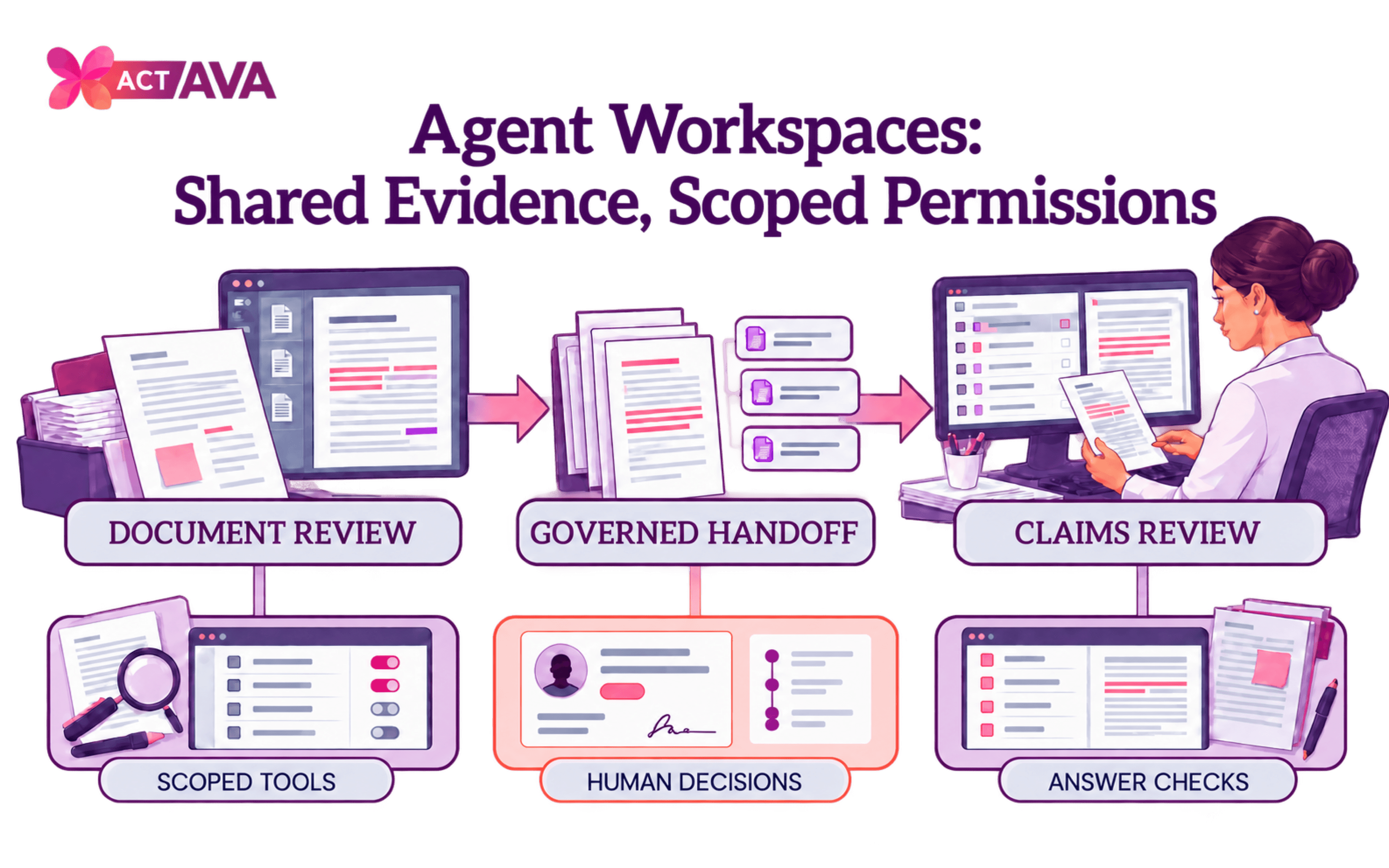
Connect your own systems, describe the work, and let the platform assemble the team, with a person at the step that matters. Most agent platforms give you a model and a prompt box. KORA gives you reach and structure. An agent is only as useful as the systems it can reach, so the MCP Store is where every connector an agent can call lives, enabled once for the whole organization and reused by every agent. One source of truth for what agents can reach, instead of per-agent reconnection sprawl. When a system isn't in the catalog, you register it yourself. A clinic's own EHR becomes callable without waiting for a native integration: a server key, a display name, a transport, an endpoint. The result is an org-private server visible only inside your organization, and it can accept a per-request access token, so access is scoped per call rather than shared. That is the security posture regulated enterprises actually require. Once your systems are reachable, the work is the easy part. You describe the pipeline in plain language, and the AI Workspace Architect designs the team. A referral arrives, match the patient, summarize the referral, check coverage, draft the prior auth, and submit nothing. The architect decomposes that brief into a four-phase team that hands off in order: Intake Coordinator, Coverage Verifier, Prior-Auth Drafter, Review Router. You express intent, not orchestration. Watch the last step in that pipeline. A review router hands the finished packet to a human. Nobody asked for it in the brief. The architect designed it in. And nothing gets built until you sign off. The architect proposes the plan for you to review before a single agent is created. Approve it, and you have a team, with each agent's handoff visible alongside run history, duration, and cost per run, so you can see and account for exactly what the team did and what it cost. Your systems, your brief, our team-building.

Video
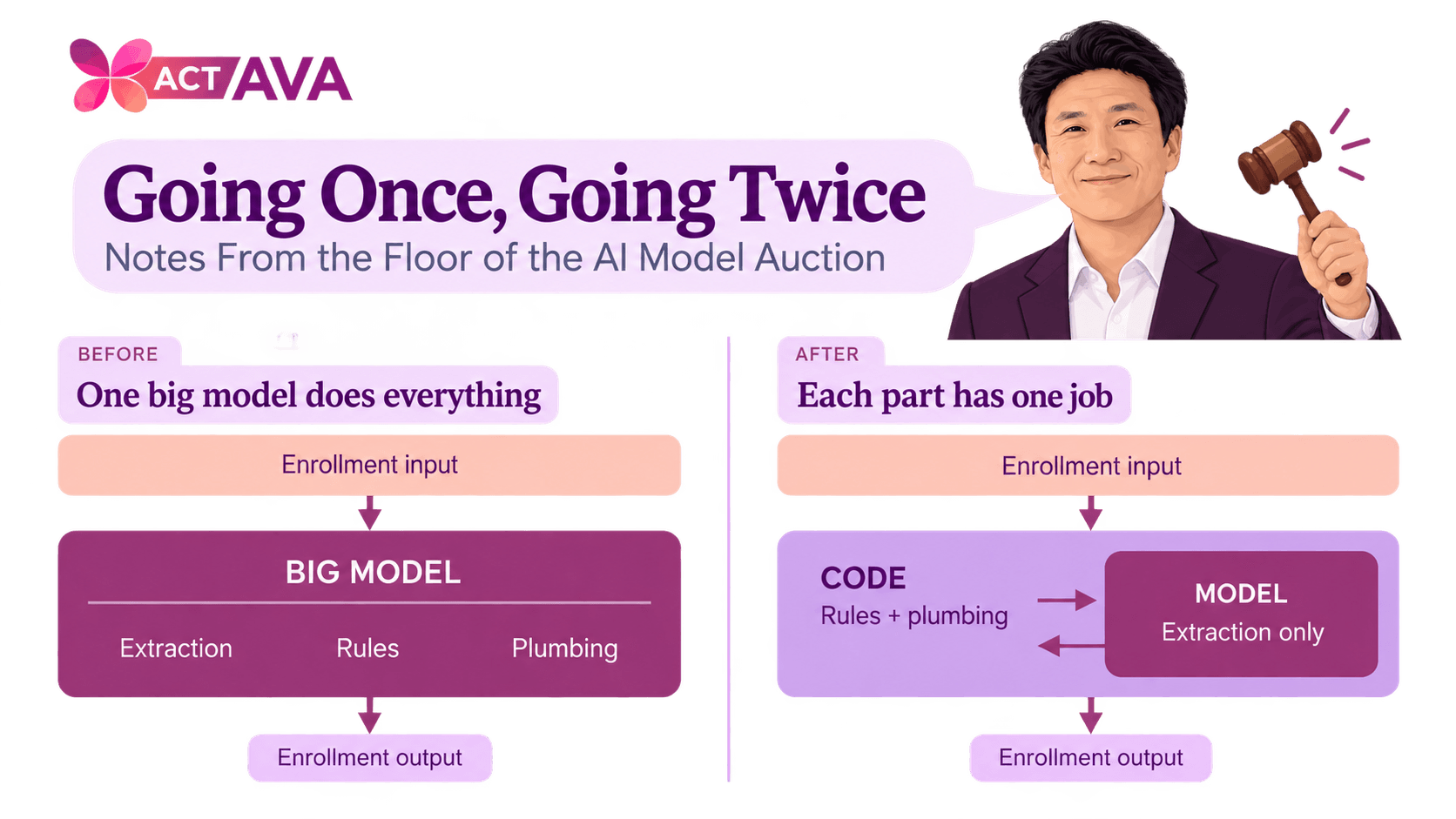
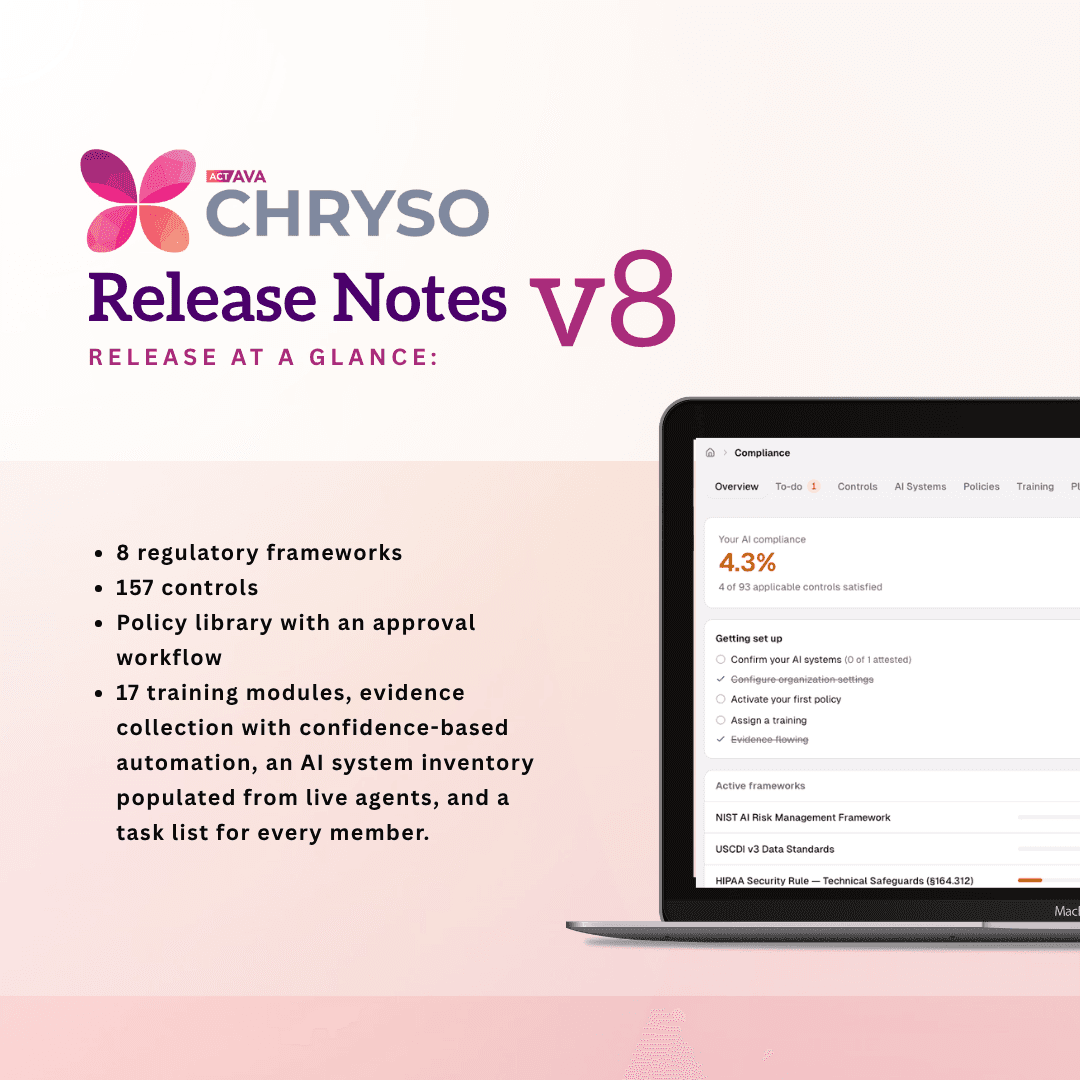
Build, evaluate, and govern behavioral health agents that reason through the policies other AI can't. Behavioral health can't absorb the misses other specialties can. More than 27 million adults go untreated, clinician burnout runs past 62 percent, and no-show and claim denial rates both run at roughly twice the rate seen elsewhere. Every gap there is a patient, a clinician, or a claim slipping through. And it all happens inside dense, moving policy: parity rules, 42 CFR Part 2, carve-out cascades, prior authorization. That is precisely where general-purpose frontier agents fall apart. On χ-BENCH, our long-horizon healthcare benchmark, a care management task staged across intake, chart review, patient outreach, assessment, and care plan saw leading agents finish only 28 percent on the first try. The model was never the hard part. Systems access, policy adherence, workflow sequencing, and approval gates matter more than raw intelligence. actAVA answers with a workflow-to-model platform, and this video walks the whole loop. In KORA you build the agent the way the work actually runs: plan and name the draft, write the system prompt, configure model tier and mode, add tools and skills, and check readiness before you bind it. The policy, the sequence, and the approval gates are part of the build, and the agent passes testing before it goes live. With CURA, you own the intelligence underneath. Swap between CURA and frontier models without rewriting eligibility or risk logic, and train on your own rules inside your own cloud, graded against healthcare evals for grounding and clinical reasoning. From there, start from the pre-built behavioral health library rather than a blank screen, with agents like the BH Eligibility-to-Payment Orchestrator and the BH Predictive Engagement Agent shipping with HIPAA compliance, human-in-the-loop controls, and EHR and FHIR, SMS and voice, and claims integrations ready on day one. Then CHRYSO proves it. The AI agent registry shows each agent marked Compliant or In Review, with controls validated against NIST AI RMF, HIPAA, CMS HEI, and ONC HTI, and sign-offs timestamped into audit packages you can produce on demand. Accountability means knowing which agent did what, under which policy, with what result. Every agent passes testing before it goes live, improves under staff review, and reports its cost and impact. So scaling behavioral health operations never means scaling the misses. Your model. Your workflows. Your intelligence.

Video
linical AI that reaches a patient has to survive evaluation first. The demand is real. Roughly 61.5 million U.S. adults need behavioral health care, and 40 percent of them live in a designated provider shortage area. That gap will never close on clinician headcount. Meanwhile about half of the patients who do start treatment disengage before it can work. The pressure to put agents into longitudinal care across millions of covered lives is obvious. The failure rate is the problem. Behavioral health is where general-purpose AI breaks down hardest. On χ-BENCH, frontier models fail 72 percent of complex U.S. healthcare workflows, and fewer than 8 percent of agents stay successful when the same task repeats. That second number is the one that matters here. Agents holding the thread between sessions have to perform on the thousandth interaction, not the first. Scaffolding, not model choice, decides whether an agent is deployable. χ-BENCH was reviewed by researchers from Stanford, Johns Hopkins Medicine, Yale, and Salesforce AI Research. actAVA is the factory underneath. With KORA, you evaluate before patients ever see it: simulate agent behavior against your clinical rubrics, log every call and trajectory, and benchmark against χ-BENCH before anything reaches live care, with reviewed work feeding back so behavior improves on evidence. With CURA, the intelligence stays yours: tuned on your clinical protocols and your population, running inside your own cloud at lower cost per interaction. Operate CURA, frontier models, or both, and swap as the frontier moves. And the safety scaffolding ships prebuilt, with crisis detection, consent validation, escalation routing, human-in-the-loop oversight, and audit logging as platform primitives, plus EHR, claims, and FHIR integrations in the box. The behavioral health agent library is yours to extend. The clinical core covers between-session support, multi-source crisis detection, outcome measurement against PHQ-9 and GAD-7, and predictive engagement. From there, intake-to-matched-provider, eligibility-to-payment, ABA session-to-billing, practice compliance, and workforce optimization become expansion surface. Every agent ships with HIPAA compliance, human approval gates, and full audit logging. Behavioral health agents you can govern, prove, and own. Every agent tests before it deploys, every action lands in the audit log, the clinician stays in the lead, and the intelligence stays in your cloud, under your control. Your protocols, your cloud, your model.

Video
Author expertise once, set the rules once, and let every agent inherit both without bloating a single prompt. Every agent needs two very different kinds of knowledge, and most platforms cram both into one system prompt. KORA separates them into first-class sections on the build screen. Skills carry the reusable how: org-wide capability bundles of instructions plus files, authored once and shared. Memory carries the always and never: the short standing rules unique to how one agent should behave. Different jobs, different homes. This video builds a real one. A nursing team writes an end-of-shift handoff report every shift, same format, different details, different rules per team. The user describes that job to Ava in plain language, and Ava proposes the shape of the agent rather than presenting a form to fill. Before drafting anything, she searches existing agents and the organization's Skills Store, so you surface expertise the org already owns instead of building a duplicate. Then the Skill goes on. The vetted shift-handoff-report skill carries the SBAR template, the section ordering, the step-by-step instructions, and a bundled blank PDF the agent fills, attached in a single action. Here is the architectural payoff: only the skill's name and description sit in the system prompt. At runtime the agent calls LoadSkill to pull the full instructions from the session workspace, and only when a task actually needs them. That is progressive disclosure, and it is what lets an organization attach many vetted skills without slowing any agent down. The standing rules land somewhere else on purpose. Always cc the on-call lead. Never include patient MRNs in the summary. Ava recognizes that always and never language and writes each one into Memory as its own visible, deletable entry. Guardrails stay legible and editable instead of buried in a prompt where nobody can find them, which is exactly what you want when a compliance officer asks what an agent was instructed to do. One more thing worth watching. Ava runs a server-verified readiness check and then submits the draft. Ava only ever drafts. A human admin reviews and approves before anything goes live. Skills are reusable expertise. Memory is standing rules. One agent, powered by both, built entirely in conversation.

Video
The case for why care management can't scale on people alone, and what to do about it. Care management revenue runs on one equation: coordinators times billable minutes. To serve more patients, you hire more people. But the people aren't there. Turnover runs past twenty-five percent, HRSA projects a shortage of roughly 141,000 physicians by the late 2030s, and millions of patients who qualify for chronic care management stay unenrolled. You cannot hire your way out of that gap. General-purpose AI doesn't close it either. Care management is a longitudinal, multi-system coordination problem, with teams working across months rather than tickets closed in a single pass. On χ-BENCH, which grounds real administrative work in care policy across multiple tools, the strongest frontier agents finished twenty-eight percent of tasks on the first try. The problem isn't intelligence. It's variability, and single-task automation breaks on work this variable. Here is the finding that changes the design. The same frontier model succeeded with strict rules in the harness and failed outright without them, on the identical task. Reliability isn't the model. It's the system around the model. And governance is what makes that system inspectable: as Johns Hopkins frames it, accountability requires knowing which agent did what, under which policy, and with what result. Until you can measure reliability, you cannot measure ROI. That's why actAVA is three parts of one platform rather than a point tool. KORA is where you build the workflows, with multimodal agents across background, voice, and chat, each passing testing before it goes live. CURA is where you own the intelligence: five models reached the same decision 93 to 100 percent of the time with rules kept in the harness. CHRYSO is where you prove it, with timestamped sign-offs and audit packages on demand. And the stakes are rising on a schedule. CMS is expanding Medicare Advantage audits from about 60 plans a year to all 550. Audit readiness is moving from exception to expectation, which means the governance you build now is the audit package you will need soon. Build the workflows. Own the intelligence. Prove the governance.

Video
CURA delivering specialist-grade reasoning, not trivia recall. Frontier models are generalists. Healthcare punishes generalists. The cost of a confident wrong answer is measured in patient harm, denied claims, and audit findings. That is why actAVA built CURA, a 1-trillion-parameter model trained for clinical and administrative healthcare work, and why we tested it where it matters. Across six of the hardest healthcare benchmarks, CURA outperformed frontier models. This example focuses on the reasoning that utilization review, clinical documentation integrity, prior authorization criteria matching, and medical affairs work all depend on. MedXpertQA Text spans board-style questions across 17 specialties and 11 body systems. The cases read like real vignettes, with history, labs, and family history feeding a diagnostic and treatment decision that requires multi-step inference. MedXpertQA Multimodal goes further, pairing a medical image from radiology, pathology, or dermatology with patient records and exam results. The image alone is never enough. The model has to integrate visual findings with clinical context across multiple stages of the diagnostic process, which is exactly how imaging-adjacent workflows behave in production, from radiology worklist support to dermatology e-consults to pathology second reads. AgentClinic is the agentic test, and it is where reasoning has to hold up under pressure. A doctor agent starts with almost nothing, interviews a simulated patient, decides which tests to order, interprets the results, and commits to a diagnosis within a limited number of turns. Some cases add medical imagery. Others inject cognitive-bias perturbations such as anchoring or patient-introduced bias, designed specifically to degrade accuracy. CURA held up. For anyone building autonomous clinical agents on KORA, that is the difference between a demo and a deployable Non-Human Resource that manages its own line of questioning. Deployed through KORA, governed by CHRYSO, and measured continuously with χ-BENCH, CURA gives healthcare and life sciences teams a workforce-grade model for the thousands of workflows the industry has never been able to automate.