Blog
Why We Built ACTAVA Model Factory: Every Enterprise Will Eventually Have Its Own AI Models
Enterprises don't run every workload on one database, and they won't run every task on one AI model. ACTAVA Model Factory, now in customer preview, turns authorized workflows and expert corrections into specialized open-weight models, with held-out evaluation, checkpoint comparison, and deployment, so organizations control the intelligence that makes them unique.
By Frank Wang
No serious enterprise runs every workload on one database.
Transactional databases hold operational records. Data warehouses run analytics. Search engines handle retrieval. Vector databases power semantic search. Each one does a different job well.
AI models will settle into the same pattern, and I think most enterprises will end up owning some of them.
I've spent 20+ years helping enterprises turn industry expertise into software. At Vlocity and Salesforce Industry Cloud, we built platforms that encoded industry knowledge into applications, business rules, and workflows. Every customer taught us the same lesson. Even companies in one industry run differently, with their own policies, exceptions, and hard-won habits.
Configuration and customization captured part of that. AI can capture much more, because it can turn organizational knowledge into specialized intelligence instead of only encoding it in software. I think that becomes one of the biggest shifts in enterprise technology.
Three kinds of models
I see three categories emerging.
Frontier models give you general intelligence
Frontier models keep getting more powerful. They solve hard problems, do research, write software, reason through unfamiliar domains, and generate ideas. Enterprises will keep benefiting from every advance the frontier labs make.
Still, not every business task needs the largest and most expensive model on the market.
Specialist models give you intelligence built for one job
A growing share of enterprise work goes to specialized models. Think voice recognition, document OCR, embeddings, reranking, information extraction, and classification.
On these jobs, the biggest general-purpose model rarely wins. A smaller specialist can deliver better task performance, lower latency, or far better economics. Pick the best intelligence for the job in front of you.
Operational models know your organization
This is the category I find most promising.
Picture a model that understands healthcare, plus how your healthcare organization actually operates. It knows your operational policies, how your team handles exceptions, how decisions escalate, and how departments coordinate. It learns from your workflows and from the corrections your domain experts make.
Two health organizations can run the same frontier model and still operate completely differently. One has its own utilization management policies, payer contracts, approval workflows, exception procedures, and seasoned reviewers. The other works another way.
That difference is where organizational intelligence lives.
I think it becomes one of the most valuable proprietary assets an enterprise can build.
Agents generate the learning signal
Most organizations already hold huge amounts of operational knowledge. Most of it is hard to capture. It sits in the judgment of experienced employees, in exceptions to standard procedure, and in decisions made mid-task.
Agents running enterprise workflows change that. An agent acts. A reviewer catches a mistake. An exception calls for a different decision. The workflow succeeds or fails. Each step leaves a learning signal behind.
With the right authorization, data controls, and verification, those signals become evaluation cases, training examples, and reward signals. The systems that do enterprise work and the systems that train models have lived apart for years. Now they can connect.
The cycle repeats as the organization accumulates verified experience.
Training on everything an agent does would be a mistake. Agent outputs can be wrong, expert corrections can conflict, and business policies change. Reliable evaluations, verified outcomes, human oversight, and governance stay in the loop at every turn.
Why we built ACTAVA Model Factory
This vision is one reason we started ACTAVA.
We began with the hard part of deploying complex agents into real enterprise operations. A demo agent is easy to build. An agent that works across multiple enterprise systems, handles thousands of cases, respects security policy, and meets regulatory requirements is a much harder build.
So we built enterprise agent infrastructure. Our platform helps organizations build and deploy agents, evaluate their performance, monitor execution, enforce security and compliance controls, and manage human approvals. ACTAVA KORA and ACTAVA Compliance carry that work.
We also think organizations shouldn't depend on a single model provider. ACTAVA helps enterprises route work to the right model based on task requirements, quality, cost, latency, and data policies.
Working with customers, we kept returning to a bigger question. What happens to all the knowledge these agents generate when they do real work? Can it become something the organization owns and keeps benefiting from?
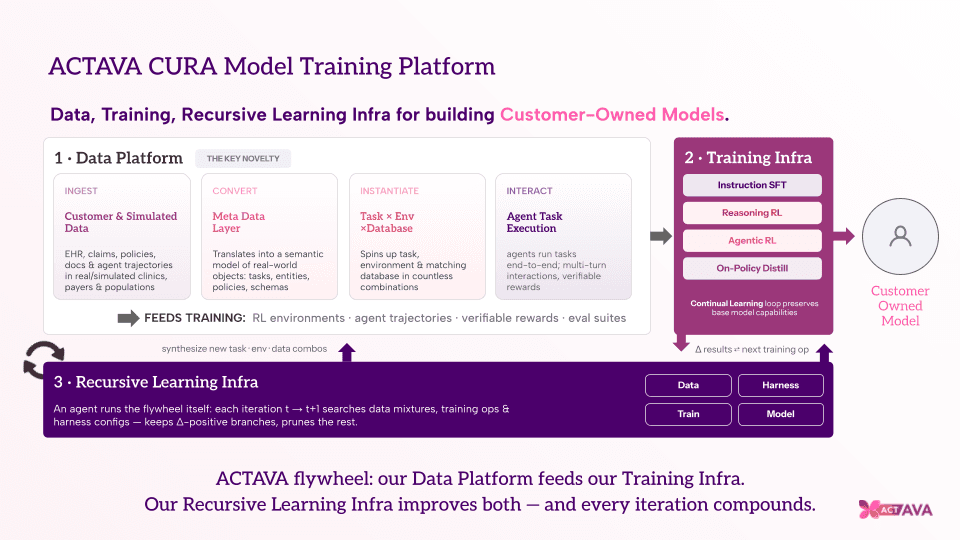
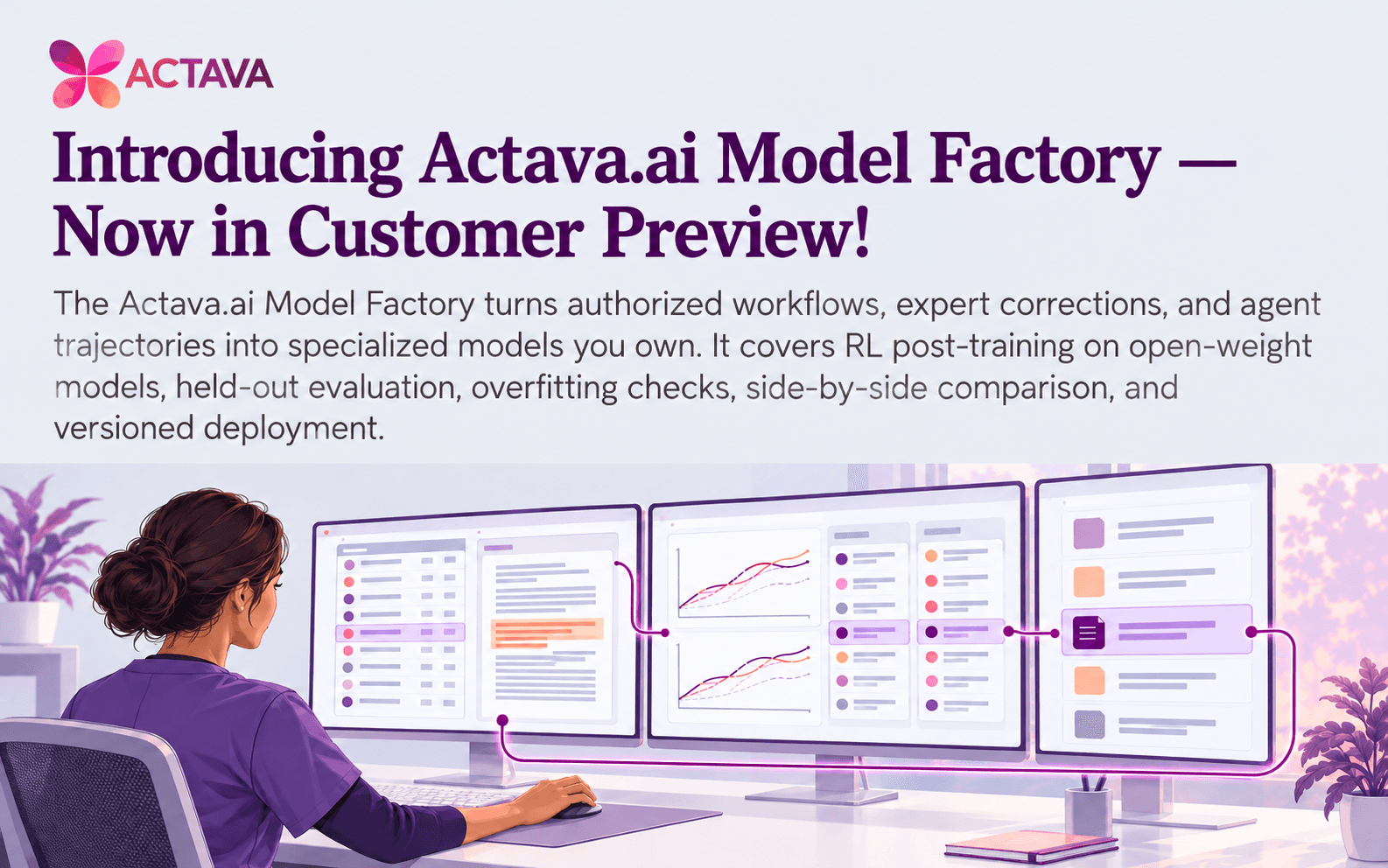
That question became ACTAVA Model Factory. Now in customer preview, it brings reinforcement learning post-training for open-weight models together with evaluation, checkpoint comparison, and deployment. Our engineers and researchers work with customers to turn authorized workflows and recorded agent trajectories into training environments, complete with tasks and verifiers.
Teams measure performance on held-out evaluation tasks, spot potential overfitting, compare specialized checkpoints against their base models, and deploy the versions they select.
We're building this inside a broader enterprise AI infrastructure, so model training stays connected to the workflows that feed it.
Rent the common intelligence, build the rare kind
I don't think every enterprise should train a frontier model, or customize every model it uses. Plenty of tasks belong on a frontier model through an API. Others run best on an existing specialist at an attractive cost. A few high-value, organization-specific workflows may justify a specialized model that becomes a real competitive advantage.
The call comes down to measurable performance, economics, data requirements, and the value of your proprietary expertise.
That's why model independence matters. Enterprises should adopt the best frontier models, use specialists where they fit, and build organizational models when the evidence justifies the investment.
Rent the intelligence that's widely available. Build and control the intelligence that makes your organization unique.
The goal is control over the intelligence that matters most to your business.
Operational intelligence as a strategic asset
Over time, I expect enterprises to run portfolios of specialized operational models. They'll work alongside databases, applications, and business systems.
Some knowledge should come from authoritative systems in real time. Some decisions need explicit business rules and human approval. Other recurring patterns are worth teaching to a specialized model. The value comes from combining all three into one coherent system.
Imagine agents that execute workflows across departments, pull current information from enterprise systems, consult specialized models, and escalate sensitive decisions to the right people. The outcomes of those workflows become verified evidence that improves the next run.
Enterprise intelligence will reflect what a model learned from the world, plus what an organization learned from operating its own business.
For decades, organizations have accumulated proprietary data and encoded their expertise into software. Now they can turn that expertise into specialized models they control.
From production workflows to customer-controlled intelligence
The strongest enterprises will combine general intelligence, specialized intelligence, and their own organizational knowledge. They'll know which models to use, how to evaluate them, how to govern their actions, and where proprietary intelligence builds lasting value.
That's the bigger vision behind ACTAVA Model Factory. Frontier labs will keep raising the ceiling. We're building the enterprise infrastructure that lets organizations use the best available models while developing the specialized intelligence that makes their business unique.
That's the future I'm building toward.
Explore ACTAVA Model Factory
Exploring specialized models, AI agents, reinforcement learning, or ways to turn your operational knowledge into intelligence you control? I'd love to connect and trade ideas. Model Factory is now in customer preview.
Learn more about Model Factory
Written by
Frank Wang
CTO & Co-Founder
AI engineering leader who turns frontier research into market-defining enterprise products across agentic and vertical platforms. As Head of Engineering at Salesforce AI Research, Frank led breakthrough work on autonomous agents, deep research agents, agent orchestration, and the Agentforce advanced RAG & reasoning engine, post-training the agent, reasoning, deep research, and RAG models behind them. Earlier, as employee #11 and founding engineer at Vlocity (acquired by Salesforce in 2020), he built core platform technology in enterprise software — inventing the award-winning Salesforce OmniStudio Mobile Platform and six vertical industry applications, and growing OmniStudio into a platform spanning 14+ industries that has helped more than 100 large enterprises.