Blog
🚀 Introducing ACTAVA Model Factory — Now in Customer Preview!
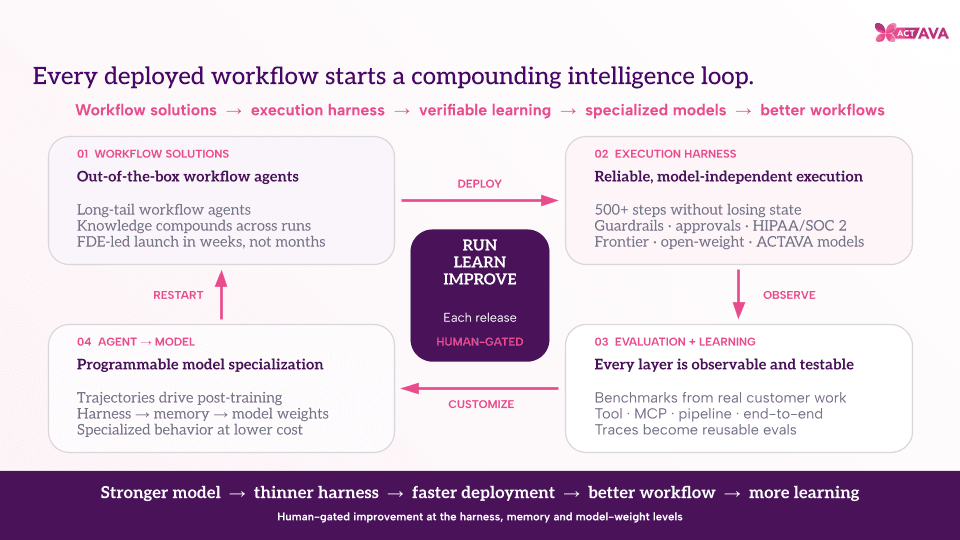
The ACTAVA Model Factory turns authorized workflows, expert corrections, and agent trajectories into specialized models you own. It covers RL post-training on open-weight models, held-out evaluation, overfitting checks, side-by-side comparison, and versioned deployment.
By Frank Wang
Every workflow your team runs leaves a trail. An agent makes a call. A reviewer corrects it. An exception goes up to a supervisor, who rules on it. Then the log rolls over and the lesson goes with it.
ACTAVA Model Factory is now in customer preview. It takes that trail and turns it into specialized models you own.
What a workflow leaves behind
Any workflow throws off agent actions, expert corrections, exceptions, and outcomes. Together they show what good looks like in your shop, one step at a time.
Picture a utilization nurse who overrides an agent's recommended pend because the clinicals sat on page 6 of a fax. That override is a labeled example. Today it disappears.
From workflow to deployed model
Our forward-deployed engineers and researchers work with you to turn authorized workflows and recorded agent trajectories into training environments. Each environment holds domain-specific tasks and verifiers that score the work. Model Factory then handles five jobs.
Train specialized models
RL post-training on open-weight models, run against environments built from your own workflows.
Evaluate against held-out tasks
Training rewards show the model is learning. Held-out evaluation tasks show whether it learned something real.
Catch overfitting
Model Factory detects when more training may hurt performance and recommends a better checkpoint.
Compare to the base model
Specialized checkpoints run side by side with the model they started from, on the same tasks.
Deploy with control
Pick a checkpoint and ship it through a stable, versioned API.
Why the held-out set matters
A model can get better at the training set and worse at the job. We've watched it happen. One Cura 1T training round lifted headline scores while damaging a held-out subset, so we reverted it and published the result.
That's why overfitting checks and checkpoint recommendations sit inside Model Factory. Picking the right checkpoint is half the work.
Why owning the model beats renting one
Frontier models start general. On χ-BENCH v1.0, the best frontier agent finishes 28% of long-horizon, policy-rich healthcare tasks on the first try.
Specialization moves that number. We proved the loop on our own model. Cura 1T, post-trained from Kimi-K2.6, scores 94.0 on MedAgentBench against 84.7 for the base model. On AgentClinic NEJM cases it scores 80.0 against 40.0.
Cura 1T is a research model, and benchmark scores don't establish safety for unsupervised clinical use. We cite them to show the loop works.
Cost follows ownership too. Our Johns Hopkins case study puts owned models at 20 to 100x cheaper per token than rented ones.
The flywheel
Each lap should feed the next. Better agents produce cleaner trajectories, and cleaner trajectories make better training data.
Your policies, PHI, prompts, outputs, and expert corrections stay inside your authorized boundary. Cura 1T acts as the teacher in the loop and never trains on your data. Ownership and portability of the resulting model follow your agreement with ACTAVA.
You don't need an ML research team
Building this alone means hiring researchers, standing up RL infrastructure, and writing verifiers for every task. Most healthcare organizations probably don't staff that bench.
Our team brings it. You bring the workflows and the experts who know what a right answer looks like.
Where Model Factory fits
The agents you build and run on ACTAVA KORA generate the trajectories. ACTAVA Compliance governs them. χ-BENCH measures them, and CURA, our healthcare model, anchors the loop.
Join the Model Factory preview
If your organization is exploring open-weight models, RL post-training, or specialized AI for its workflows, bring us one workflow. We'll show you what it can teach a model.
Request preview access
Written by
Frank Wang
CTO & Co-Founder
AI engineering leader who turns frontier research into market-defining enterprise products across agentic and vertical platforms. As Head of Engineering at Salesforce AI Research, Frank led breakthrough work on autonomous agents, deep research agents, agent orchestration, and the Agentforce advanced RAG & reasoning engine, post-training the agent, reasoning, deep research, and RAG models behind them. Earlier, as employee #11 and founding engineer at Vlocity (acquired by Salesforce in 2020), he built core platform technology in enterprise software — inventing the award-winning Salesforce OmniStudio Mobile Platform and six vertical industry applications, and growing OmniStudio into a platform spanning 14+ industries that has helped more than 100 large enterprises.