Blog
Non-Human Resources: Managing the Workforce That Doesn't Sleep
Non-Human Resources is HR for AI agents, with the same Build, Deploy, Govern, and Improve infrastructure HR provides for people. Around 80% of U.S. workers may see AI affect at least 10% of their tasks. Treat agents as a tech purchase and you invite the coordination failures that erase the ROI you expected.
By Kevin Riley
Here is the question most leadership teams are not asking yet: if the workforce is changing, why isn't the operating model?
AI agents are joining org charts. Not as a side experiment in a skunkworks lab — as operational team members taking on real work across real workflows. And the organizations treating this shift as a technology procurement decision, rather than a workforce management decision, are setting themselves up for exactly the kind of coordination failure that erases the ROI they were expecting.
This Is Not a Future State. It Is a Current One.
Around 80% of U.S. workers may see AI affect at least 10% of their tasks, with 19% facing potential disruption to over half of their core responsibilities. Those numbers are not projections about what might happen if AI develops further. They describe what is already in motion across every industry, every function, and every level of the enterprise.
This is not task-level automation. Task-level automation changes how individual work gets done. What is happening now is structural — a change in how work is organized, allocated, and executed across an entire organization. Org charts are starting to include both human colleagues and AI agents working side by side. The management question is not whether to prepare for this. It is whether to prepare for it deliberately or reactively.
Old Automation Followed a Script. Agentic AI Follows an Objective.
Previous waves of automation were predictable in a particular way: they did exactly what they were programmed to do, and nothing else. Rule-based, deterministic, brittle at the edges. That made them manageable — not because they were simple, but because the boundary of their behavior was fixed. You knew what the system would do. You designed around it.
Agentic AI is closer to delegated operations. It can receive a goal, plan a multi-step path to that goal, make decisions at each junction, join the dots across systems, and execute with limited human supervision — continuing until it believes the objective has been met. Agents analyze data, make decisions, plan workflows, and execute processes in ways that look less like software and more like delegation.
Old Automation
A tool you use
Follows a fixed script. Triggered by explicit conditions. Does exactly one thing in exactly one way. Managed by IT. The boundary of its behavior is defined by what you programmed it to do.
Agentic AI
A workforce you manage
Receives a goal, not a script. Plans multi-step paths. Makes real decisions at each junction. Operates across systems. Needs governance, oversight, and development — the same as any team member.
That shift moves AI from a tool you use to a workforce you manage. And managing a workforce — even a digital one — requires management infrastructure that most organizations have not built yet.
This Transformation Won't Happen Well on Its Own
According to PwC, this transformation requires deliberate choices — starting with how organizations design roles, structure teams, and develop talent. The companies that win will redesign around outcomes and treat AI agents as part of the team, not a side experiment that runs in parallel to the real workforce.
What that looks like in practice is three specific choices that most organizations have not yet made:
A Digital Workforce Needs the Same Infrastructure as a Human One
HR departments exist because managing a workforce is not self-organizing. People need to be hired into the right roles, onboarded with the right context, measured against the right outcomes, developed continuously, and governed when they go off-script. Without that infrastructure, even excellent talent produces chaos at scale.
AI agents need exactly the same thing. Not metaphorically — structurally. They need to be built into the right roles with the right tools. Deployed into the right workflows with the right permissions. Measured against the right performance criteria. Governed when they produce unexpected outputs. And improved continuously so that the agent running a workflow in twelve months is better than the one that started it.
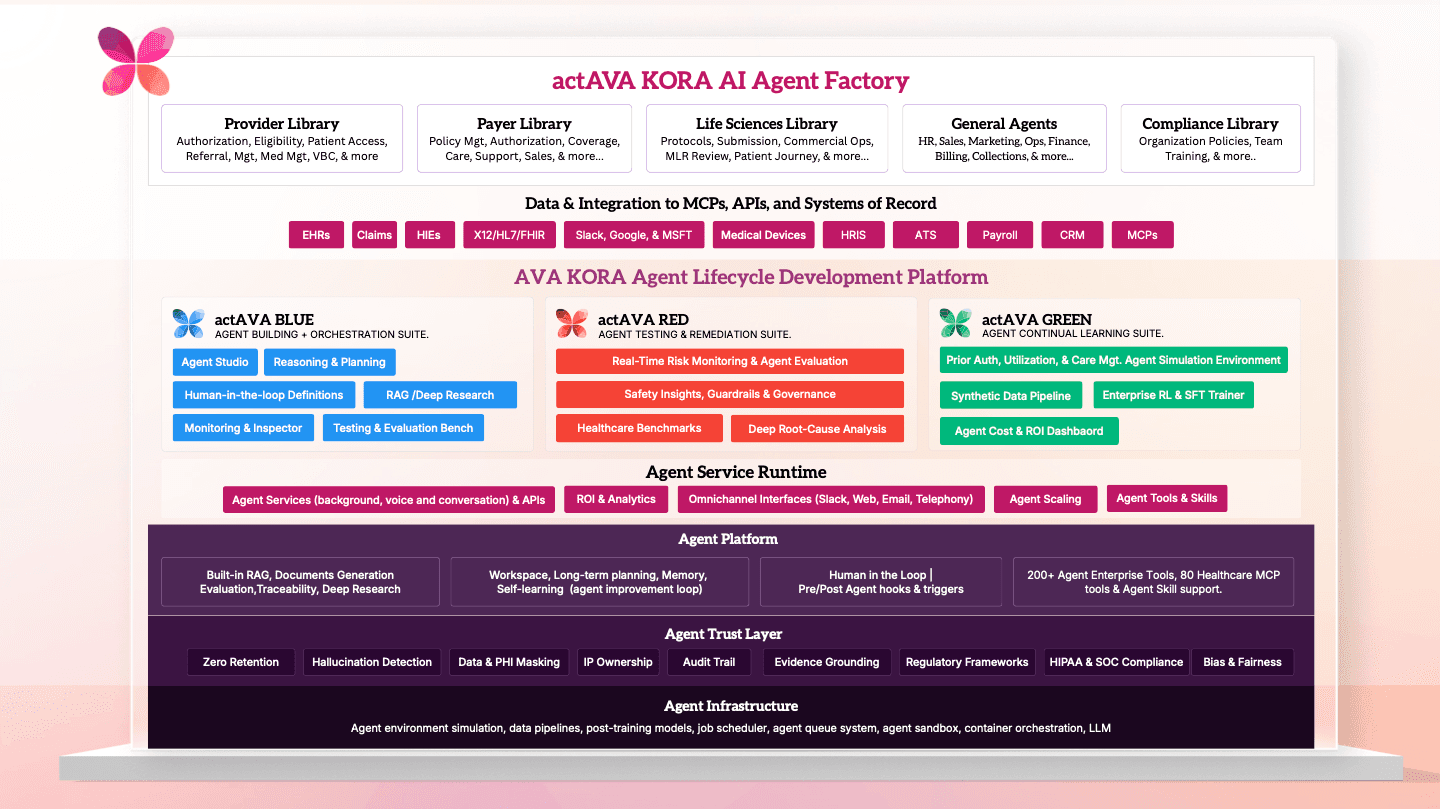
Just as a human workforce needs HR to hire, manage, and develop people — a digital workforce needs a platform to build, deploy, govern, and improve its agents.
That platform is Non-Human Resources. And that is what Actava.ai delivers with KORA.
Every HR function has a digital workforce equivalent that most organizations are currently running without any system at all:
Build · Hiring & Onboarding
Natural-Language Agent Factory
Enable citizen developers — not just engineers — to create the agents their team needs. Your engineers do not have to build the platform; Actava.ai is it. Structured creation with governed tools, defined permissions, and version control from day one. Your people know their workflows best. Now they can build the agent that runs them.
Deploy · Team Integration
Deep Agents Inside Existing Workflows
Run agents inside the systems your teams already use — not alongside them. Integration means the agent is part of the workflow, not a parallel track that generates duplicate effort and unclear handoffs. The agent joins the team; the team does not build a second one around it.
Govern · Policy & Compliance
Human-in-the-Loop Safety
Every consequential action routes through an approval gate. Every session produces an append-only audit log. Every escalation has a path. Governance is not a constraint on your agents — it is the condition that makes them trustworthy enough to delegate to at scale.
Improve · Performance & Development
Observability and Continuous Improvement
Measure what each agent produces. Catch what it gets wrong. Feed production traces and human corrections back into refinement. An agent that improves continuously compounds value. An agent that never improves is technical debt accumulating inside a critical workflow.
Do Not Give Your Agentic Future to a Single Model Provider
There is a version of this transformation that organizations are beginning right now that will not work. It looks like this: a team deploys a capable AI model through a consumer-grade interface, achieves impressive demo results, and concludes that they have solved the agentic AI problem. They have not. They have rented intelligence they do not control — built on a foundation that a pricing change, a policy update, or a competitive shift can undercut at any moment. No governance substrate. No audit trail. No improvement loop that does not require starting over.
A Non-Human Resources platform brings the same rigor to managing AI agents that you would expect from managing people. Not as an analogy — as a practical architecture:
Building with rigor
Structured agent creation with typed tool sandboxes, governed prompts, and version control — not ad-hoc prompt engineering that no one can reproduce or audit when something goes wrong.
Deploying with governance
Human-in-the-loop approval gates, documented escalation paths, and session-level audit logs that survive a compliance review — not a black-box system that cannot explain what it did or why.
Observing at the agent level
Performance metrics, failure pattern detection, and cost attribution per agent — not aggregate AI spend with no line-item accountability for what any individual agent is actually doing inside your workflows.
Improving continuously
Closed feedback loops from production traces, human corrections, and escalation patterns feeding back into agent refinement — not a static deployment that performs the same way in month twelve as it did in month one.
That is not an AI product. That is infrastructure for a workforce.
If the workforce is changing, the operating model should too.
The organizations that compound the advantage of every AI investment they make are not the ones that deploy the most agents. They are the ones that build the management infrastructure to run them deliberately — with the same accountability systems, the same performance standards, and the same commitment to continuous improvement that any high-performing organization applies to its human workforce.
Your people have HR. Your AI agents need Non-Human Resources. Learn more at actava.ai/why-kora.
Sources: AI workforce impact — Stanford Future of Work · Agentic workforce transformation — Financier Worldwide · Agentic AI in HR — Gloat · Workforce redesign for the agentic era — PwC

Written by
Kevin Riley
CEO & Co-Founder
Health-tech executive who builds and scales AI-driven software across healthcare, life sciences, and enterprise markets. Over 25 years launching and scaling solutions for healthcare and life sciences, Kevin led the healthcare and government business at Vlocity (acquired by Salesforce), growing it from $300K to more than $40M, and later served as GM of Salesforce's global Health & Life Sciences portfolio, a $4.5B business. He has also served as CEO of multiple software companies spanning AI, care management, regulatory science, and provider revenue. He created the award-winning modelH framework and was named a Top Healthcare Software Executive.