Blog
AI Is Advancing Faster Than the Systems Built to Keep It Safe
The 2026 Stanford AI Index makes it official: 90% of leading AI models now come from industry, 88% of organizations have adopted AI, and real-world incidents are climbing faster than the controls meant to catch them. In healthcare, that gap shows up as governance debt, accruing quietly with every agent that touches prior auth, clinical decisions, or revenue cycle. Here's how Actava.ai CHRYSO (automated compliance, evidence, and policy under one roof) and Actava.ai RED (continuous, production-grade testing for hallucinations, bias, and drift) close that gap before your next audit, incident, or patient interaction.
By Deon Metelski
AI Governance · Healthcare
AI adoption has outpaced governance. The 2026 Stanford AI Index says so out loud.
Here's how Actava.ai CHRYSO and Actava.ai RED close the gap, before your next audit, incident, or patient interaction.
The gap between what AI can do and what organizations can safely govern has never been wider. The newly released 2026 Stanford HAI AI Index makes it official: industry now produces more than 90 percent of leading AI models, enterprise adoption has crossed 88 percent of organizations, and the technical capability of these systems (solving advanced scientific problems, writing production code, reasoning across clinical data) is compounding faster than the governance infrastructure built to oversee them.
For healthcare and life sciences organizations, this plays out every day in operations. Every AI agent processing prior authorizations, supporting clinical decisions, or navigating revenue cycle workflows carries risks: hallucinations, bias, regulatory noncompliance, and silent performance degradation. Right now, most organizations lack the instrumentation to even detect those failures in real time, let alone prevent them.
"The risk and governance surface of AI is quite jagged, and enterprises are running up a governance debt." Kush Varshney, IBM Fellow, quoted in the 2026 Stanford AI Index
Governance debt is the right frame. Like technical debt, it stacks up invisibly, layer by layer, deployment by deployment, until something breaks. In a regulated environment, the stakes of that break aren't just reputational. They're clinical, financial, and increasingly legal.
Capability and control aren't at odds. They need intentional architecture.
The Stanford report's most actionable insight is also its most hopeful: adoption and governance aren't competing priorities. You can do both at once. But you can't do both at once with tools designed for only one of them.
Generic AI platforms give you deployment speed. They don't give you a compliance posture. Frameworks like NIST AI RMF, HIPAA, CMS HEI, and ONC HT1 are architectural requirements. They have to be designed in from the start, and they have to evolve continuously, because the regulatory environment itself is accelerating.
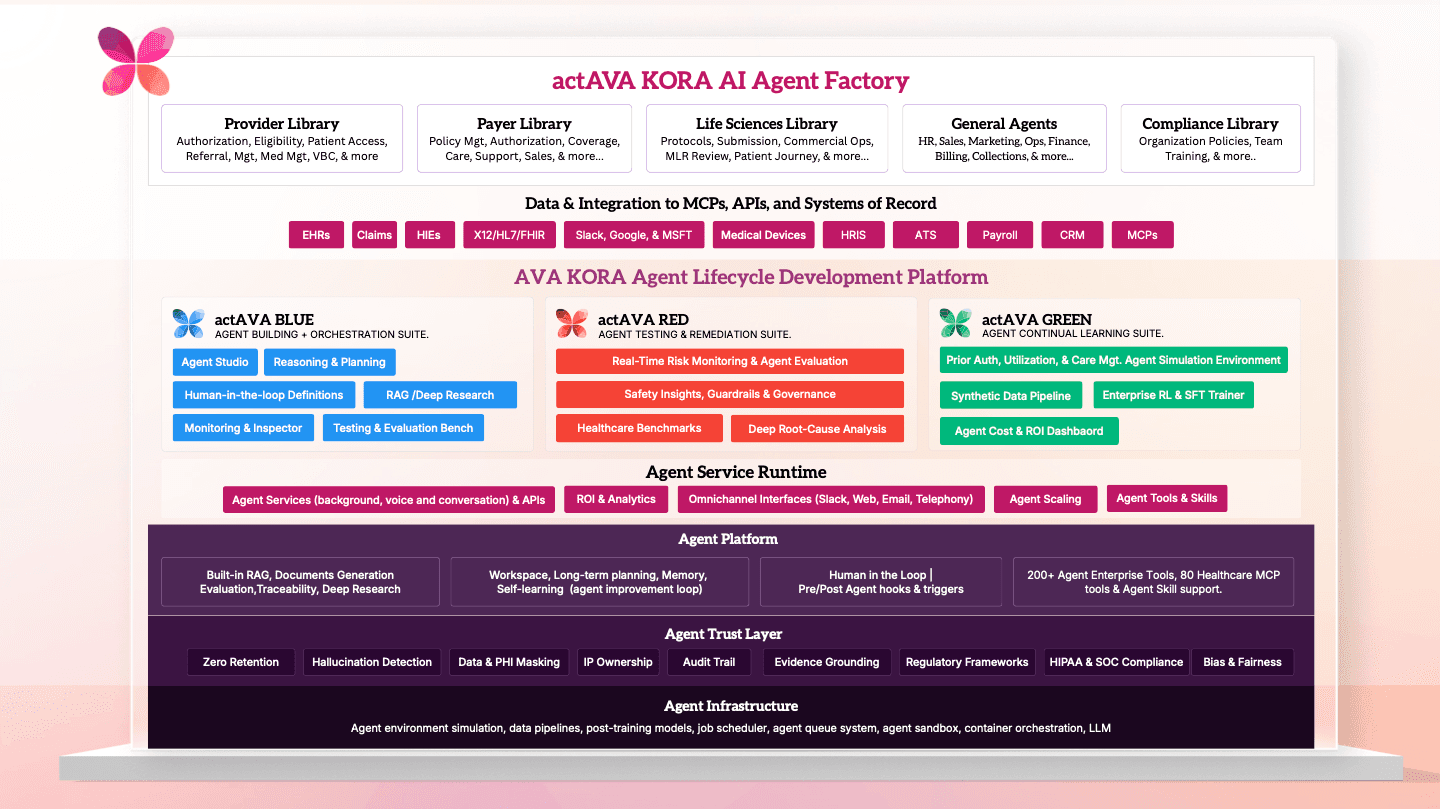
This is the problem Actava.ai was built to solve. Founded by leaders from Salesforce AI Research and the healthcare technology industry, Actava.ai sits at the intersection of what frontier AI makes possible and what healthcare's regulatory environment demands. Our KORA platform is a purpose-built healthcare AI factory, built for regulated environments rather than general use. Two of its components address the governance gap head-on.
If your organization runs AI in a regulated environment (and in healthcare, every environment is regulated), CHRYSO is the governance backbone you can't afford to operate without. It's the only end-to-end compliance platform purpose-built for AI in healthcare and regulated industries, delivering automated control evidence, policy management, workforce training, and real-time agent monitoring under one roof.
CHRYSO maps directly to the frameworks auditors, regulators, and accreditation bodies actually care about. Inside CHRYSO, NIST AI RMF's four functions (Govern, Map, Measure, Manage) become executable controls, evidence requirements, and accountability structures tied to your specific agents and workflows. HIPAA compliance across systems that touch protected health information is enforced at the AI layer, not just the infrastructure layer. CMS Health Equity Index mandates (algorithmic fairness, bias monitoring, disparity documentation) are woven into how agents get evaluated and reported, not retrofitted afterward.
CHRYSO also keeps pace as the rules change. State AI laws are accelerating across the country, with new provisions governing automated decision-making, algorithmic accountability, and consumer rights taking effect on rolling timelines. CHRYSO provides continuously updated coverage of enacted and pending state AI laws, mapped to your control environment the moment they take effect, not when your compliance team spots them in a newsletter.
It integrates natively with Actava.ai RED, the AI red-team engine built for autonomous agent evaluation. Policy management and agent behavior aren't siloed: every deployed agent can be continuously probed for safety failures, jailbreak vulnerabilities, bias, and policy violations, with governance documentation updated automatically.
Governance frameworks tell you what your AI must do. Actava.ai RED tells you whether it's actually doing it continuously in production across every interaction. KORA|RED is our AI testing and validation platform, calibrated for the failure modes that matter in healthcare: hallucinations that could influence a clinical decision, compliance violations that could trigger regulatory action, bias patterns that could worsen health disparities, and performance degradation that creeps in silently over weeks or months.
The Stanford report documents a rise in real-world AI incidents tied to failures in reliability and safety. Most share a common trait: they weren't caught during initial evaluation. They emerged over time, in edge cases, under conditions pre-deployment testing never surfaced. KORA|RED is built for that reality. It provides deep trace observability and advanced analytics that continuously evaluate agents across complex real-world scenarios, not just at launch but throughout the entire deployment lifecycle.
Passing an evaluation and maintaining trustworthiness in production are two very different things. One gives you a safe AI deployment; the other leaves you with a liability. KORA|RED's proprietary risk engine keeps your agents excellent after go-live, with instant risk detection that catches dangerous errors in real time and guarantees consistent, trustworthy results across every patient interaction and operational workflow.
For organizations grappling with the governance debt Stanford describes, RED provides the instruments to actually measure what you owe, and start paying it down. Saying AI is compliant isn't enough. You need to prove it, continuously, with evidence that satisfies auditors, regulators, and the clinical leaders who carry responsibility for patient safety.
The adoption and governance equation
The 2026 Stanford AI Index captures a pivotal moment. AI capability is compounding at a rate that exceeds anything the governance ecosystem was designed to handle. The organizations that come out ahead won't be the ones that slow their adoption out of fear. They'll be the ones that build governance infrastructure capable of keeping pace.
In healthcare, that infrastructure is mandatory. It's the difference between AI that transforms care delivery and AI that creates new categories of clinical, financial, and regulatory exposure. The experts quoted in the Stanford report are right: adoption and governance aren't at odds. They just require a platform designed to do both at once, rather than two point solutions bolted together after the fact.
"Enterprises have the burden of ensuring that those capabilities are implemented in a way that benefits the general public, not just the deep experts or the corporate bottom line." Gabe Goodhart, Chief Architect of AI Open Innovation, IBM
Actava.ai was founded on exactly that principle. Our KORA platform, from the agent-building capabilities of BLUE, to the compliance infrastructure of CHRYSO, to the continuous safety evaluation of RED, to the self-improving intelligence of GREEN, is designed as an integrated system where speed and safety reinforce each other instead of trading off.
The AI governance gap is real. The good news: closing it doesn't require slowing down. It requires the right architecture from the start.
Ready to close your governance gap?
See how Actava.ai CHRYSO and Actava.ai RED work together to give your organization the compliance posture and continuous safety monitoring healthcare AI demands.
Explore CHRYSO Request a Demo
Written by
Deon Metelski
Chief Product Officer
Product leader shaping agentic healthcare AI that feels human and interoperates across every clinical ecosystem. Previously a healthcare product leader at Zyter|TruCare, Deon has spent his career turning complex clinical and operational work into products clinicians trust. At Actava.ai he leads distributed teams to orchestrate safe, explainable AI agents across EHRs and connected ecosystems, translating clinical and operational needs into intuitive, dependable experiences. His work blends empathy with data, advancing healthcare AI through a product lens, and is driven by a commitment to access, interoperability, and measurable outcomes across the care continuum.