Blog
Meet our Advisors: Gabriela Perez
Gabriela Perez is a seasoned, multi-exit senior commercial leader focused on the intersection of healthcare, artificial intelligence, and venture building. When she isn't scaling companies from the inside, Gabriela is fueling the broader tech ecosystem. She serves as a Venture Partner at NextGen Venture Partners, backing next-generation healthcare startups, and supports AI-native healthcare solutions with the venture firm Neo. An alumna of Harvard Business School, Gabriela regularly lends her expertise as a mentor at the Harvard Innovation Labs, helping early-stage founders navigate the complex bottlenecks of scientific R&D, data infrastructure, and enterprise scaling. She is also an advisor to Actava.ai.
Gabriela Perez has spent two decades at the intersection of healthcare, technology, and venture — not as an observer, but as an operator. She has scaled companies across three continents, engineered two landmark healthcare acquisitions, and built commercial engines that generated hundreds of millions in revenue before crossing finish lines that matter: a Teladoc acquisition, a Labcorp acquisition, FDA-cleared digital therapeutics reaching millions of patients.
Today she serves as a Venture Partner at NextGen Venture Partners, backing next-generation healthcare startups, and supports AI-native healthcare solutions with the venture firm Neo. An alumna of Harvard Business School, Gabriela regularly lends her expertise as a mentor at the Harvard Innovation Labs, helping early-stage founders navigate the complex bottlenecks of scientific R&D, data infrastructure, and enterprise scaling.
We sat down with Gabriela to talk about the strategic shift healthcare leaders are missing, why AI adoption is breaking down at scale, and what it actually takes to build a healthcare organization that runs on agents — not just software that supports them.
"We are moving from software that supports work to agents that perform work — this shift will redefine healthcare operations, workforce models, and the future of clinical and administrative labor."
"We are moving from software that supports work to systems that perform it — and healthcare is about to feel that shift at full force."
The Strategic Mindset Shift Healthcare Is Missing
Actava.ai: Healthcare has moved fast on AI adoption. What are most organizations still getting wrong at the strategic level?
Gabriela Perez: The biggest shift healthcare needs is moving from narrow, use-case-by-use-case AI adoption to thinking in systems of agents.
Today, organizations are optimizing in silos — one workflow, one department at a time. But as agent adoption expands, this breaks down. You don't end up with transformation; you end up with a growing number of uncoordinated agents, rising operational complexity, and diminishing ROI.
The strategic question is no longer "where do we deploy AI?" but "what is the operating model for agent-driven execution across the enterprise?" That requires a new coordination layer — what I think of as the "AI factory" — where agents are not deployed in isolation, but orchestrated, governed, measured, and managed as a unified system of execution.
Actava.ai is building for exactly this shift: from fragmented automation to a structured system where agentic labor is coordinated and scaled as part of the core operating model of healthcare.
The Coordination Tax: Where Healthcare AI ROI Goes to Die
Actava.ai: Many health systems have moved from pilot to production on multiple AI tools. What happens next is where it gets interesting.
Gabriela Perez: Healthcare AI adoption is breaking down not because the technology is insufficient — but because organizations are scaling agents without an operating model to manage them.
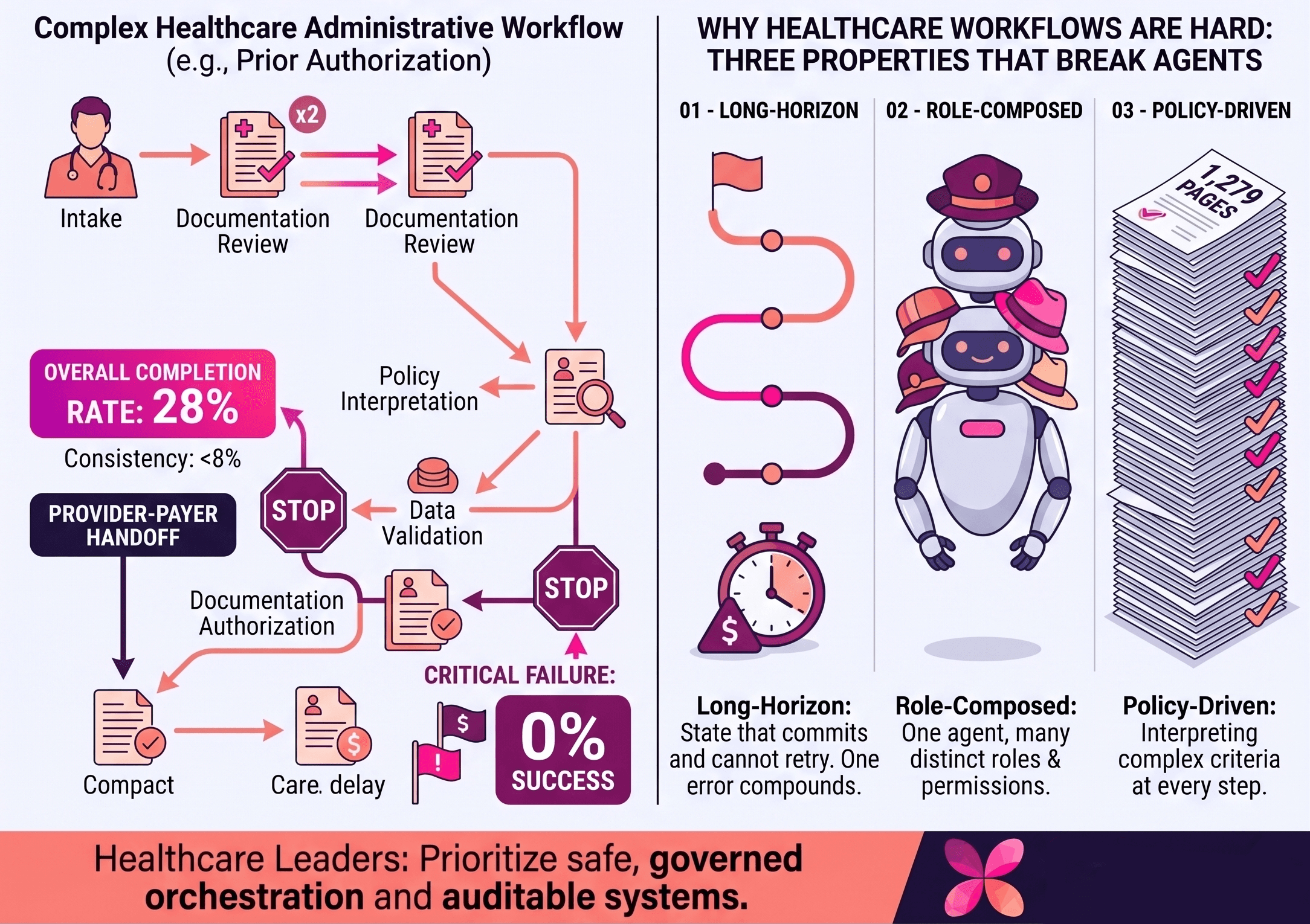
The assumption has been that agents can be deployed like point solutions: optimize a workflow, measure local efficiency, and move on. But at scale, agents introduce what I call a coordination tax — rising overhead to manage, align, and govern systems that were not designed to work together.
We already see this in large health systems deploying multiple AI tools across documentation, prior authorization, and clinical workflows. Each tool may improve a specific function, but together they create new operational burden: multiple dashboards, fragmented integration points with the EHR, broken feedback loops, and unclear ownership of performance across teams. Instead of simplifying work, coordination becomes work.
The Core Gap
This is where ROI starts to degrade — not at the point of capability, but at the point of scale.
Without a coordination and governance layer, agentic systems generate complexity faster than they generate leverage. The core gap is the absence of an AI operating layer that can orchestrate agents as a unified system of execution.
Six Things Every Health System Must Have Before Scaling Agentic AI
Actava.ai: If a Chief Digital Officer asked you what they need to have in place before scaling agentic AI across their health system, what would you tell them?
Gabriela Perez: Scaling agentic AI in healthcare is not about adding more use cases — it is about building the operating conditions for agents to function as a system.
01
Clear ownership of agents as operational assets
Every agent needs a defined business and clinical owner, not just a technical owner. Agents that belong to no one are managed by no one.
02
Lifecycle management across agents
Onboarding, versioning, monitoring, and retirement of agents as they evolve — the same discipline you apply to any operational asset.
03
Performance measurement tied to outcomes
Not just task completion, but impact on cost, quality, access, and workflow efficiency. If you cannot measure it, you cannot scale it.
04
End-to-end visibility across agent behavior
Understanding how agents interact across workflows, not just in isolation. Siloed monitoring is how the coordination tax compounds invisibly.
05
Governance embedded into execution
Safety, compliance, and policy constraints enforced as part of the operating layer — not applied after the fact as an audit exercise.
06
A feedback loop between humans and agents
Clinicians and operators must be able to continuously refine system behavior based on real-world use. Without this, agents drift from the work they were built to do.
Without this foundation, organizations don't actually scale AI — they accumulate disconnected automation. The next frontier in healthcare AI is not more agents. It is the ability to orchestrate and operate them as a coordinated system of execution.
Why She Became an Advisor to Actava.ai
Actava.ai: You have seen a lot of healthcare AI companies from both sides of the table — as an operator and as a venture partner. What made Actava.ai stand out?
Gabriela Perez: What drew me to Actava.ai is the opportunity to help re-architect how healthcare work is done — not by optimizing existing systems, but by shifting to agentic systems that perform work in real environments at scale.
This is a structural change in how organizations operate. We are beginning to treat agents as a form of labor — which means they need to be onboarded, managed, given feedback, measured through KPIs, and integrated into workflows with clear accountability. In that world, you are no longer deploying software. You are organizing a hybrid workforce of humans and agents. That will reshape how every industry functions.
Actava.ai stands out because it is building for that reality — where agentic systems are not tools, but a managed layer of execution inside healthcare itself. That is exactly where I want to be.
About Gabriela Perez
Gabriela Perez has spent over two decades transforming the convergence of healthcare, technology, and venture building. Known for driving massive commercial growth and engineering high-profile acquisitions, she has built a reputation as a go-to executive for scaling impactful health-tech innovations — and crossing finish lines that matter.
As a founding team member at Best Doctors, she helped scale the global telehealth and e-second opinion platform across 45 countries, generating hundreds of millions in revenue before its successful acquisition by Teladoc Health (NYSE: TDOC). As Executive Vice President and General Manager at Ovia Health, Gabriela drove triple-digit year-over-year revenue growth, expanded its network to over 2,000 clients, and secured 27 major health plans — leading to a successful acquisition by Labcorp (NYSE: LH).
Beyond exits, Gabriela is a champion for clinical efficacy, enterprise software adoption, and the expansion of patient access to modern medicine. As Chief Commercial Officer at Big Health, she spearheaded global growth for FDA-cleared digital therapeutics, bringing non-drug treatments for anxiety, depression, and insomnia to the masses. As Chief Growth Officer at Tomorrow Health, she focused on reshaping home-based care by streamlining how patients access vital medical equipment.
Connect with Gabriela on LinkedIn.