Blog
The Model Gets the Headlines. The Harness Does the Work.
Two teams can run the same frontier model and ship two completely different agents: one trustworthy, one quietly guessing. On the public GAIA leaderboard, a single model swings about 44 points depending only on the software wrapped around it. Same weights, different harness. ACTAVA CTO Frank Wang argues that the number worth grading isn't the model, it's the harness: what the agent can do without a human, how many steps it gets, what it remembers, which systems it can reach, and how it's caught when it's wrong. Here's where the agent line actually sits, why the permission surface matters most in healthcare, and why we build the part you own instead of chasing the model you rent.
By Frank Wang
The model gets the headlines. The harness does the work.
Two teams can run the exact same frontier model and ship two completely different agents. One is trustworthy. The other quietly guesses. In healthcare, that gap is the whole job.
Every model release triggers the same reflex. Everyone reads the benchmark table, argues about which lab is ahead this month, and rewires their agents to point at the new leader.
I understand the pull. I also think it's aimed at the wrong number.
Here's a data point that reframed how my team builds. On the public GAIA agent leaderboard, one frontier model scores about 75% in one agent setup and about 31% in another. Same model. Same weights. The only thing that changed was the software wrapped around it.
~44 points
The swing on one benchmark for a single frontier model, depending only on the harness it ran inside. The model didn't get smarter or dumber. The system around it did.
Sit with that for a second. A 44-point spread is not a rounding error. It's the difference between an agent you'd put in front of a prior-auth queue and one you'd never let near a patient record. And none of it came from the model.
So when someone asks me whether our agents run on the smartest model, I tell them that's not the question that keeps me up at night. The question is what the model is allowed to do between the moment a nurse asks and the moment something happens in the EHR. That answer lives in the harness, and the harness is ours to engineer.
Where the agent line actually sits
People treat "agent" like a property of the model. It isn't. It's a property of the runtime. The same model becomes an assistant or an autonomous agent depending on five things you decide in code, not in the prompt.
What can it do without a human in the loop. How many steps does it get before it has to stop. What does it remember across those steps. Which tools and systems can it actually reach. And how is every one of its moves graded and caught.
Change any of those and the same model slides from "helpful chat" to "does things in your systems." No model swap. No fine-tune. Just a different set of rules around it.
Agency isn't something the model has. It's something the harness grants, one permission at a time.
This is why I get uneasy when a vendor pitches an agent by naming the model underneath it. That tells me almost nothing about how it'll behave in production. It's like judging a surgeon by the brand of scalpel.
The permission surface is the part that matters most
Of those five levers, one carries more weight than the rest in healthcare: what the agent is allowed to do on its own.
There's a hard line between an agent that drafts a prior-authorization letter and one that submits it. Between an agent that flags a possible contraindication and one that changes an order. On one side, the human stays in control and the agent is a very fast assistant. On the other, you've handed real authority to a system that can be wrong.
That line is not a personality trait of the model. It's a policy you write. In KORA, it's explicit: every tool an agent can touch carries a rule about whether it runs on its own or waits for a sign-off, and that rule is enforced by infrastructure, not by hoping the model behaves. You decide, per action, where "suggestion" ends and "delegated action" begins.
Get this wrong in either direction and you pay for it. Too locked down and the agent is a glorified autocomplete nobody bothers to use. Too loose and a single bad inference reaches somewhere it shouldn't. The craft is putting each individual action on the right side of that line, and being able to move it as trust is earned.
Full autonomy is the wrong goal
The industry keeps selling autonomy like more of it is always better. In healthcare it isn't. The agent I want isn't the one that never asks for help. It's the one that knows exactly when to stop and escalate.
The benchmarks back this up. When instructions get ambiguous, even the best models don't reliably know when to hand off to a human, and their performance falls off a cliff. The failure isn't that the model got dumber. It's that nobody built it a way to say "I'm not sure, check me."
So we treat escalation as a feature we design, not an accident we hope for. Knowing when to defer is a capability. We build it into the harness on purpose, because in clinical and payer work the cost of a confident wrong answer is not symmetric with the cost of asking.
Same model, two agents
Two health systems license the same frontier model for appeals. System A wires it straight to the API: the model reads the denial, writes the appeal, and files it, in one unbroken run. It demos beautifully.
System B runs it inside a harness. The model still drafts the appeal, but it can only pull from an approved policy set, it gets a fixed number of steps, it stops and asks a human when the medical-necessity criteria are ambiguous, and every action it takes is logged. Same model. One is a liability waiting for its first bad week. The other is something a compliance officer will actually sign off on.
The five layers we actually build
When we design an agent, the model is one line in a much longer spec. The parts that decide whether it's trustworthy break into five layers, and four of them have nothing to do with which lab trained the weights.
Persona
The job. Who this agent is, what it's responsible for, where its authority ends, and when it hands off. Stable job descriptions, not vibes.
Tools and actions
What it can reach, and under what rule. This is where a chat surface becomes operational, and where the permission line gets drawn. In KORA this is the BLUE build and orchestration layer.
Reasoning and planning
How it decides. Some lives in the model. The durable part, plans it can resume, steps it can be held to, lives in the harness where you can inspect it.
Knowledge and memory
What it carries across steps and sessions: your policies, your traces, your institutional judgment. This is where an agent gets better on your data. In KORA, the GREEN continual-learning layer.
Evaluation and feedback
How every move is graded, caught, and audited. The layer demos skip and production can't live without. In KORA, the RED testing and remediation layer.
Persona, tools, and reasoning are non-negotiable in any real agent. Memory earns its place the moment the work runs longer than a single turn. And evaluation is the one everybody treats as optional in the demo and mandatory the day it touches a patient.
Notice what's missing from that list: "pick the best model." The model plugs into this structure. It isn't the structure.
Why we optimize the harness, not the model
There's a strategic reason we build this way, beyond safety.
The model is the most commoditized, fastest-moving, least controllable piece of the stack. A better one ships every few months, and you don't own any of them. If your agent's reliability lives inside a specific model's weights, it resets every time you switch, and you're renting the one thing you most need to trust.
The harness is the opposite. It's the part you own, the part that accumulates your policies and your hard-won judgment, and the part that keeps a powerful, imperfect model inside the lines. So that's where we put the engineering. When a stronger model ships next quarter, our customers repoint the router and keep everything that made their agent trustworthy: the permissions, the evals, the escalation rules, the audit trail, the memory of what worked.
Grade the harness, not the model. The model is a component you'll replace. The harness is the product.
None of this is a knock on the frontier labs. Their models are remarkable, and we route to several of them. But the next time you're evaluating a healthcare agent, don't start with which model it runs. Start with what that model is allowed to do without asking, how it's caught when it's wrong, and what happens when it isn't sure.
The model gets the headlines. The harness does the work. In healthcare, the harness is the work.
See the harness in production
KORA is the permission surface, the evals, and the escalation rules that turn a frontier model into an agent you can put in front of clinical and payer work.
Request a demo
Written by
Frank Wang
CTO & Co-Founder
AI engineering leader who turns frontier research into market-defining enterprise products across agentic and vertical platforms. As Head of Engineering at Salesforce AI Research, Frank led breakthrough work on autonomous agents, deep research agents, agent orchestration, and the Agentforce advanced RAG & reasoning engine, post-training the agent, reasoning, deep research, and RAG models behind them. Earlier, as employee #11 and founding engineer at Vlocity (acquired by Salesforce in 2020), he built core platform technology in enterprise software — inventing the award-winning Salesforce OmniStudio Mobile Platform and six vertical industry applications, and growing OmniStudio into a platform spanning 14+ industries that has helped more than 100 large enterprises.
More from the blog
View all posts Blog
BlogNewsweek Asked If Healthcare AI Hit a Reliability Wall. The Answer Is an Architecture Choice.
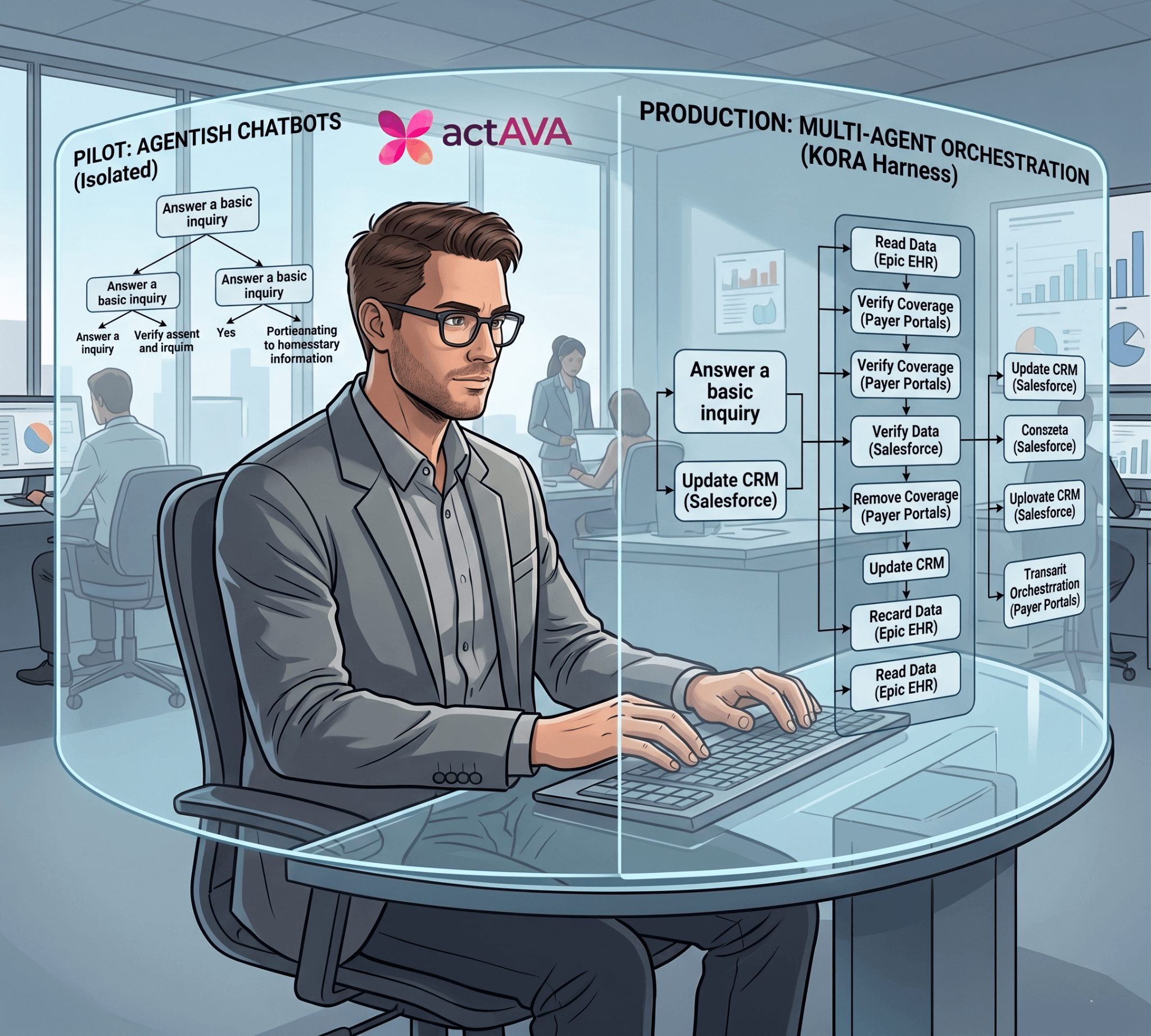 Blog
BlogThe State of AI Pilots in Healthcare & The 7 Ways Healthcare Agents Fail Before You Deploy Them
 Blog
Blog