Blog
A Comprehensive Guide to Measuring ROI in the Age of Agentic AI
In this post, Steve Brown (our CCO) outlines Actava.ai’s approach to evaluating the true value of agentic AI in healthcare. Our structured methodology helps healthcare leaders move beyond outdated ROI frameworks to capture the compounding, transformative impact of AI orchestration.
By Steve Brown
The promise of agentic AI in healthcare is profound. It orchestrates intelligent agents to handle complex workflows, reduce administrative burdens, accelerate care delivery, and empower clinicians. Yet the stakes could not be higher. A misstep in a consumer app might frustrate users. In healthcare, it can delay treatment, compromise safety, or erode trust across providers, payers, and patients.
As Chief Commercial Officer at Actava.ai, I lead the go-to-market efforts for our AI orchestration platform. The platform is purpose-built for healthcare operations. It enables organizations to build, deploy, and scale compliant agentic solutions. These solutions coordinate across EHRs, billing systems, prior authorization engines, and more. Our work draws on deep expertise rooted in Salesforce AI Research and in healthcare technology veterans. We focus on making agentic AI reliable, auditable, and impactful at enterprise scale.
Recent research underscores a critical challenge. MIT’s NANDA initiative’s 2025 report, “The GenAI Divide: State of AI in Business 2025,” analyzed hundreds of enterprise AI initiatives. It found that, despite $30–40 billion in investments, 95% delivered no measurable P&L impact. For healthcare leaders running pilots, this statistic can feel like a reason to pull back. Perspectives from UC Berkeley’s SCET AI Commons initiative suggest the issue often lies not in the technology. It lies in applying the wrong measurement lens to a fundamental leap forward.
At Actava.ai, we see the GenAI Divide as an opportunity for reimagination rather than retreat. Traditional ROI focuses on immediate quarterly revenue or isolated cost cuts. It misses the essence of agentic AI in healthcare. It is much like evaluating the early internet solely by postage savings. True value emerges through compounding effects across efficiency, quality, workforce resilience, and capability.
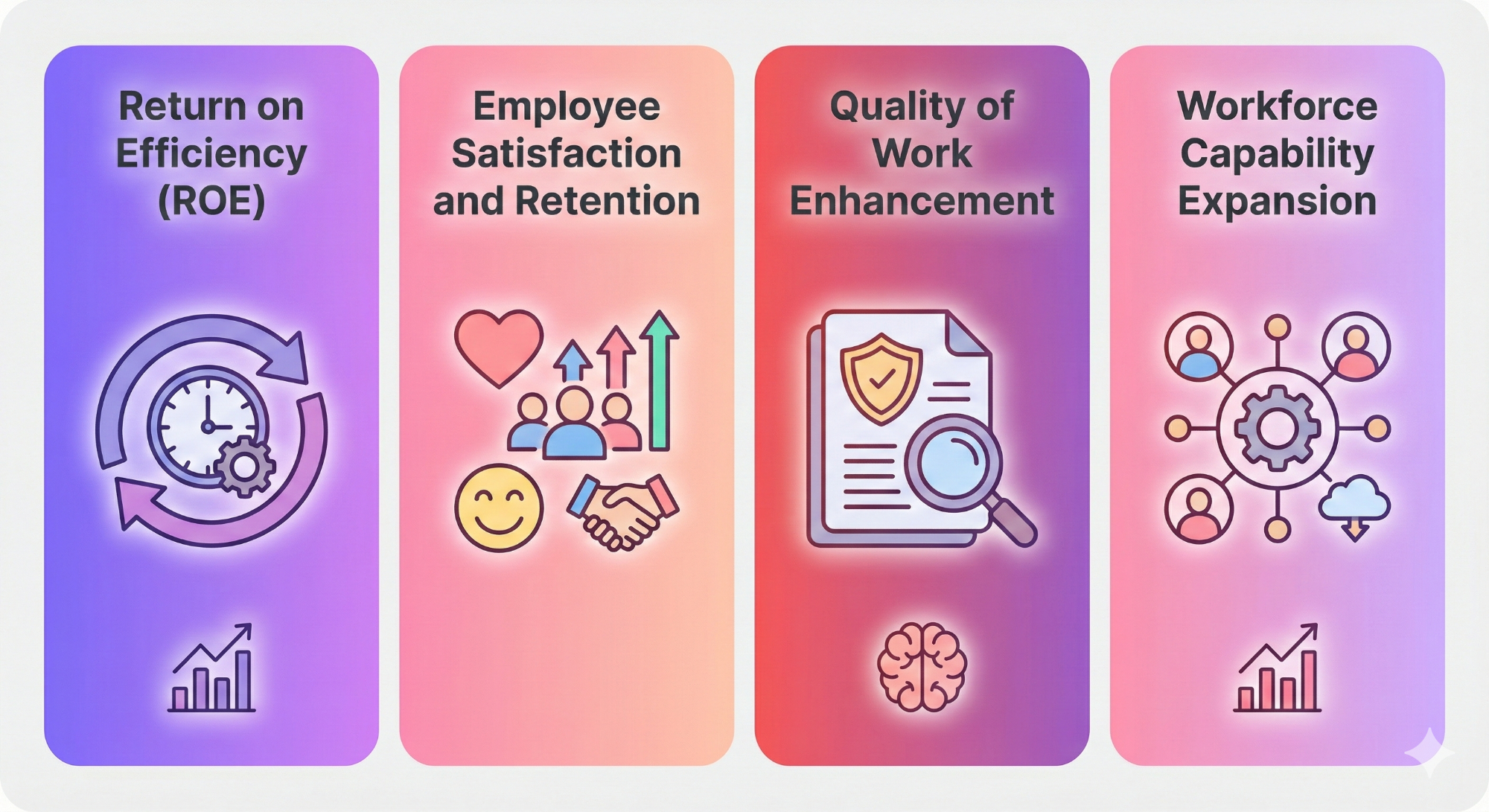
Our approach centers on four core pillars. These pillars better reflect how agentic orchestration creates a durable impact in high-stakes healthcare environments.
Measure 1: Return on Efficiency (ROE) (the foundational metric)
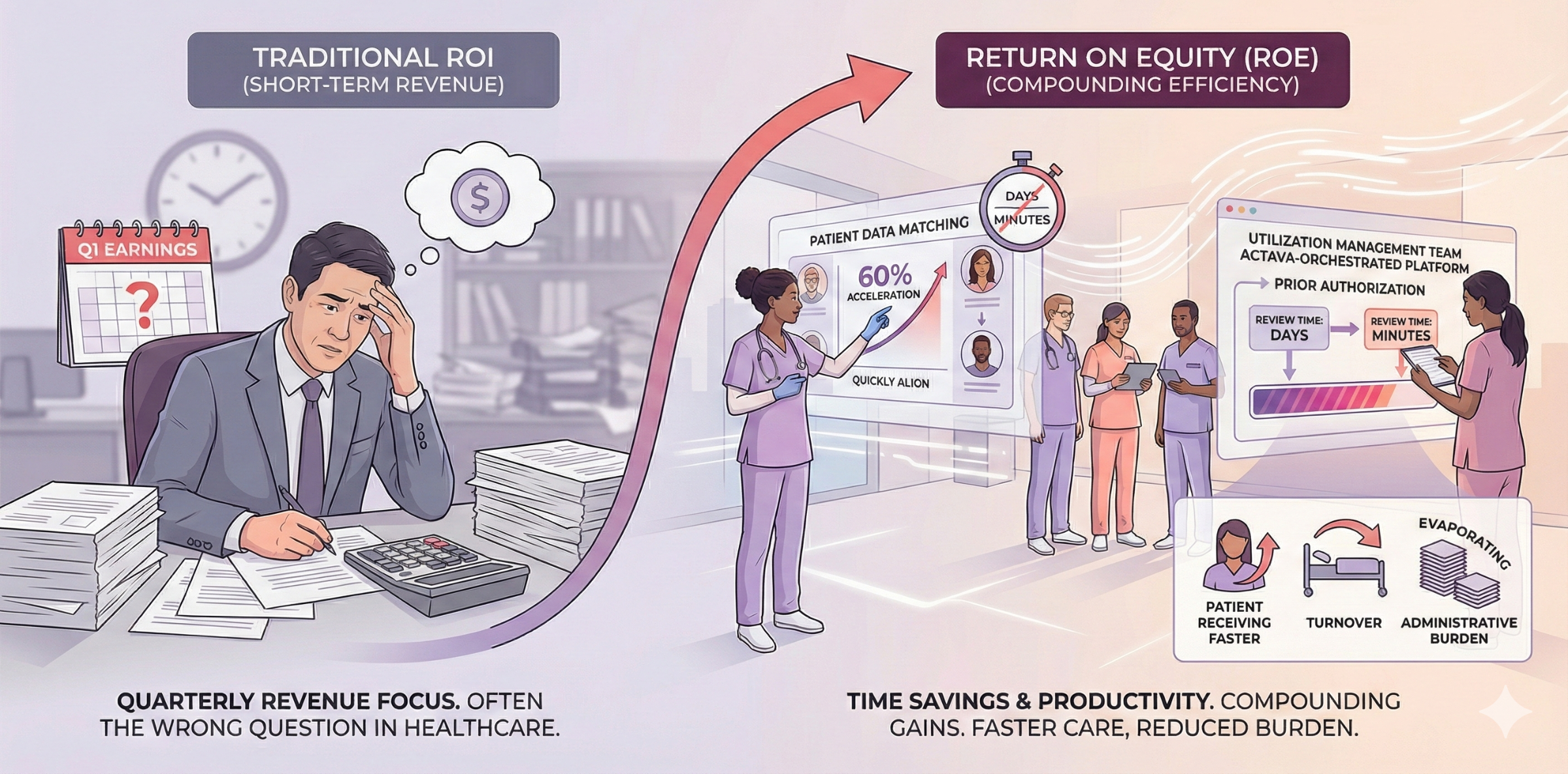
Before chasing revenue lifts, healthcare organizations must address the crushing administrative load. This load erodes margins and clinician well-being. Return on Efficiency measures time savings and productivity gains that compound across operations. It often provides the first tangible signal of value.
When our platform orchestrates agents to manage prior authorization workflows, the win is not a direct billing code spike in the current quarter. It is a utilization management team reducing review cycles from days to minutes. This enables faster approvals and fewer downstream denials. In one deployment, a clinical research coordination team accelerated patient matching for trials by over 60%. The immediate financials may appear modest. The ripple effects are profound and accumulate over time. These include quicker trial starts, improved bed utilization, and reduced paperwork fatigue. ROE captures these efficiencies as the silent killers of healthcare profitability begin to fade.
Measure 2: Quality of Work Enhancement (beyond speed to safety+accuracy)
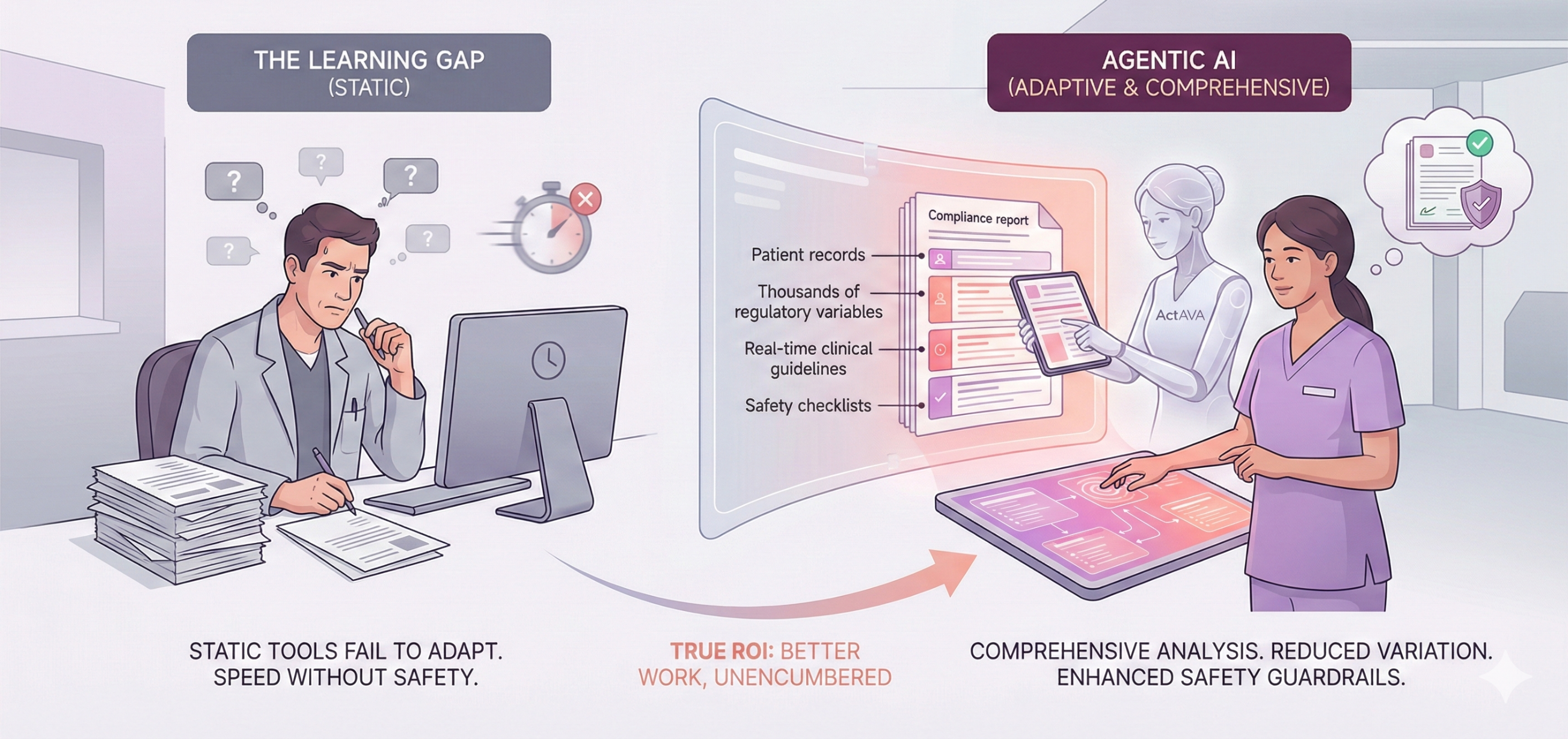
The MIT report highlights a “Learning Gap.” Static tools fail because they lack contextual adaptation. Agentic AI addresses this by evolving in response to feedback. Traditional metrics overlook the quality dimension.
We measure Quality of Work Enhancement to ensure speed never compromises safety. An orchestrated agent drafting a compliance report is not valuable just because it is faster. It is valuable because it cross-checks against thousands of regulatory variables. It catches fatigue-induced oversights that humans might miss. This leads to reduced clinical variation, stronger guardrails, and avoidance of multimillion-dollar audit exposures or sentinel events. These benefits often remain latent on short-term dashboards. They become evident when they prevent a costly failure. They represent a core component of ROI in regulated environments such as healthcare.
Measure 3: Employee Satisfaction and Retention (preserving the human-in-the-loop)
A striking paradox appears in the MIT findings. Formal enterprise pilots struggle. The “Shadow AI Economy” flourishes, with 90% of employees turning to personal tools for relief. In healthcare, burnout reaches crisis levels. This signals a clear opportunity.
We track Employee Satisfaction and Retention as a direct outcome of agentic deployment. Tools that eliminate “pajama time” are not merely productivity aids. Late-night charting after family hours takes a toll. These tools are longevity investments. When a nurse manager offloads scheduling logistics to an agent, she refocuses on team mentoring. Measurable improvements in job satisfaction follow. Our deployments show retention gains that dwarf software costs. Retaining a seasoned clinician is orders of magnitude more valuable than any license fee. It preserves institutional knowledge and reduces turnover-driven disruptions.

Measure 4: Workforce Capability Expansion (the strategic multiplier)
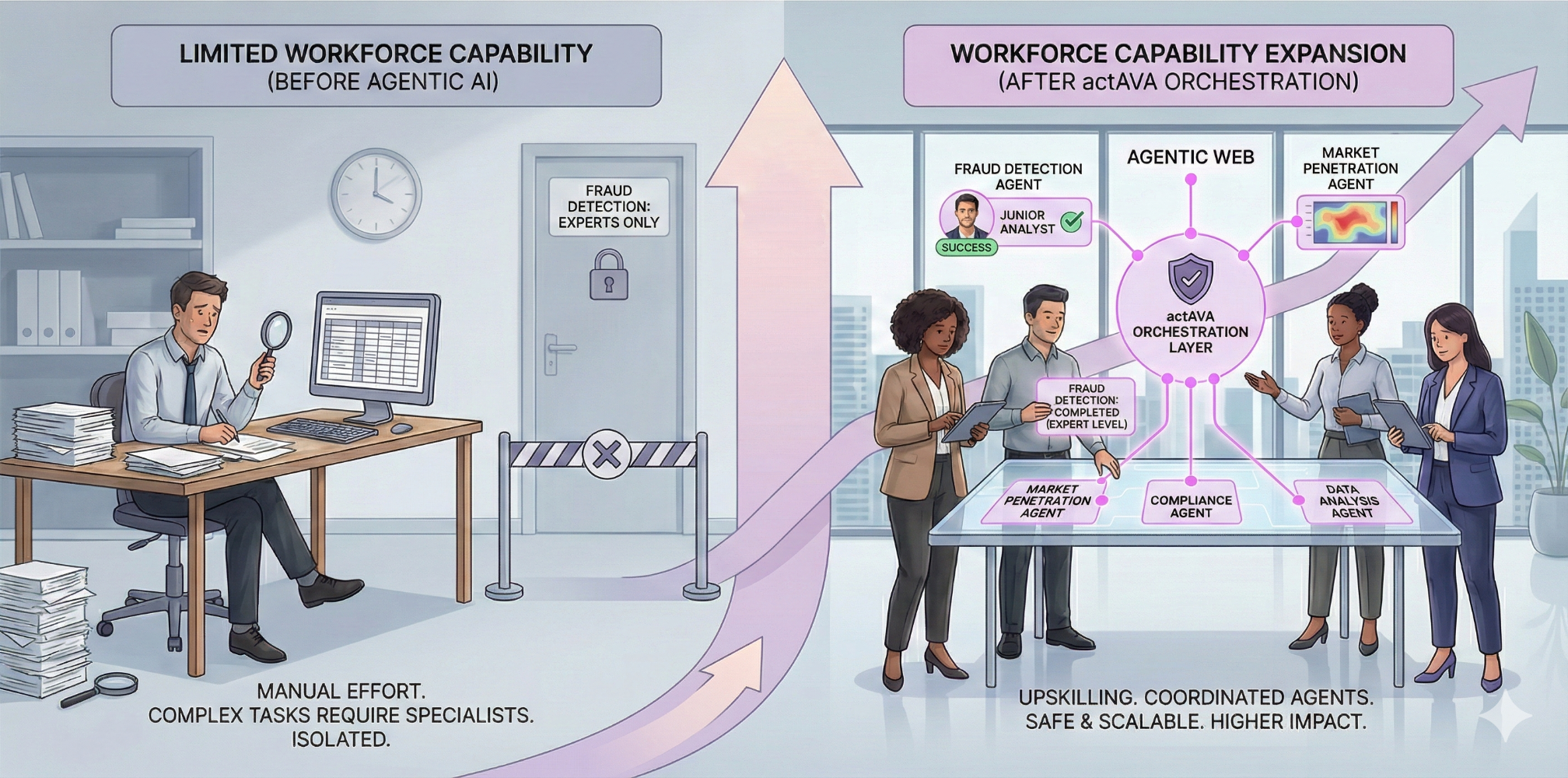
Finally, we emphasize Workforce Capability Expansion. This is the long-horizon value that redefines what teams can achieve. Agentic AI does not just automate. It augments and upskills.
With proper orchestration, a junior claims analyst performs fraud detection once reserved for forensic experts. A practice administrator conducts sophisticated market penetration analysis without external consultants. This aligns with the “Agentic Web” vision in emerging research. Coordinated agents tackle multi-step processes safely and scalably. At Actava.ai, our platform provides the governance layer that ensures this expansion is compliant and reliable. It enables existing workforces to deliver significantly greater impact.
Crossing the Divide: From Measurement to Meaningful Adoption
The MIT report notes that the successful 5% treat AI as a capability to cultivate. They use integration, learning loops, and contextual refinement. They do not treat it as plug-and-play software. In healthcare, we cannot afford to languish on the wrong side of the GenAI Divide. We cannot deny patients and providers access to transformative tools. We also cannot cling to yardsticks designed for incremental software.
By prioritizing Efficiency, Quality, Satisfaction, and Capability, we build toward a healthcare system that is more productive, safer, more humane, and more sustainable. That is how we bridge the divide. It happens one orchestrated workflow, one empowered clinician, and one better patient outcome at a time.
That is the Actava.ai way.
Sources:
The GenAI Divide: State of AI in Business 2025 by MIT’s NANDA initiative

Written by
Steve Brown
Chief Customer Officer
Technology executive who transforms horizontal platforms into vertical industry solutions across global enterprise markets. Over 25 years, Steve has built high-performing pre-sales, solution engineering, and enablement teams in enterprise software. At Salesforce, he served as SVP of Global Solution Engineering for Industries, growing the team past 200 and achieving 200% revenue growth in FY22. At Actava.ai, he leads forward-deployed engineering, delivering agentic AI infrastructure that bridges business needs and technology. He scaled Vlocity's global solution engineering team from 10 to 120, helping drive Salesforce's $1.33B acquisition; he holds a B.Sc. in Computer Science from Western Ontario.