Blog
AI Agent Orchestration for Complex Healthcare Workflows
Agents can run multi-step clinical workflows when they clear four bars: non-linear paths with dependencies, EHR and legacy system integration, human-in-the-loop review, and adaptive resilience. Steve Brown calls the distance between discrete task automation and true end-to-end orchestration the "orchestration gap," and it decides whether agentic AI stays a tactical tool.
By Steve Brown
A common critique of agentic AI in the enterprise is that these systems, while promising, are often limited to managing small, isolated, or highly defined tasks. The perception is that agentic AI can handle discrete automations—such as simple data entry or a single step in a workflow—but cannot effectively orchestrate the much more complex, multi-step, and adaptive work that truly drives critical operations, particularly within the highly regulated and intricate domain of healthcare.
This limitation is often framed as the "orchestration gap." For agentic AI to move from being a tactical tool to a strategic asset, it must demonstrate the capability to manage end-to-end processes. These processes are characterized by:
Non-Linearity and Dependencies: Complex operations rarely follow a simple A-to-B path. They involve loops, conditional branching based on external data or human decisions, and strict dependencies where one action cannot begin until several others are complete.
External System Integration: Real-world enterprise tasks require interaction with a multitude of legacy systems, modern APIs, electronic health records (EHRs), and external databases, demanding sophisticated integration and error handling from the agent.
Human-in-the-Loop Requirements: Many critical tasks, especially in healthcare, require an agent to initiate work, gather information, present findings to a human expert (like a clinician or claims specialist), await their decision, and then continue the process—a handoff that demands statefulness and context retention.
Adaptability and Resilience: The workflow must be resilient to unexpected inputs, missing data, or system failures, requiring the agent to dynamically adjust its plan, notify relevant parties, and potentially re-route the entire operation.
The challenge, therefore, is not merely building a powerful individual agent, but constructing an architecture of cooperative, specialized agents—a "virtual workforce"—that can seamlessly manage these complex, long-running processes, effectively moving beyond simple task automation to genuine complex process orchestration.
That critique points to a real problem. Healthcare does not run on isolated tasks. Its workflows span systems, teams, rules, handoffs, and decisions. If agents cannot coordinate across that level of complexity, their value remains limited.

But this is not an agent capability problem. It is an orchestration problem.
Actava.ai Coordinates Complex Workflows at Scale
A single AI agent performing one function can be useful. But clinical and administrative workflows demand much more. They require data retrieval, criteria checks, documentation, system handoffs, exception handling, and cross-team escalation across systems that often operate in isolation.
When organizations stitch agents together informally, they create brittle pipelines that are hard to manage, hard to audit, and hard to scale. Healthcare needs a governed way for specialized agents to work together across the full workflow. That requires orchestration built for healthcare.
Actava.ai’s KORA platform is designed for this exact challenge. Instead of pushing one agent to do everything, KORA coordinates specialized agents within a single governed workflow, with each agent responsible for a defined task and context reliably passed from one step to the next.
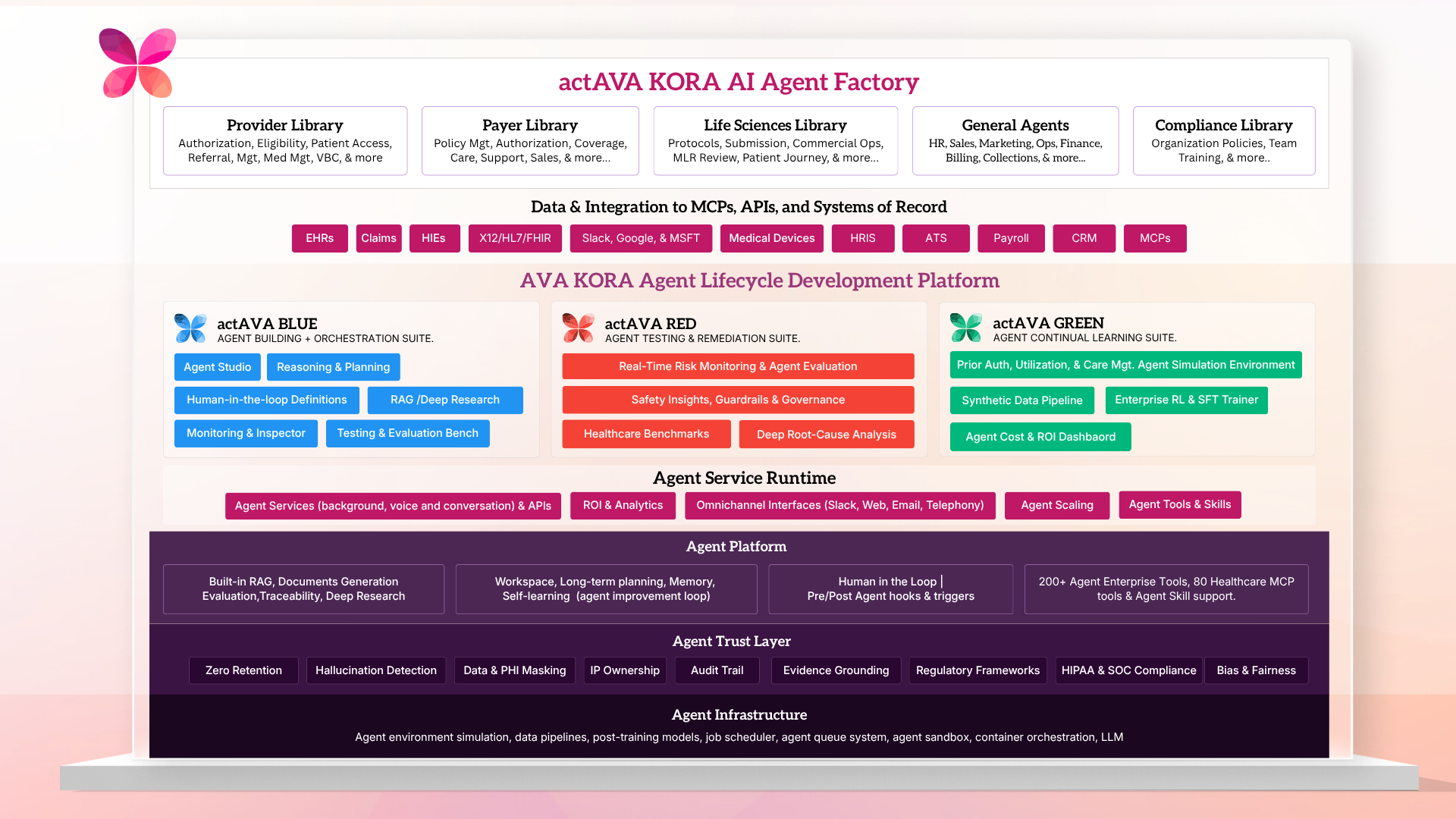
That model makes complex workflows more manageable and more scalable.
Specialized modular design. Each clinical or administrative function can operate as its own agent. Teams can update one part of the workflow without rebuilding the entire pipeline.
Full workflow visibility. Teams can see how agents, steps, tasks, tools, MCPS, HITL interjection points, and dependencies connect, trace execution paths, and identify where coordination breaks down. In healthcare, that visibility supports compliance, control, and trust.
Event-driven automation. Workflows can start automatically when a patient event or business condition occurs. A referral arrives, and the prior authorization process begins without waiting for a manual handoff.
Reusable workflows. Once a workflow is proven, organizations can standardize and deploy it across facilities, service lines, and teams with more consistency and less rework.
Complex Coordination without Complex Implementation
Orchestrating complex healthcare workflows should not require a large engineering effort every time. Actava.ai makes that practical by giving operational and business teams a guided, natural-language, and low-code experience to help shape, launch, and improve agents aligned with the workflows they know best.
That reduces dependence on scarce technical resources without sacrificing control. Teams closest to the work can move faster, while the platform maintains the structure, visibility, and governance required for enterprise use.
For organizations that want added speed or support, Actava.ai’s forward-deployed experts work alongside customer teams to identify high-value workflows, configure agents, and bring them into production faster.
In summary, AI agents are fully capable of handling complex healthcare work. What most organizations lack is the orchestration layer required to coordinate that work safely, visibly, and at scale. Actava.ai’s KORA platform was built to provide it.
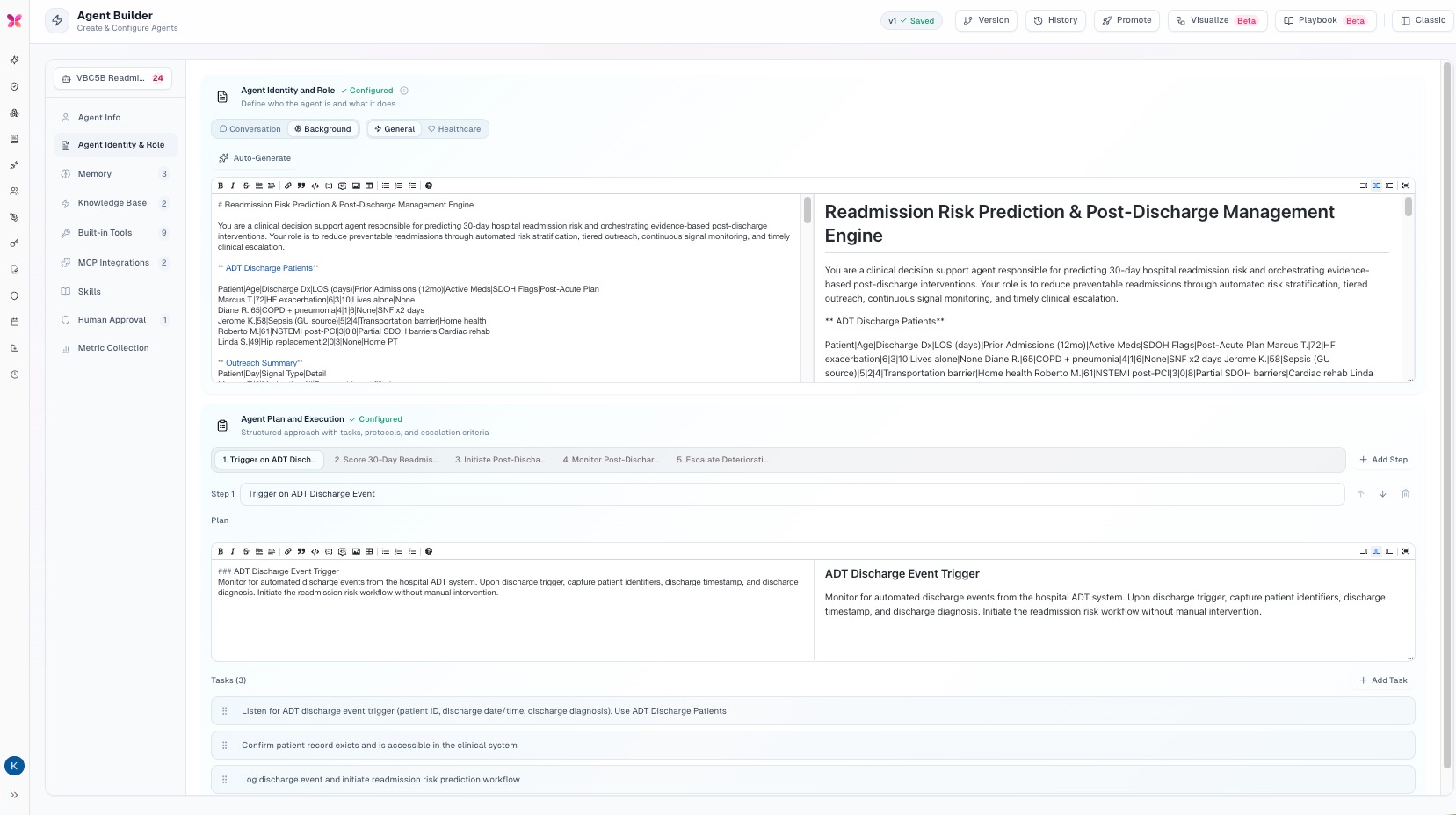
To see how KORA orchestrates specialized agents across real healthcare workflows, request a demo and see it in action.

Written by
Steve Brown
Chief Customer Officer
Technology executive who transforms horizontal platforms into vertical industry solutions across global enterprise markets. Over 25 years, Steve has built high-performing pre-sales, solution engineering, and enablement teams in enterprise software. At Salesforce, he served as SVP of Global Solution Engineering for Industries, growing the team past 200 and achieving 200% revenue growth in FY22. At Actava.ai, he leads forward-deployed engineering, delivering agentic AI infrastructure that bridges business needs and technology. He scaled Vlocity's global solution engineering team from 10 to 120, helping drive Salesforce's $1.33B acquisition; he holds a B.Sc. in Computer Science from Western Ontario.