Why running many models beats betting on one
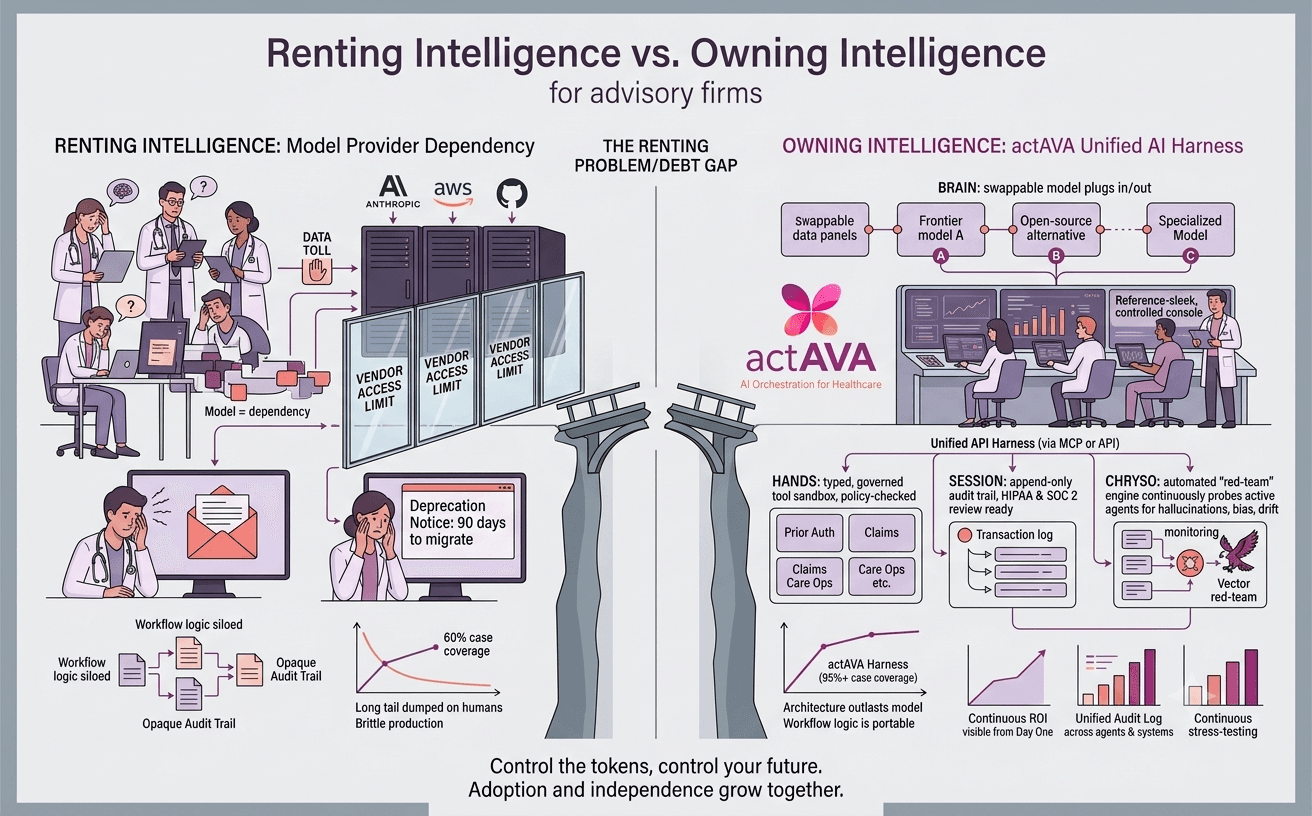
Pick a single model provider to run your whole healthcare AI stack, and you've made a quiet bet: that this lab, this model, this pricing, and this roadmap will stay ahead for years. That bet used to look safe. It doesn't anymore.
The ground under the frontier is moving fast. Open-weight models have stopped competing only on price and started reaching the frontier on capability, including sensitive work like cybersecurity. A recent CNBC segment put it plainly: companies like Coinbase, Airbnb, and Shopify have already shifted at least some of their workloads onto open-source models because they're good enough, and sometimes almost as good as the leading closed models out of the US.
When the model you bet the farm on can be matched by an alternative that's cheaper, faster, or hostable inside your own walls, lock-in stops being a convenience and starts being a liability.
The lock-in trap nobody plans for
Almost nobody chooses lock-in on purpose. It creeps in. You build your first agent on one provider's API. Your prompts get tuned to that model's quirks. Your evals assume its behavior. Six months later, switching means rewriting half your stack, so you don't, even when a clearly better option lands.
In most industries that's an annoyance. In healthcare it's a risk with teeth. A model provider can change pricing, deprecate the exact version you validated, ship a safety update that shifts behavior on clinical edge cases, or restrict access for reasons that have nothing to do with you. If your prior-auth agent and your patient-triage agent both depend on one provider, one upstream change can ripple through your whole operation at once.
There's a bigger version of this risk too. If a single ecosystem becomes the default for AI the way Android became the default mobile OS for much of the world, then whoever owns that default gets to set the standards, the defaults, and the rules of the stack everyone else builds on. Healthcare leaders should be wary of inheriting someone else's defaults for work this sensitive.
Don't give your agentic future away to a single model provider.
What "many models" actually buys you
Multi-model means matching each task to the model that genuinely fits it, and keeping the option to change your mind. Collecting provider logos is beside the point. Four concrete payoffs:
1. The right model for the actual job
Healthcare work isn't one workload. Summarizing a long clinical note rewards deep reasoning. Classifying an inbound message rewards speed and low cost. Drafting a prior-auth packet rewards accuracy and tight grounding. No single model wins all three. Route each step to the model that's strongest for it, and the whole pipeline gets better and cheaper at the same time.
2. Cost control with a scalpel instead of a hammer
Enterprises are already pulling back on AI spend, and most are doing it bluntly. SemiAnalysis recently documented a global travel-tech company with 800 engineers, spending just under $10M a year on AI, that switched its default model for every employee from Opus to Sonnet. A top-3 US aerospace and defense manufacturer went further and turned off Opus 4.8 entirely, calling it unnecessary.
Both moves cut the bill. Both are also hammers. When the only lever you have is flipping a model on or off for everyone, you either overpay on the tasks that don't need a frontier model or you starve the tasks that do. That's the cost of all-or-nothing control: you can't tune spend without taking capability away from someone.
Per-task routing hands you a scalpel. You keep the frontier model running and point it only at the steps that earn it, like clinical reasoning and medical-necessity calls. High-volume intake and classification ride a fast, low-cost model. Nobody loses access to the best model for the work that needs it. You just stop paying frontier rates for work a cheaper model does just as well. At healthcare volumes, that gap compounds fast.
3. Resilience when a provider has a bad day
Providers have outages, rate limits, and quiet quality regressions. If your agents can fail over to a second model, a single provider's bad day stops being your bad day. One point of failure becomes none.
4. Data sovereignty and compliance fit
Some workloads can ride a hosted API. Others need to run on-prem or in a private environment where PHI never leaves your control. Multi-model means you can match the deployment to the sensitivity of the data, instead of forcing every workload through the one door a single vendor offers.
How Actava.ai KORA makes this real
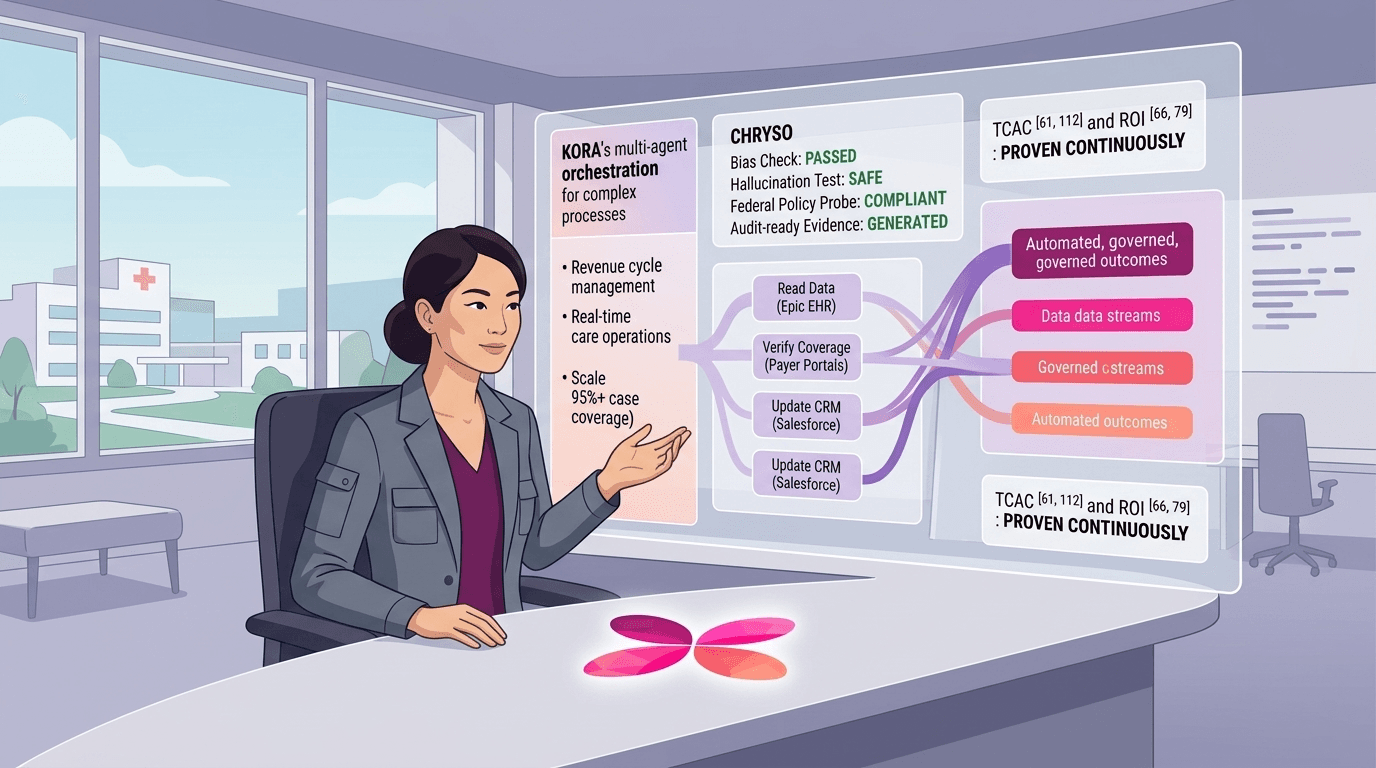
Choice only helps if it's safe to use. A pile of model options with no governance is just a bigger attack surface. KORA was built so that switching models is a setting, not a project, and so that every model runs inside the same guardrails.
When you build an agent in KORA BLUE, the model is one configurable part of the agent card, alongside its prompt, skills, memory, and tools. You can point a step at a frontier reasoning model today, swap it for a faster or lower-cost option tomorrow, and keep everything else exactly as it was. Your workflow doesn't care which lab the intelligence came from.
Because that choice sits behind one platform, governance doesn't fragment as you add models. KORA RED red-teams agents and screens for hallucination and bias regardless of the model underneath. CHRYSO enforces policies, audit trails, and HIPAA-aware safeguards on every request. KORA GREEN keeps improving agents in production. Swap the model, keep the governance.
Many models feed in. One governed pipeline comes out. Humans stay in the lead.
What this looks like on a real workflow
Take a prior-authorization workflow, the kind of high-volume, high-stakes process that wears teams down. A single-model build runs every step through the same engine and pays top rates for all of it. A KORA build splits the work:
- Intake and classification run on a fast, low-cost model. High volume, low complexity, no reason to overspend.
- Clinical reasoning and medical-necessity checks route to a frontier reasoning model, where accuracy matters most.
- PHI-sensitive steps run on a private or on-prem model so protected data stays inside your environment.
- Every step passes through the same guardrails, audit trail, and human-in-the-loop gates, no matter which model ran it.
The result is a pipeline that's cheaper to run, easier to defend in an audit, and free to adopt the next strong model the week it ships. When an open-weight model crosses the bar for one of those steps, you move that step over and leave the rest untouched.
The freedom to be wrong about the future
Here's the honest part: I don't know which lab will be ahead in 18 months. Neither do you, and neither does anyone selling you a single-provider roadmap. The frontier is trading hands too fast for confident bets.
So the goal is to build so that whichever lab wins doesn't matter to your operation. Multi-model on a governed platform gives you exactly that: the freedom to be wrong about the future and absorb it as a config change instead of a rebuild.
Your people have HR. Your agents have Actava.ai. And the best digital workforce, like the best human one, isn't loyal to a single source of talent. It hires the best available for each job, and keeps the door open for whoever's better next.