Blog
Keep the Baby and the Bathwater; Just add agentic Soap!
Rather than replacing legacy healthcare systems to fix rigid and broken workflows, organizations can introduce Agentic AI as a flexible, intelligent layer to seamlessly connect siloed platforms. By utilizing AI agents to handle the cross-system reasoning and execution traditionally managed by humans, healthcare providers can unlock new operational efficiency without discarding their existing data or software.
By Kevin Riley
There is a constant tension in healthcare IT. On one side, you have the massive Systems of Record — the Epics, Cerners, and Salesforce Health Clouds of the world. On the other hand, you need speed, flexibility, and automation across workflows that span far beyond any single system.
We have spent years watching the same pattern play out. Transformation consultants walk in and tell you the system is broken. They imply you need to toss the bathwater (your legacy workflows), and sometimes they inadvertently endanger the baby (your hard-won clinical and operational data) by suggesting massive overhauls.
But at Actava.ai, I see it differently. You don’t need to throw anything out. You just need a better cleaning agent. You need Agentic AI.
The Problem with "Rigid" Reality
Think about how healthcare organizations interact with software today. The pattern is archaic. A care coordinator opens the EHR to check patient status, switches to a payer portal to verify eligibility, logs into a separate credentialing system to confirm a provider is active, and then updates a referral tracker. That is one workflow. One person. Four systems.
For years, we tried to automate this with integration engines and iPaaS platforms — Workato, MuleSoft, Rhapsody. They are powerful, but they suffer from a specific flaw: rigidity. Every workflow must be deterministic. You define the flow, the edge cases, and the error handling. You build the bridge brick by brick. And when a payer changes their portal or a new compliance requirement drops, the whole thing breaks.
Humans: The "Connective Tissue"
Because software automation has been so rigid, humans have remained the connective tissue between systems.
Your average healthcare operations workday proves it. You are the API. You grab patient data from System A, context-switch to System B to verify insurance, then update System C with the outcome. You hold the institutional logic in your head — when a prior authorization is actually needed, which payer requires which form, which provider is credentialed at which facility.

Healthcare SaaS systems work great in their own domains. Epic owns the clinical record. Salesforce Health Cloud owns engagement. Availity owns payer connectivity. But the moment a workflow crosses those domain boundaries, the product stops. It hits a wall. That is where humans have always stepped in.
Until now.
Enter the Agentic "Soap"
This is where Agentic AI changes the game.
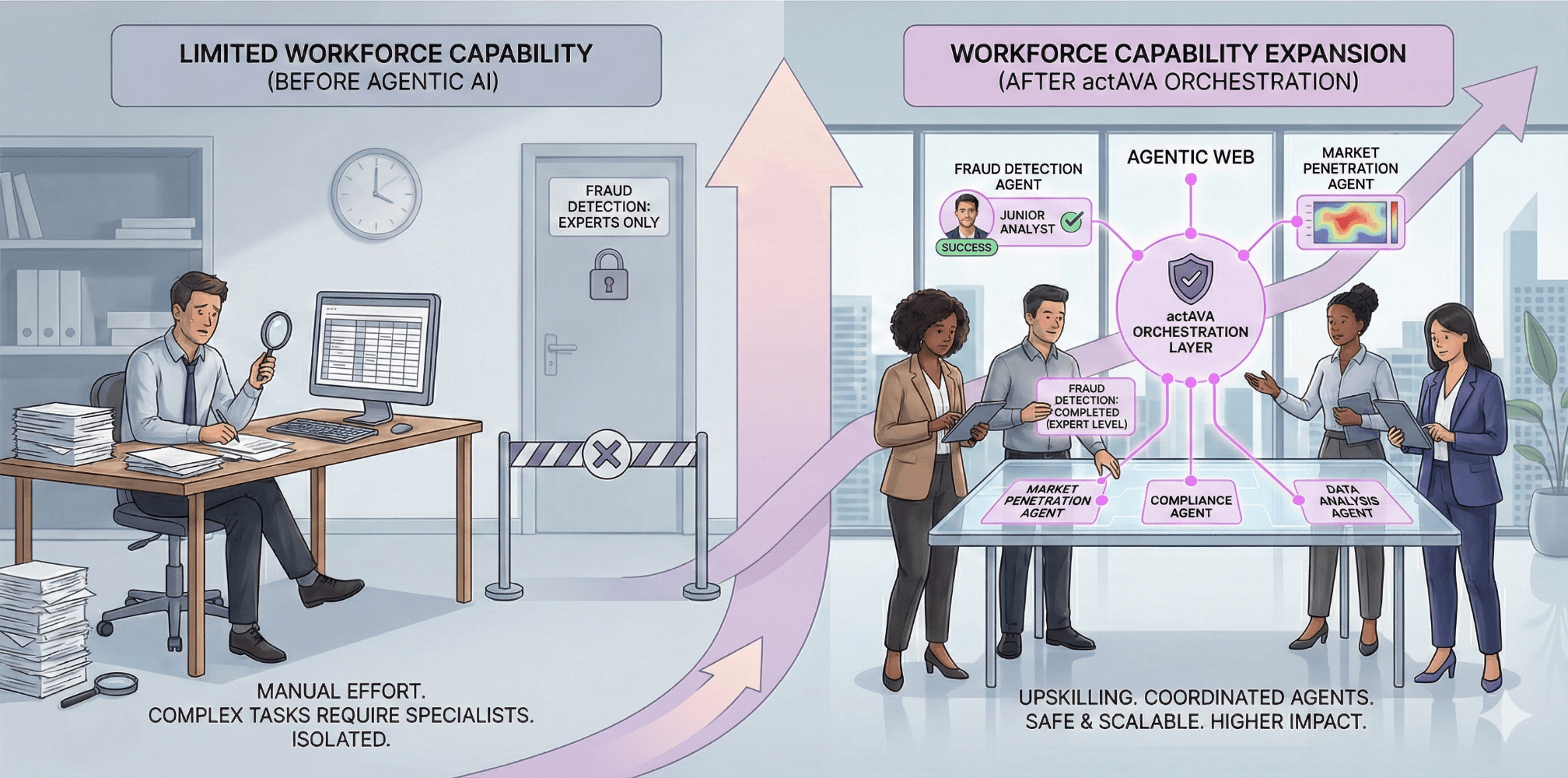
AI Agents are not just better automation. They are a new layer that sits on top of your existing stack. Unlike rigid integration workflows, Agents can retrieve context from the EHR, apply reasoning—the logic previously trapped in a coordinator's head—and execute actions across payer systems, credentialing platforms, and scheduling tools.
The "Soap" is the fluid intelligence that “cleans up” friction between siloed healthcare applications. Agents don't care about domain boundaries. They don't care that Epic, Salesforce, and Availity don't natively talk to each other well. Agents become the new connective tissue, working 24/7 without burning out.
The "Dumb CRUD Database" Dilemma
A big question looms for legacy SaaS vendors: why can't they just build this AI layer themselves?
The answer is architectural. System of Record A struggles to build a product that works seamlessly inside System of Record B. They are incentivized to keep you in their walled garden. They lack the access and the DNA to build experiences that span beyond their domain.
Satya Nadella put it plainly when he said SaaS applications are essentially CRUD databases with business logic, and that in the agent era, the business logic will migrate to AI agents that operate across multiple backends without discriminating between them. The intelligence moves to the AI tier.
If the primary user of healthcare software shifts from a human clicking through screens to an AI Agent executing workflows — and I believe it will — then the interface changes entirely. Agents will be the ones creating value, coordinating care, and driving operational efficiency across systems. The legacy platforms become what they always were underneath: stores of information.
AI becomes the UI - in a matter of speaking.
The New Layer
So keep the baby — your data. Keep the bathwater — your existing systems of record. You don't need to rip and replace your EHR, CRM, or credentialing system to achieve modern efficiency.
You need to introduce the agentic layer — the soap — that works between the cracks, creating intelligent workflows that cross the boundaries your current systems cannot. That is what we are building at Actava.ai. We are not replacing the system. We are liberating the value trapped inside it.
Learn more at Actava.ai

Written by
Kevin Riley
CEO & Co-Founder
Health-tech executive who builds and scales AI-driven software across healthcare, life sciences, and enterprise markets. Over 25 years launching and scaling solutions for healthcare and life sciences, Kevin led the healthcare and government business at Vlocity (acquired by Salesforce), growing it from $300K to more than $40M, and later served as GM of Salesforce's global Health & Life Sciences portfolio, a $4.5B business. He has also served as CEO of multiple software companies spanning AI, care management, regulatory science, and provider revenue. He created the award-winning modelH framework and was named a Top Healthcare Software Executive.