Blog
Meet Deon Metelski
We sat down with Deon Metelski, Chief Product Officer at Actava.ai, to discuss how agents are fundamentally different from the apps clinicians use today, why safety matters more than polish, and what he sees coming for healthcare AI in 2026.
Meet Deon Metelski, Chief Product Officer of Actava.ai
As Chief Product Officer at Actava.ai, he leads our effort to build the AI factory for healthcare. He is passionate about solving complex healthcare challenges through digital innovation, helping organizations streamline workflows and deliver more personalized, data-driven patient outcomes. Deon spends his time solving a deceptively simple problem: how do you build AI agents that actually work in healthcare instead of breaking under real-world pressure?
We sat down with him to talk about how agents are fundamentally different from the apps clinicians use today, why safety matters more than polish, and what he sees coming for healthcare AI in 2026.
How are agents different from the apps healthcare and life sciences use today?
Today's healthcare apps are tools that require humans to drive the workflow—users sit at the center, making decisions, executing tasks, and navigating between systems. An agent is different because it can perceive its environment, reason about what's needed in context, take action, and adapt based on outcomes.
In healthcare specifically, this matters enormously. Instead of a nurse manually checking five different systems to gather data before making a medication adjustment decision, an agent can autonomously integrate that data, flag relevant context, and present a curated, actionable summary. The app is static; the agent is dynamic and responsive to actual workflow needs as they emerge.
The real difference, though, is that agents can handle the complexity of healthcare's fragmented systems architecture without requiring humans to be the glue layer. That's a fundamental shift from how healthcare IT has worked for the last 20 years.
Why do you feel that a great agent can make up for an average app?
A great agent can take an average app and dramatically improve its utility by doing cognitive work—understanding context, anticipating needs, and reducing friction. If the agent is well-trained and genuinely understands the workflow, the UI becomes almost irrelevant because the user isn't wrestling with the interface; they're working with an intelligent partner.
Conversely, you can have a beautiful, well-designed app built with sound UX principles, but if there's no intelligence behind it, users still have to do all the heavy cognitive lifting. They still have to know what data matters, how to find it, and how to interpret it.
In healthcare, clinicians are already cognitively overloaded. A great agent absorbs that cognitive load. It addresses the "finding the right information at the right time" problem, which is where most healthcare app failures originate—not because the UI is bad, but because the tools don't meet people where they are in their workflow.
How do you work with your customers to drive their needs back into your roadmap?
We lead with listening, not assumptions. Before we build anything, we embed ourselves in the customer's actual workflows—not a demo environment, not a scripted process, but real work in real environments. We watch where the friction points actually are versus where people think they are.
Then we come back with what we think we heard and ask them to identify any gaps. We pressure-test our assumptions together. And when we build something, they're in it early—not when it's done, but when it's still being shaped.
The other part is being honest about why we say yes or no to things. If we're deprioritizing something, we explain it. Is it because it doesn't fit our vision? Or because we're solving that problem in a different way that'll help more customers? That transparency matters.
And we implement feedback loops. We don't just collect needs and disappear. We close the loop and show customers how their input shaped what shipped.
Bonus Round: What is your prediction for the biggest AI trend impacting your customers in 2026?
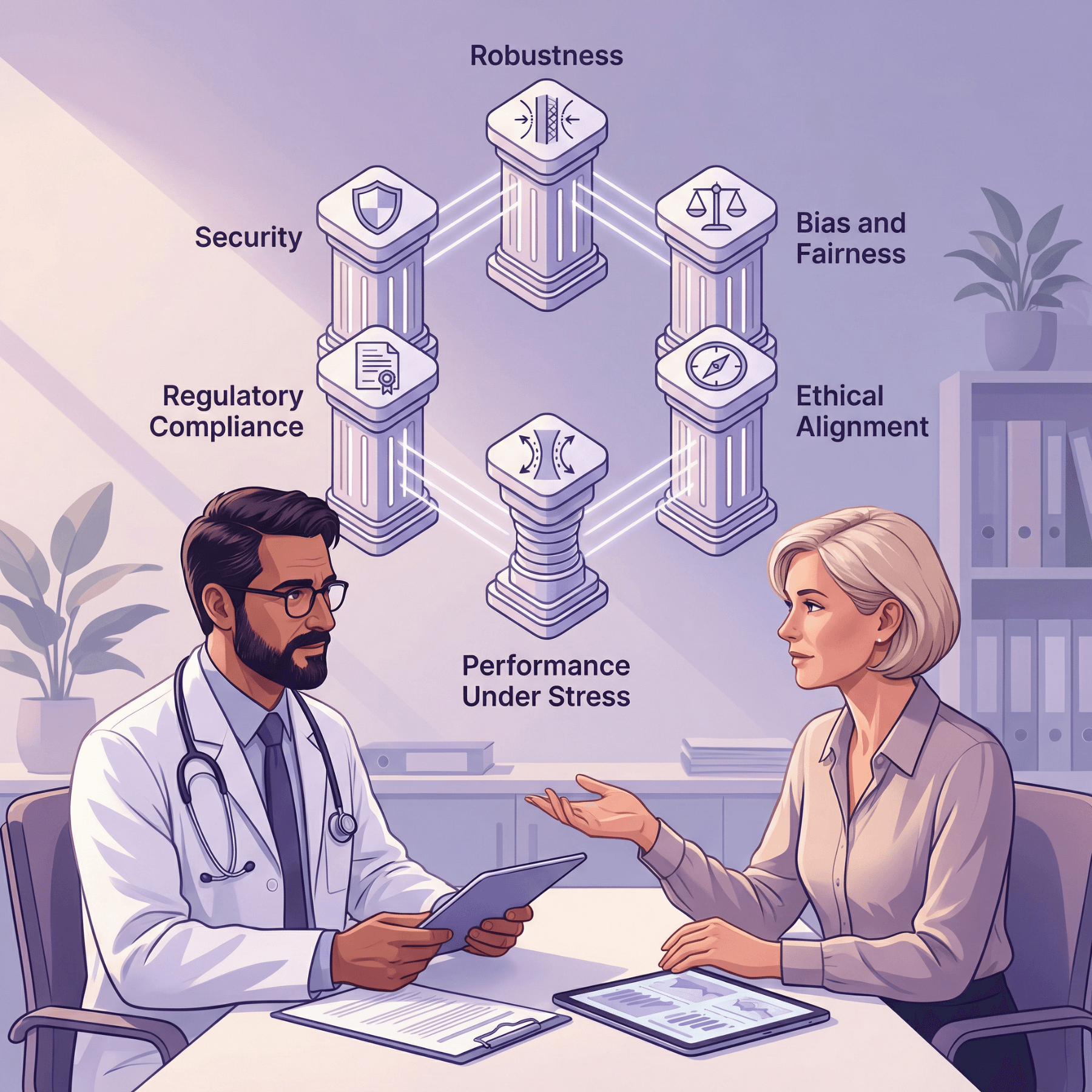
Safety and compliance will become the actual battleground for competition rather than just a checkbox.
Right now, healthcare organizations are still asking, "Can we trust AI at all?" By next year, that question will be answered, and the focus shifts to "whose AI can we trust more?" That's when fairness, bias, and explainability—along with safety and accuracy evaluations—become what actually win deals. It's not a feature anymore. It's the feature.
The companies that built safety into their DNA from day one will win. Those who bolted it on later will be playing catch-up.
The other thing: healthcare buyers will demand standardized proof that your AI is safe and fair. Think of it like how they audit your security or your compliance program. That's coming for AI. The organizations that can prove it will have a real advantage.
Thanks for your time today, Deon, and your passion for using AI to unlock better healthcare.
Visit us at https://actava.ai/ to learn more.
Meet Weiran: View LinkedIn Profile