Blog
Meet Kevin Riley
We took this Friday to interview Kevin about how Actava.ai’s brand of AI is changing the game for healthcare and life sciences companies, helping them realistically own their AI destinies.
Meet Kevin Riley, CEO and co-founder of Actava.ai
Kevin is a veteran health-tech executive who led Salesforce's global Health & Life Sciences portfolio and served as CEO of several successful software companies in AI, care management (Zyter), regulatory science (Aetion), and provider services (Tendo). He created the award-winning modelH framework and was named a 2024 Top Healthcare Software Executive.
We took this Friday to interview Kevin about how Actava.ai’s brand of AI is changing the game for healthcare and life sciences companies, helping them realistically own their AI destinies.
When you say “own your AI destiny”, what exactly do you mean?
Essentially, it is a call for healthcare and life sciences organizations to be the architects of their own AI strategy rather than passive consumers of outsourced point solutions. I am not advocating they build their own AI platform - that would be a poor use of time and capital.
I am saying that it is feasible to use an outsourced agent-building platform that enables them to more easily adapt to new AI innovations and replace models as technology evolves, without being locked into a single vendor's ecosystem.
Healthcare organizations face a choice: stitch together a growing number of point solutions or go the "DIY" route. We feel the DIY route is the better solution, which is why we built Actava.ai.
This approach is ultimately about future-proofing. In a field where "state-of-the-art" has a shelf life of about six months, being tethered to a static point solution is a fast track to technical debt. By owning the orchestration layer, you gain the model agility to swap out underlying LLMs as they become faster, cheaper, or more clinically accurate. You aren’t just buying a tool; you’re building a capability. This ensures that as the AI landscape shifts, your organization remains nimble enough to integrate best-in-class innovations without having to "rip and replace" your entire operational framework.
Furthermore, owning your destiny ensures that AI serves as a bespoke extension of your clinical, scientific, or business expertise rather than a generic "black box" imposed upon it. It allows your medical and research leaders to define the guardrails, logic, and workflows that reflect your institution’s unique patient populations and internal protocols. When you control the "intellectual blueprint" of the agent, the AI becomes a high-leverage collaborator that understands your specific nuances. It transforms a standard technology purchase into a strategic asset that scales your institutional wisdom across every touchpoint of the patient journey.
Why does Actava.ai’s platform approach better than a point solution?
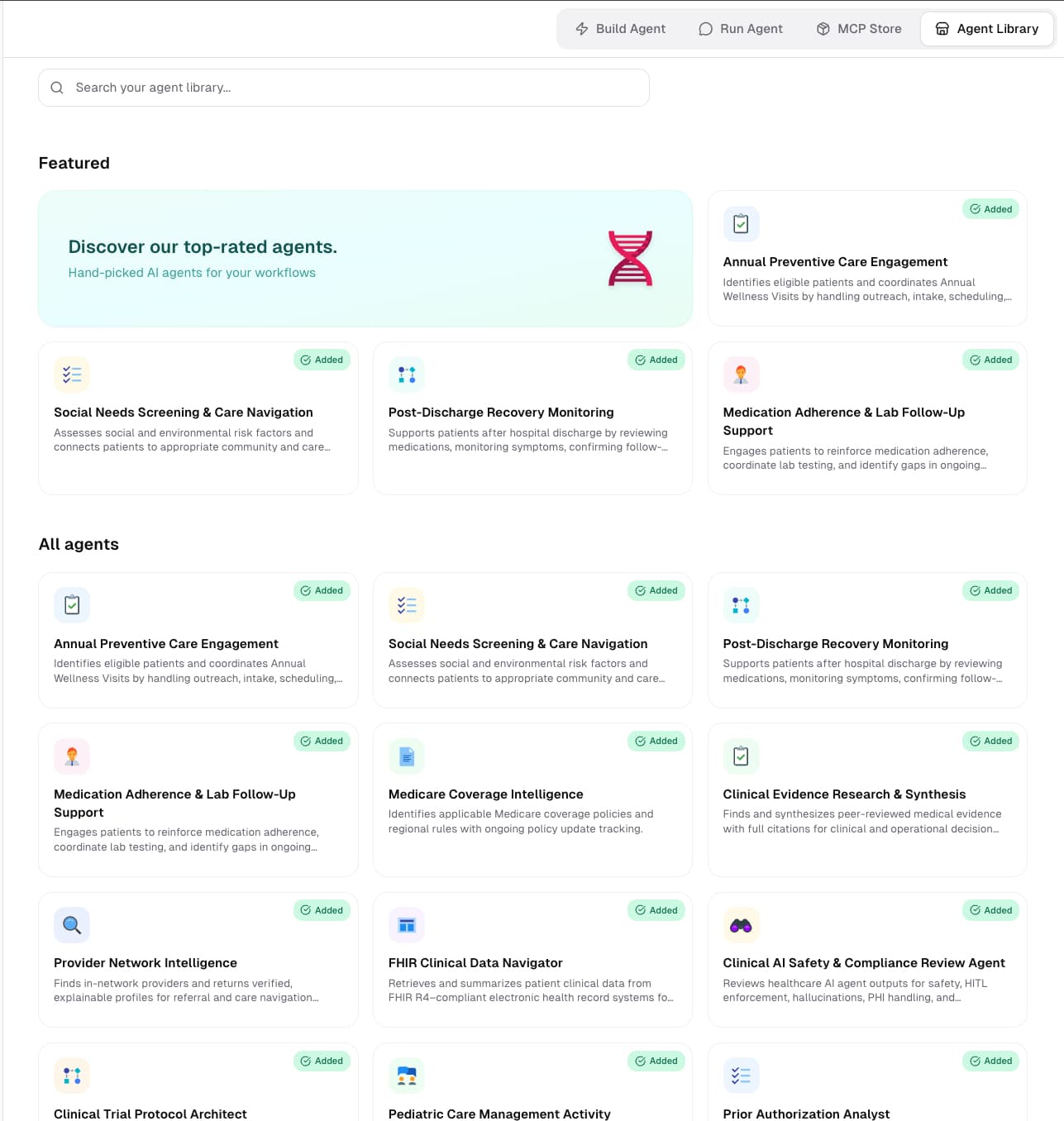
The proof is in the Library. There are quite a few “AI vendors” in this space that started as platforms and realized their tools were not easy to use for their own teams, let alone for business users. This reality has led them to change their strategy and focus on a single problem space, such as prior authorization, revenue cycle management, and similar areas. If they were a good platform, why did they have to pick a lane?
Our KORA platform provides everything needed to coordinate multiple AI agents across your existing apps and workflows - from creation BLUE to governance RED to continuous improvement GREEN. This is why we give our customers access to our entire library and have dedicated forward AI engineers focused solely on building new agents, tools, prompts, and MCP servers. Our customers take the baseline and link it to their own way of doing things. Our KORA platform bends our library agents to meet our customers' way of working - not the other way around.
We believe an agent is an agent is an agent; they differ only by the business that uses them. If you go with one of the point solutions I mentioned above, you are just buying into the same old rip-and-replace model - throwing out your old SaaS app for a new one with rigid “agents” as part of the feature set.
You don't have to do this.
Bonus Round: What is your prediction for the biggest AI trend impacting your customers in 2026?
More and more healthcare companies are publicly stating they will own their own agentic futures. We are approaching the "point solution plateau." After years of pilot programs with niche AI vendors, major players are pivoting toward Enterprise Agentic AI—building proprietary internal platforms to orchestrate their own autonomous agents rather than buying fragmented, single-use tools.
Payers
UnitedHealth Group: UHG has publicly shifted its focus to its proprietary "United AI Studio," a secure internal platform for building and managing its own AI applications. They currently manage over 1,000 internal AI use cases. UHG executives expect autonomous agents to handle more than half of customer interactions by late 2025, as the company moves away from third-party call center software.
Oscar Health: Instead of licensing a generic member portal, Oscar built "Oswell," a proprietary AI agent platform. It serves as an autonomous layer for both members (interpreting test results) and providers (surfacing insights from patient data). Oscar’s leadership emphasizes that their "full-stack" tech approach enables them to build these agents in-house rather than buy off-the-shelf.
Humana: While Humana partners with Google Cloud for infrastructure, it has built a custom Agentic AI tool for their member advocates. This internal system autonomously guides employees through complex benefit structures and summarizes calls in real-time, replacing the need for multiple disparate "point" documentation tools.
Providers
Kaiser Permanente: Launched the Intelligent Navigator (KPIN), a proprietary AI-driven platform. Rather than using a third-party symptom checker, KPIN uses its own NLP to guide 4.9 million patients through care pathways. Kaiser has publicly emphasized a "return on health" strategy that favors internally developed, integrated tools over siloed vendor products.
Mayo Clinic: Through its "Mayo Clinic Platform," the organization has moved beyond being a consumer to becoming a developer. They have publicly stated that their goal is to use their massive datasets to build "foundational models" for healthcare, effectively creating their own suite of agents for clinical trial matching and remote monitoring, rather than relying on startups.
Cleveland Clinic: They have publicly spoken about their piloted internal agentic workflows that ingest data directly from wearables into their Epic systems, specifically stating a move away from "siloed dashboards" provided by niche vendors.
Pharmaceutical Companies
Moderna: They have been vocal about their "AI Academy" and its goal to integrate AI agents across every department. They have built internal agents to draft complex regulatory documents and synthesize cross-functional data (Legal, Manufacturing, and Commercial). Their strategy is to build a "workforce of code" rather than buying point solutions for each department.
Johnson & Johnson (J&J): They are publicly moving toward Autonomous Drug Discovery through an internal agentic system that decides the timing of chemical synthesis steps (e.g., solvent switches) without human intervention, replacing the manual, iterative software of the past.
Pfizer: Under its "Purpose Blueprint," Pfizer has stated it intends to "Lead the industry in AI." This push includes the internal development of AI agents to predict patient enrollment rates in clinical trials and optimize global vaccine supply chains, emphasizing a shift toward proprietary development platforms.
Thanks for your time today, Kevin, and for painting a picture of what it means to really be in charge of your agentic AI future.
Visit us at https://actava.ai/ to learn more.
Meet Weiran: View LinkedIn Profile
More from the blog
View all posts Blog
BlogBeyond the Note: Why Health Systems Need an Orchestration Layer Above Ambient Scribes
 Blog
BlogOwn your own AI destiny with Actava.ai’s AI factory and Claude for Healthcare & Lifesciences
 Blog
Blog