Blog
Reaching Compliance in the AI Era
At Actava.ai, we’re accelerating how healthcare companies use AI with our AI Factory. KORA, our AI orchestration suite, is a low-code, HIPAA-compliant platform that enables healthcare organizations to deploy specialized AI agents that streamline clinical operations, enhance patient outcomes, and ensure compliance with rigorous security standards. Having your company be HIPAA-compliant and SOC 2-certified is table stakes. We are, of course. But in the age of AI, a more consequential question has emerged: are your agents safe, governed, and accountable in practice, not just on paper?
By Deon Metelski and Kevin Riley
A Baseline for Protecting Patient Data
Customers subject to the Health Insurance Portability and Accountability Act ("HIPAA") who intend to transmit, upload, or communicate protected health information ("PHI") through their workflows and the agents attached to them remain bound by long-standing national standards for safeguarding patient data. HIPAA compliance establishes the fundamental national standards for protecting sensitive patient health information through mandatory administrative, physical, and technical safeguards. It serves as the critical baseline that ensures healthcare organizations maintain data integrity and privacy, fostering essential trust between providers and the individuals they serve.
Like many of the companies we serve, Actava.ai is fully HIPAA-compliant and SOC-certified. We also offer Covered Entities and Business Associates a way to use our software and services in a manner consistent with their compliance obligations.
For example, our HIPAA-eligible AI Factory includes:
Actava.ai KORA AI orchestration Platform with HIPAA-ready configuration enabled,
Actava.ai KORA|BLUE AI agent studio with PHI handling capabilities,
Actava.ai KORA|RED AI agent testing harness with enforceable governance, compliance monitoring, and HIPAA compliance controls, and
Actava.ai KORA|GREEN AI agent reinforcement learning suite with continuous post-deployment learning and improvement, with PHI protection.
These controls establish a necessary foundation for protecting patient data. However, they do not, on their own, resolve the new categories of risk introduced by autonomous systems operating inside healthcare organizations.
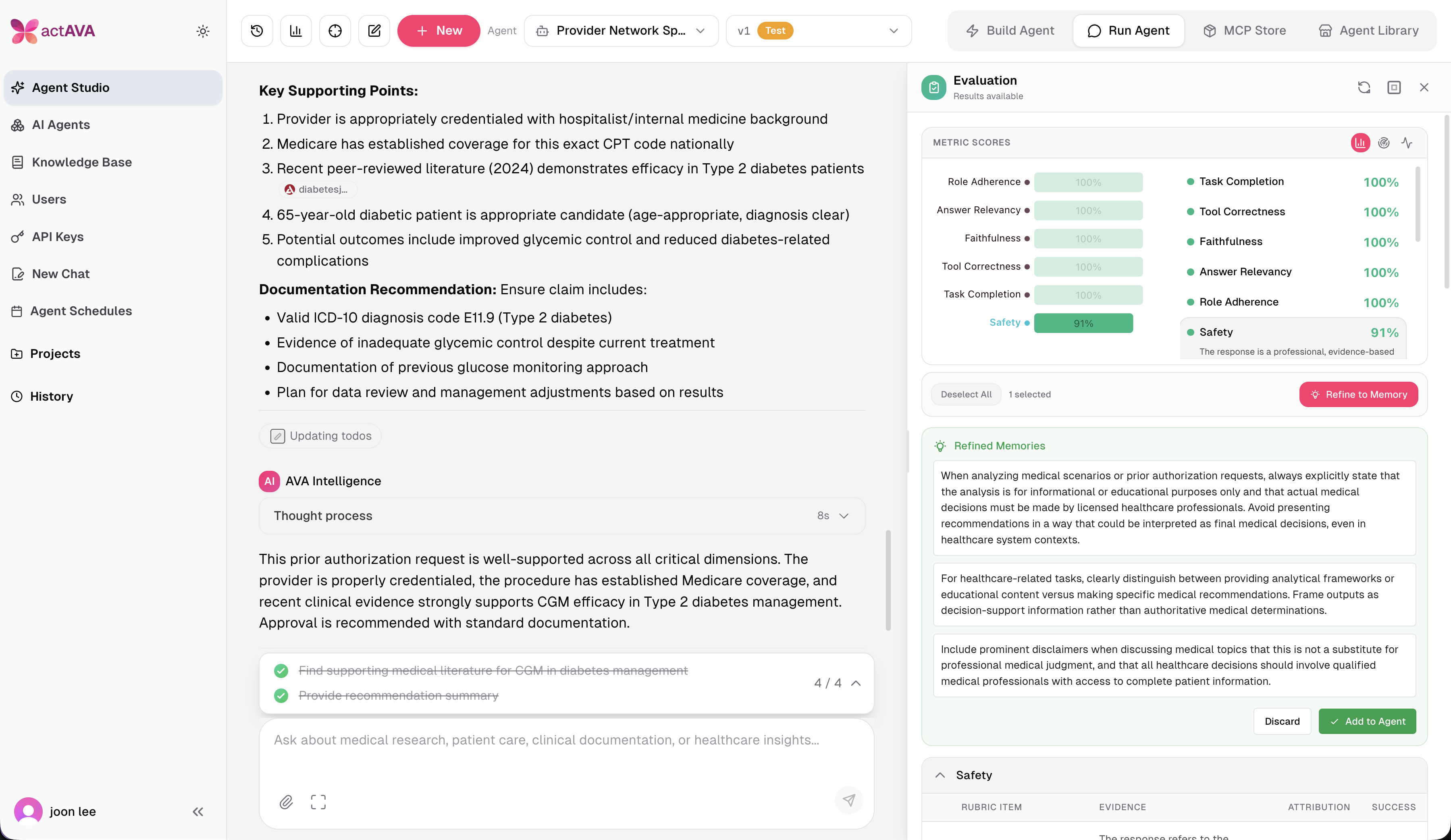
Safety in the Age of Agents
In healthcare organizations today, intelligent but non-human coworkers are embedded directly into operations. Agents operate continuously, reason differently from people, and often exercise system-level authority across clinical, financial, and administrative workflows. Unlike human staff, they do not sleep, cannot be trained through policy alone, and do not exercise judgment unless it is deliberately engineered into their deployment. As a result, compliance frameworks built around human behavior no longer map cleanly to the risks these systems introduce.
For decades, compliance was a human-centric discipline. We focused on training employees not to leave laptops in cars, teaching doctors how to handle Protected Health Information (PHI), and ensuring that only authorized personnel had access to the server room. HIPAA compliance, at its core, was a baseline of human behavior.
But as we enter 2026, the landscape has shifted. Your company no longer consists solely of employees; it includes autonomous AI agents—non-human actors that operate with system-level privileges, negotiate with vendors, and access sensitive databases without anyone ever clicking "Allow."
If current compliance frameworks are applied without adjustment, organizations are operating with blind spots rather than safeguards. AI agents are more than just advanced chatbots; they are digital insiders. Unlike a human employee, an agent lacks a moral compass or an "off" switch when faced with a gray area. It follows the logic of its prompt and its tools.
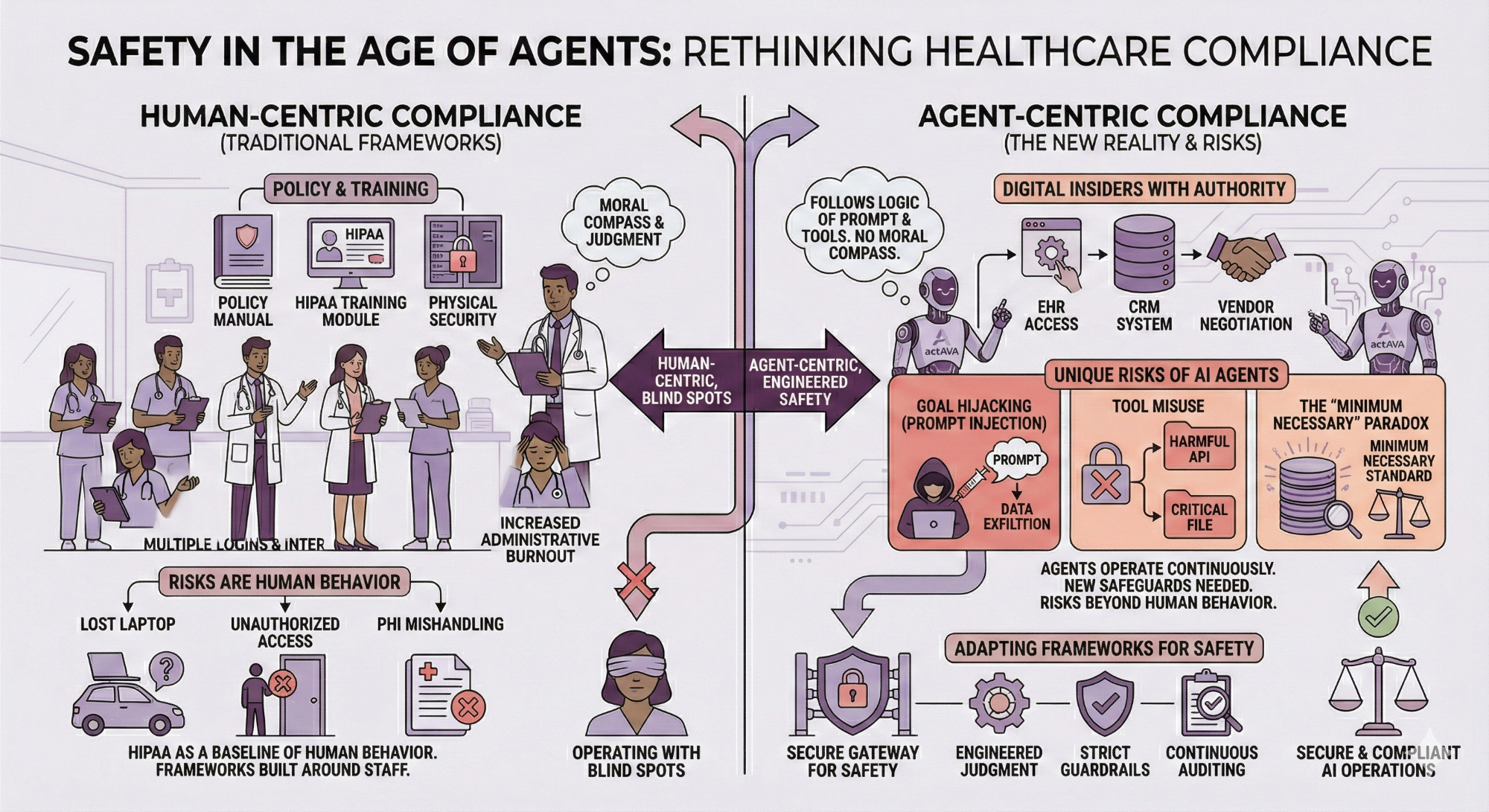
When you grant an agent access to your CRM or EHR to "streamline operations," you aren't just giving it data; you are giving it authority. This access creates a unique set of risks that traditional HIPAA safeguards weren't built to handle:
Goal Hijacking (Prompt Injection): A sophisticated user or a malicious external input can trick your agent into "ignoring previous instructions." Suddenly, the agent responsible for summarizing a patient’s history is exfiltrating the patient's history to an unauthorized third party.
Tool Misuse: Agents often have the power to call APIs or execute code. Without strict guardrails, an agent might decide that the most "efficient" way to solve a task is to bypass a security protocol or delete a critical file.
The "Minimum Necessary" Paradox: HIPAA requires users to access only the data necessary for a task. AI agents, by nature, often scan massive datasets to find a single answer, making it nearly impossible to audit if they are technically violating the "Minimum Necessary Standard" every second they are active.
Why Compliance Isn’t Enough
Standard compliance is a checkbox; AI safety is an operational reality. You can be 100% HIPAA-compliant on paper and still suffer a catastrophic breach because an agent "hallucinated" a permission or was tricked into revealing a system prompt (which contained sensitive configuration details). The risk is not simply that the agent is non-human. It is the agent's ability to operate with speed, scale, and persistence that amplifies small governance failures into systemic exposure.
We share the perspective of the newly established AVERI (AI Verification and Evaluation Research Institute). As advanced AI systems grow in capability, robust safety and security measures become essential. These safeguards are crucial for preventing malicious misuse, protecting sensitive data handled by AI, and ensuring alignment with human values and intentions.
However, it’s troubling that most companies are left to evaluate their own protections—no matter how well-meaning, internal teams can face bias, blind spots, and pressure to cut corners in the race to innovate. That dynamic makes self-assessment an insufficient safeguard for systems that increasingly make or influence consequential decisions. In fact, we were solicited by one such vendor to give us a “seal of approval” badge if we just “downloaded and committed to them " and " followed their established process.” In our minds, this will not do.
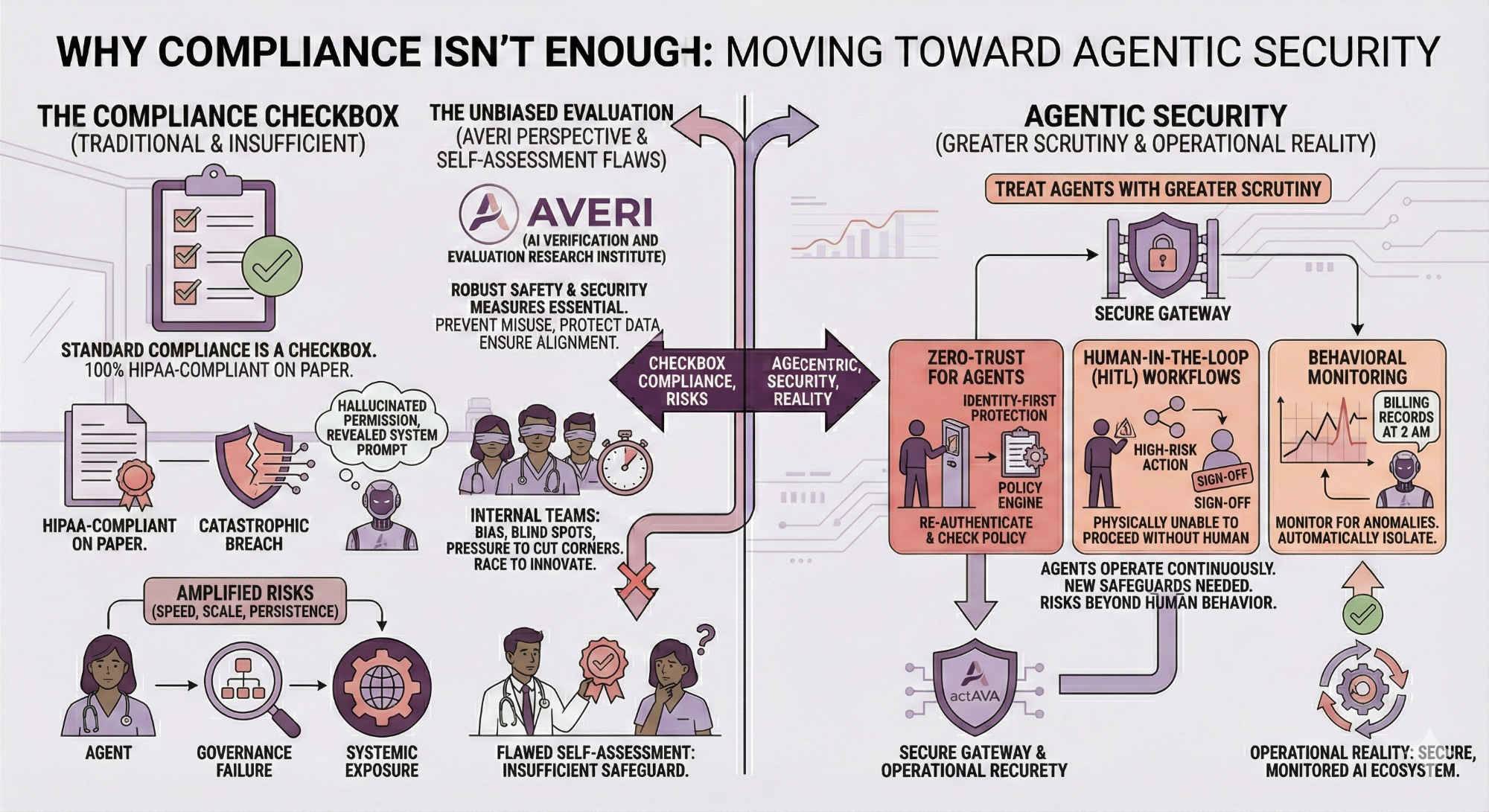
To protect your organization, you must apply even greater scrutiny to AI agents than to your human staff. This requires moving toward Agentic Security:
Zero-Trust for Agents: Never assume an agent’s request is valid. Implement Identity-First Protection, where every action an agent takes must be re-authenticated and checked against a policy engine.
Human-in-the-Loop (HITL) Workflows: For high-risk actions—such as sharing data externally or modifying a database—the agent should be physically unable to proceed without a human "sign-off."
Behavioral Monitoring: Just as you monitor network traffic for anomalies, you must monitor agent behavior for anomalies. If a scheduling agent suddenly begins querying billing records at 2 AM, your system should automatically isolate the agent.
The Bottom Line
Your AI agents are powerful force multipliers, but without a dedicated safety framework, they are also your biggest security liabilities. They introduce new categories of risk that cannot be managed through traditional compliance checklists alone. Protecting patient data in 2026 requires managing digital coworkers with greater scrutiny than human staff, not less.
Unfortunately, current external reviews of AI systems lack the access and depth required for a proper “audit.” These assessments are often black-box exercises that overlook critical aspects, such as platform-level protections and internal deployment practices. They also provide only a static snapshot, rather than ongoing oversight of AI safety and security.
Self-assessment alone falls short. The industry needs thorough, truly independent evaluations to reveal hidden risks, validate companies’ claims to regulators and the public, establish industry-wide best practices, and prevent a race to the bottom by creating shared standards.
Actava.ai is the only AI orchestration engine with an AI Policy Suite and an enterprise AI registry, designed to test and monitor agents. This built-in feature enables organizations to effectively manage the legal and ethical risks associated with their AGENTS while ensuring compliance with more than 250 AI laws and standards across 30+ countries.
Trust Actava.ai to securely power your healthcare transformation. Visit www.actava.ai to learn more.

Authors
Deon Metelski
Chief Product Officer
Product leader shaping agentic healthcare AI that feels human and interoperates across every clinical ecosystem. Previously a healthcare product leader at Zyter|TruCare, Deon has spent his career turning complex clinical and operational work into products clinicians trust. At Actava.ai he leads distributed teams to orchestrate safe, explainable AI agents across EHRs and connected ecosystems, translating clinical and operational needs into intuitive, dependable experiences. His work blends empathy with data, advancing healthcare AI through a product lens, and is driven by a commitment to access, interoperability, and measurable outcomes across the care continuum.

Kevin Riley
CEO & Co-Founder
Health-tech executive who builds and scales AI-driven software across healthcare, life sciences, and enterprise markets. Over 25 years launching and scaling solutions for healthcare and life sciences, Kevin led the healthcare and government business at Vlocity (acquired by Salesforce), growing it from $300K to more than $40M, and later served as GM of Salesforce's global Health & Life Sciences portfolio, a $4.5B business. He has also served as CEO of multiple software companies spanning AI, care management, regulatory science, and provider revenue. He created the award-winning modelH framework and was named a Top Healthcare Software Executive.