Blog
The Healthcare AI DIY Trap - Why Building Your Own Agent Infrastructure is a Mistake
The healthcare industry is at a crossroads with AI. While 95% of corporate AI initiatives fail to deliver ROI, organizations are often caught between two difficult paths: buying fragmented "point solutions" or attempting the daunting "DIY" route. In a recent overview, Frank Wang, CTO of Actava.ai, explores why both extremes often lead to failure and introduces a "Goldilocks" middle ground.
By Frank Wang
If you’ve been following the AI world lately, you’ve noticed one word everywhere: Agents. Everyone is building them, talking about them, or trying to figure out why the one they built last month still isn't working in a clinical setting. Building an AI agent from scratch is deceptively tricky. You start by managing a simple API call, and before you know it, you’ve built a small, fragile operating system just to run a single bot.
A lot has been made about the MIT paper on why most agentic work is just a POC - and they ultimately fail. Despite $30–40B invested in generative AI, research from MIT Sloan suggests that 95% of corporate AI initiatives fail to deliver ROI, with 80% stalling in the early stages due to insufficient expertise (MIT Sloan / VentureBeat).
So healthcare organizations face a choice: stitch together a growing number of point solutions or go the "DIY" route. Either way, the decision carries real weight — vendor proliferation, hidden costs, compliance risks, and technical debt all come into play.
The Vendor by Vendor Approach
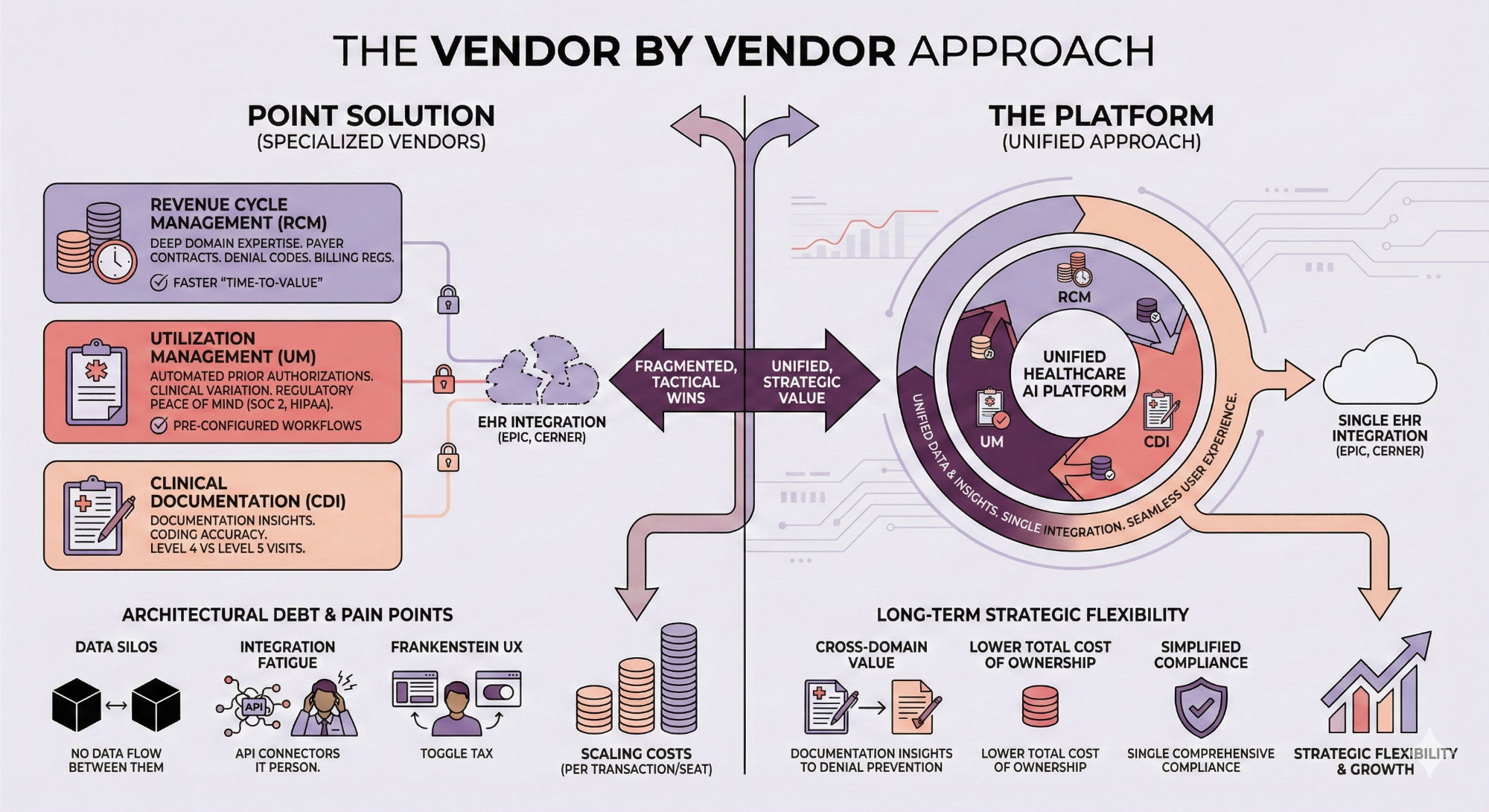
In the healthcare AI landscape, a purpose-built vendor (often called a "point solution") focuses on mastering a single, high-complexity domain, such as Revenue Cycle Management (RCM) or Utilization Management (UM). Choosing between a specialized point solution and a broader platform involves balancing immediate tactical wins against long-term strategic flexibility. Specialized vendors succeed because they go deep where general models go wide.
Deep Domain Expertise: Some specific AI solutions rely on massive, well-trained language models, such as those trained on millions of payer contracts, denial codes, and state-specific billing regulations. These models understand the difference between a "Level 4" and "Level 5" office visit in a way a general agent might not. BUT: do you want the model or the expensive workflows that come with it? Why can't you just use one, but not the other?
Faster "Time-to-Value": Because these tools are pre-configured for a specific workflow (e.g., automated prior authorizations), they can often be deployed in weeks. You aren't building the logic; you are simply plugging into it. BUT: how hard is it to remake these same agents yourself - you know your business better than they do?
Regulatory Peace of Mind: A vendor dedicated to UM is likely already holding the specific SOC 2 Type 2 and HIPAA certifications tailored to that data flow, reducing the compliance burden on your internal IT team. BUT: Individual certifications are table stakes for any AI vendor now — the real burden is maintaining compliance across a dozen different vendors, each with its own data flow and security profile.
However, while point solutions solve immediate headaches, they create long-term "architectural debt."
The "Data Silo" Problem: When you use one AI for RCM and another for Clinical Documentation (CDI), the two systems rarely talk. Insights from documentation that could prevent a denial in RCM are lost because the data resides in two separate vendor "black boxes."
Integration Fatigue: Each specialized vendor requires its own EHR integration (e.g., Epic, Cerner). Maintaining 10 different API connections, each with its own update schedule and security profile, can overwhelm an IT department.
The "Frankenstein" User Experience: Clinicians and back-office staff end up switching between multiple interfaces. This "toggle tax" reduces the AI's efficiency gains.
Scaling Costs: Point solutions often charge per transaction or per seat. While affordable for a single department, the total cost of 15 specialized AI vendors across a health system is typically much higher than that of a single unified platform.
The DIY Approach
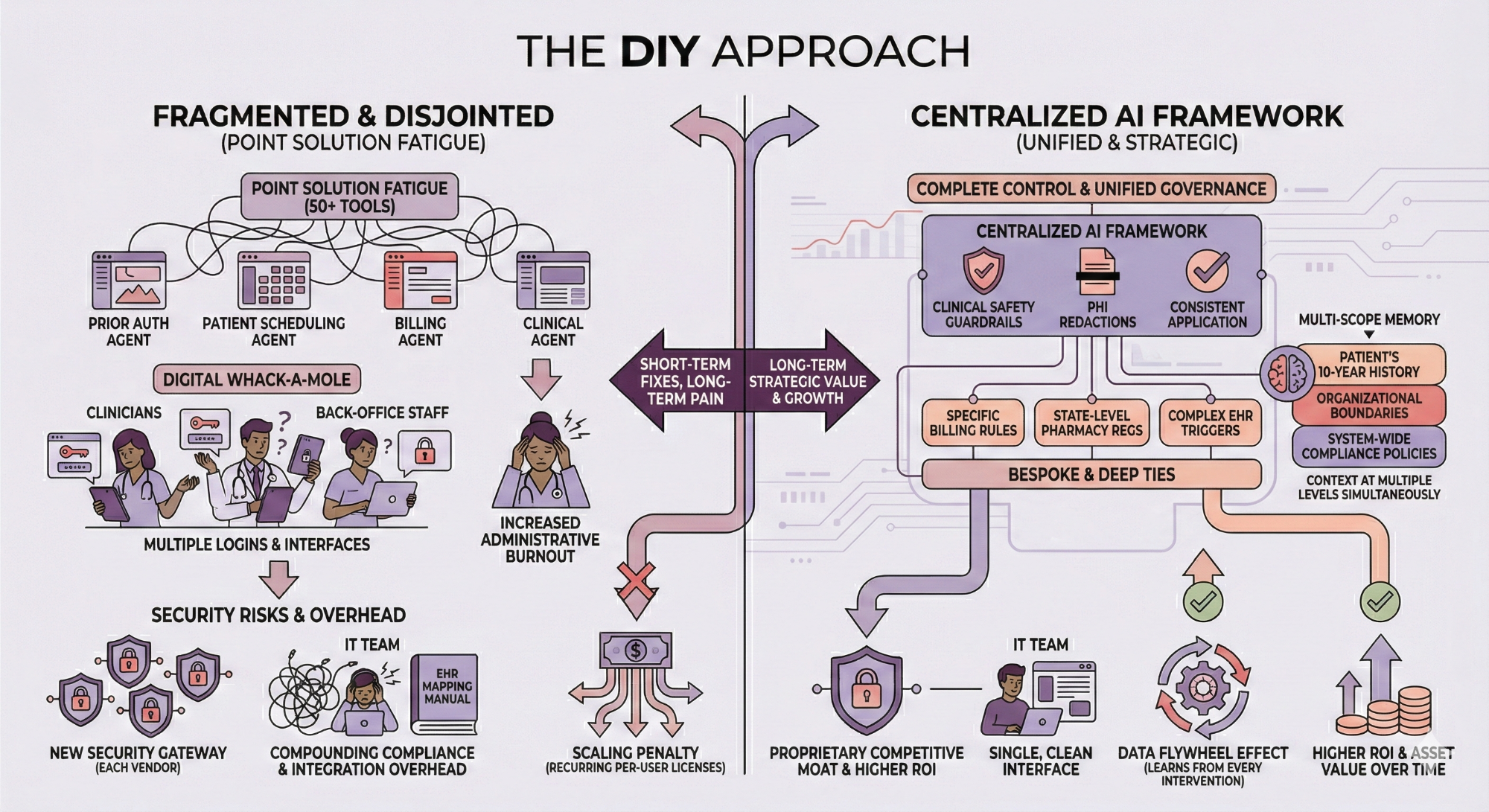
Building your own healthcare AI infrastructure—or using a unified platform—is a strategic defense against "point solution fatigue," a phenomenon in which a health system manages 50+ software tools that don't talk to each other. When a hospital buys a separate AI agent for each niche task, from prior authorization to patient scheduling, it inadvertently creates a "digital whack-a-mole" environment. This fragmentation forces clinicians to juggle multiple logins and disjointed interfaces, which, ironically, increases administrative burnout rather than alleviating it. Moreover, each independent vendor introduces a new security gateway to sensitive patient data, compounding compliance and integration overhead for IT teams who must manually map each new tool to the existing EHR ecosystem.
By building a centralized AI framework, healthcare organizations gain complete control over the "brains" of their operations, ensuring that clinical safety guardrails and PHI redactions are applied consistently across all departments. Off-the-shelf agents are often built for the "median" use case, but medical workflows are rarely average; they require deep, bespoke ties into specific billing rules, state-level pharmacy regulations, and complex EHR triggers. Developing an internal foundation enables what we call "multi-scope memory" — the ability for AI to hold context at multiple levels simultaneously: understanding a specific patient's 10-year history while respecting the organizational boundaries of different specialty clinics and system-wide compliance policies. This level of granular control is impossible to achieve with a patchwork of third-party bots that view every interaction as an isolated ticket.
In the long run, shifting from buying point solutions to building an AI-native infrastructure creates a proprietary competitive moat and a significantly higher ROI. The upfront investment may seem daunting, but it eliminates the "scaling penalty" of recurring per-user licenses, which can balloon into the millions as an organization grows. More importantly, it creates a "data flywheel" effect: the system learns from every successful clinical intervention and documentation correction, becoming an asset that increases in value over time. Instead of renting generic intelligence from dozens of vendors, the organization owns a unified, self-learning ecosystem that evolves with its specific patient demographic and operational goals.
The Goldilocks Solutions
So if buying point solutions creates fragmentation and going fully DIY is unrealistic, what's the middle ground? Building a generic chatbot is a walk in the park. Building a healthcare-compliant deep agent is climbing a mountain. When you "roll your own" using standard APIs, you take on the full burden of building and maintaining an ever-growing set of agents—defining custom connectors for EMRs, HL7, and FHIR feeds that break whenever a vendor updates, and manual testing that doesn't scale. How do you prove your agent won't give incorrect medical advice? This is exactly the problem we built Actava.ai to solve. Rather than forcing you to become an AI research firm, Actava.ai provides purpose-built infrastructure designed for the high-stakes world of healthcare and life sciences. We partner with healthcare organizations to deploy sophisticated AI orchestration technology without the complexity of building infrastructure from scratch.
Our KORA platform provides everything needed to coordinate multiple AI agents across your apps and workflows - from creation BLUE to governance RED to continuous improvement GREEN.
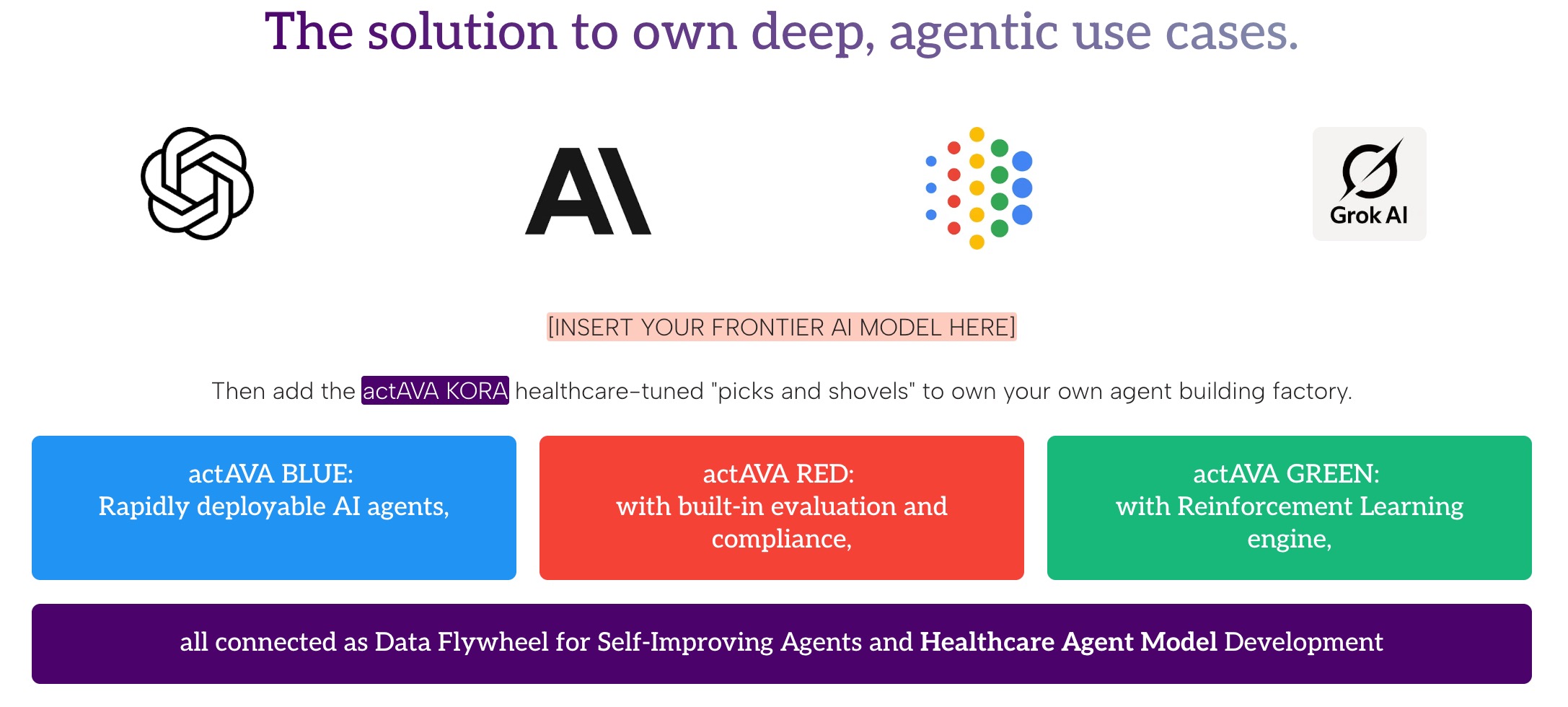
Actava.ai BLUE: The "Brains" & Infrastructure
Actava.ai’s KORA|BLUE is the core engine. While DIY solutions rely on basic vector search, we utilize advanced RAG (Retrieval-Augmented Generation) and built-in enterprise agent management tools.
Role-aware architecture: KORA|BLUE supports role-based access control (RBAC), ensuring users can access only what they're authorized to see. Define workflows using our natural-language command center, which assembles tasks, tools, and guardrails for each agent. Moreover, agent builders can rely on our MCP-extensible architecture, universal interoperability, prebuilt prompts, tools, and agent library to streamline their work.
Reason-aware planning: KORA|BLUE manages agent-to-agent interactions with our intelligent workflow routing and task delegation. Builders can scale their agents with our memory-aware infrastructure, which features a HIPAA-compliant vector database and relational indexing. All agents include automatic PHI detection and redaction at retrieval time, ensuring data remains protected without sacrificing AI performance.
Context-aware intelligence: KORA|BLUE also isolates memory and maintains separate contexts for each conversation, patient case, quality improvement project, and organizational unit, preventing data leakage and ensuring relevant recall for every interaction. Builders can use our advanced chain-of-thought reasoning engine (thought → action → observation) to optimize for complex clinical questions, quality metrics, and financial analyses using our proprietary multi-step logic and evidence synthesis.
Actava.ai RED: Automated Quality Assurance
In healthcare, "close enough" isn't good enough. Actava.ai’s KORA|RED is the automated "red-teaming" suite that supports a comprehensive AI testing and validation approach calibrated for the healthcare market.
Evidence-based accuracy: KORA|RED verifies every clinical claim against established medical guidelines, peer-reviewed evidence, and regulatory standards in real-time. Our tools automatically flag unsafe recommendations, unverified medical advice, or outputs lacking credible sourcing. Humans-in-the-loop approve agent results only when required, such as when explicit evidence and citations are present. We ensure every AI recommendation is defensible, traceable, and grounded in legitimate medical knowledge.
Continuous protection & transparency: KORA|RED helps builders deploy agents with confidence by providing one-click guardrails that integrate seamlessly into a development pipeline, including CI/CD testing checkpoints that catch issues before production and automatically block risky outputs. Our tools monitor in real time with live drift detection and risk dashboards that alert you to emerging problems. We maintain audit readiness with exportable compliance reports that provide complete transparency for leadership, regulators, and accreditors.
Vulnerability & risk checking: KORA|RED simulates real-world attacks with one-click red teaming and comprehensive adversarial testing across all AI interaction types. Test for critical vulnerabilities, including prompt injection, jailbreaks, hallucinations, toxic outputs, and bias in all agents, integrations, and external models. Builders can visualize risk instantly with color-coded heat maps and quantified risk scores that pinpoint where their AI is vulnerable and how severe each threat is.
Actava.ai GREEN: The Self-Learning Flywheel
Self-learning agents are where DIY truly fails. Actava.ai’s KORA|GREEN enables your AI to get smarter with every interaction. It learns from successful clinical decisions and automatically tunes its own prompts to improve performance over time. It delivers agent reinforcement learning (RL) through three integrated layers that work together to capture, reflect on, and consolidate improvement with each agent episode. The result is an ever-evolving agent whose knowledge becomes a permanent part of the continuous improvement vector, made available for all future tasks without needing the original context.
Episodic capture: During an interaction, KORA|GREEN uses an adaptive vector to enable "test-time learning." It records specific experiences, successes, and failures as raw episodic memories.
Reflective distillation: Through reinforced learning, triggered by human feedback or performance milestones, KORA|GREEN reflects on these episodes, filters out the noise, and extracts the underlying principle.
Semantic consolidation: The distilled insight is then "refined to memory" by updating the agent's semantic or procedural memory. KORA|GREEN updates our vector database, modifies the agent's knowledge graph, and fine-tunes the agent’s model weights.
The Bottom Line
Remember that 95% failure rate? It doesn't have to be your story. Healthcare organizations should focus on what they do best: delivering exceptional patient care — not debugging AI plumbing. Actava.ai provides the infrastructure layer purpose-built for healthcare, so your teams spend less time managing technology and more time making a difference where it matters most.
Learn more at Actava.ai.

Written by
Frank Wang
CTO & Co-Founder
AI engineering leader who turns frontier research into market-defining enterprise products across agentic and vertical platforms. As Head of Engineering at Salesforce AI Research, Frank led breakthrough work on autonomous agents, deep research agents, agent orchestration, and the Agentforce advanced RAG & reasoning engine, post-training the agent, reasoning, deep research, and RAG models behind them. Earlier, as employee #11 and founding engineer at Vlocity (acquired by Salesforce in 2020), he built core platform technology in enterprise software — inventing the award-winning Salesforce OmniStudio Mobile Platform and six vertical industry applications, and growing OmniStudio into a platform spanning 14+ industries that has helped more than 100 large enterprises.