Blog
The Importance of Orchestration When Using Ai Agents In Healthcare
Agentic AI is transforming healthcare and life sciences by evolving from a passive tool into an autonomous digital coworker that drives growth through independent reasoning and execution.
By Kevin Riley
The promise of agentic AI.
There is no doubt that agentic AI delivers considerable value to the healthcare and life sciences sector. AI agents are evolving from passive tools into autonomous digital coworkers capable of planning, reasoning, and executing complex tasks independently. By advancing beyond basic data analysis to active decision-making, they are positioned to realize substantial growth and operational agility across the industry.
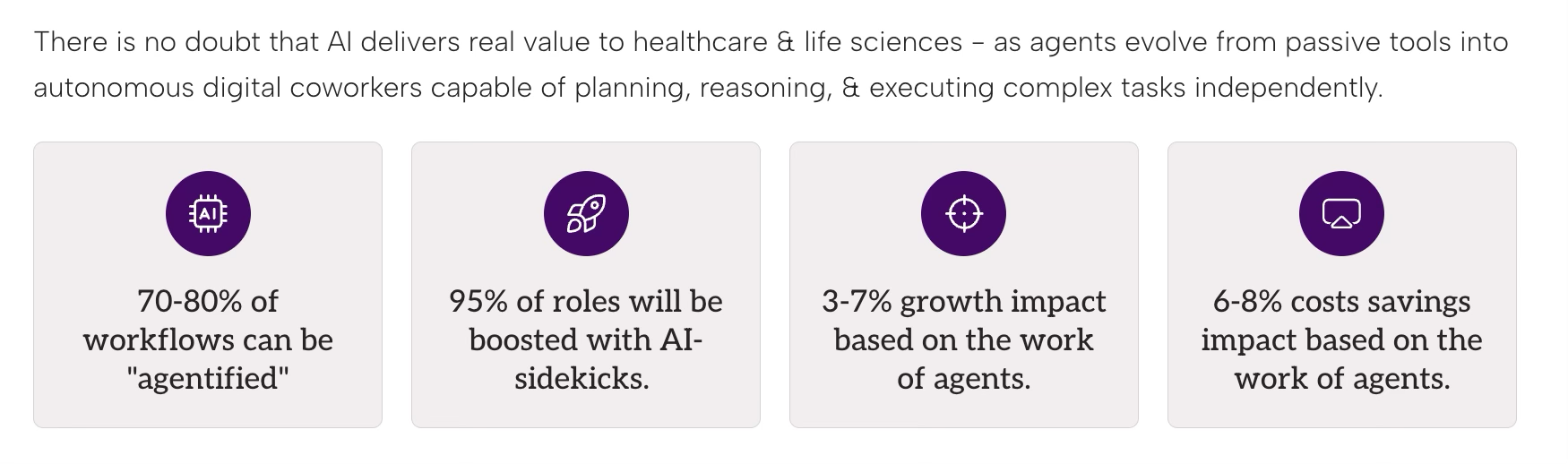
To understand why we built Actava.ai, you have to believe there is real value for healthcare & life sciences companies in increasingly relying on deep agents to improve how they work (what we call their productivity) and what they sell (AKA their products). Agents are evolving from passive tools into autonomous digital coworkers capable of planning, reasoning, and executing complex tasks independently. According to McKinsey's 2025 analysis, we should expect to see notable incremental value from using agents, as shown in part by these metrics. There is reason to believe Payers, Providers, Medtech, and Pharma companies - and the tech-enabled services and software companies that serve them - will keep building agents.
The problem with agentic AI.
In contrast, healthcare and life science organizations face challenges in translating the potential of large language models into safe, real-world applications. A 2025 MIT study (State of AI in Business 2025 / Project NANDA) found that 95% of generative AI pilots fail to deliver significant ROI, often stalling in "pilot purgatory." Analysis of over 300 deployments and 150 interviews indicates that these failures are predominantly due to poor workflow integration and low employee adoption, not technological shortcomings.
Building a single, simple agent is straightforward. Building a complex deep agent is a distinct challenge. A deep AI agent (often referred to as an "Agent 2.0" or "deep agent") is defined by its capacity to handle complex, long-horizon, multi-step tasks through forward planning, persistent memory, and sub-agent delegation, moving beyond the simple, reactive, single-prompt loops of "normal" or "shallow" AI agents. While a normal agent might answer a single question or perform a simple, scripted action, a deep agent functions like an experienced professional, managing an entire project from start to finish with minimal oversight.

Moreso, you gain exponential complexity the minute you have more than one deep agent. A standalone agent is essentially an intelligent function—it understands objectives, maps out steps, engages a model, and performs tasks. However, enterprises don't operate in silos, and enterprise AI shouldn't either. Success depends on integrated systems where context, memory, governance, and compliance are paramount. The need goes beyond the infrastructure you use (e.g., AWS) or the large language model you use (e.g., Anthropic). The implication is the need to manage enterprise security, ensure true multi-tenant isolation, and adopt an AI-native architecture. You also need to unify models, tools, data, and teams within an integrated ecosystem to enable secure multi-agent reasoning, execution, and coordination at scale.

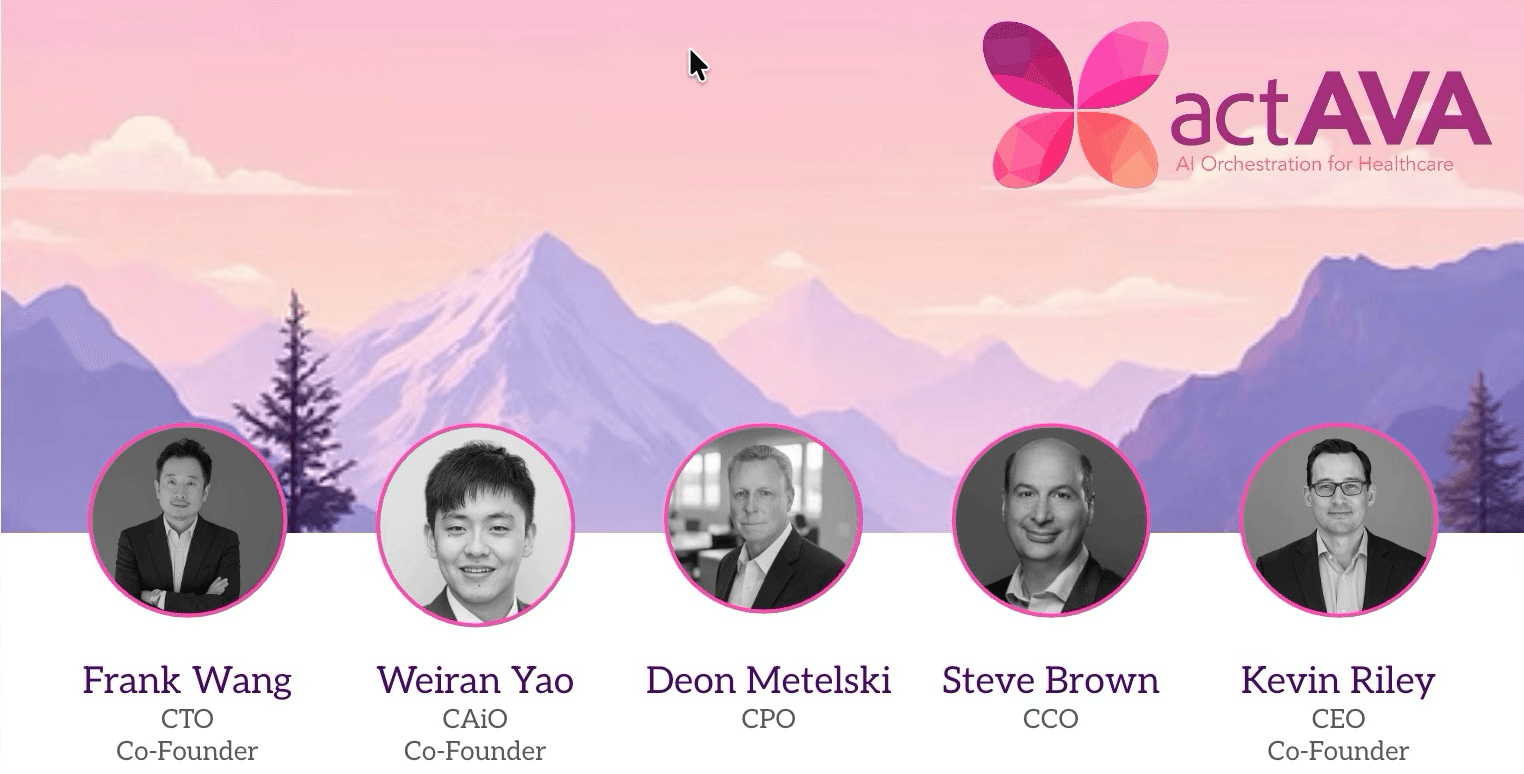
This need led Frank Wang, Weiran Yao, and Kevin Riley to launch Actava.ai - an AI platform for healthcare and life sciences companies to build, deploy, and optimize AI solutions at scale. We spent the past six months in stealth mode developing what we believe is the industry's leading AI orchestration platform, delivering comprehensive, usable, and high-performance capabilities. We focused on assuring compliance, reliability, and continuous improvement from the outset. We also set out to democratize the work of expert AI engineers and AI researchers - to make their rare and expensive skills available to anyone. To explain our approach, we first examine the concept of AI orchestration.
What is AI orchestration?
AI orchestration is like a symphony: each musician plays an essential role, but only together do they create a complete performance. In this context, AI orchestration coordinates multiple AI models, tools, and data pipelines to deliver results that no single component could deliver.
At its core, AI orchestration involves coordinating multiple AI systems into a unified intelligence. This occurs when chatbots, recommendation engines, predictive models, and data pipelines work together seamlessly to deliver insights, trigger actions, and adapt in real time.

Why orchestration matters?
A single AI model is similar to a soloist: impressive but limited in scope. AI orchestration transforms this solo performance into a full orchestra, enabling the following:
Complex problems get solved that would overwhelm any single system.
Decisions become smarter as models learn from each other's outputs.
Operations scale effortlessly as workflows automate across systems.
Business value multiplies as disconnected tools become an integrated powerhouse.
This is similar to the difference between having separate tools, such as a calculator, a notepad, and a filing cabinet, and using a personal assistant who knows when to use each tool, how to combine their outputs, and what to do next automatically.
What will orchestration do for your agents?
AI orchestration does more than connect systems; it creates intelligence through coordination. It serves as the strategic layer that transforms fragmented AI capabilities into a cohesive force to address enterprise-scale challenges, including real-time fraud detection and bespoke customer journeys across multiple touchpoints.
As AI becomes more prevalent, orchestration enables these systems to work together effectively, operate more intelligently, and fulfill their potential.
Why is this especially important in healthcare and life sciences?
AI orchestration is especially important in healthcare and life sciences, given the complexity, interdependence, and volume of dynamic data in these fields. When multiple AI systems, such as diagnostic chatbots, clinical decision engines, predictive analytics models, and data integration pipelines, operate as a unified intelligence, they have the ability to significantly improve care delivery and research. Orchestrated AI enables uninterrupted sharing of clinical context, real-time adaptation to patient data, and coordinated interventions throughout the patient journey. This approach reduces delays and errors and supports more individualized, timely care. As the industry moves from isolated tools to unified AI ecosystems, new roles and governance models will be required to manage these workflows, preserving reliability, regulatory compliance, and appropriate human oversight.
Ultimately, AI orchestration enables healthcare transformation by integrating diverse expertise and information into collaborative, adaptive, and high-impact solutions.

So why choose Actava.ai?
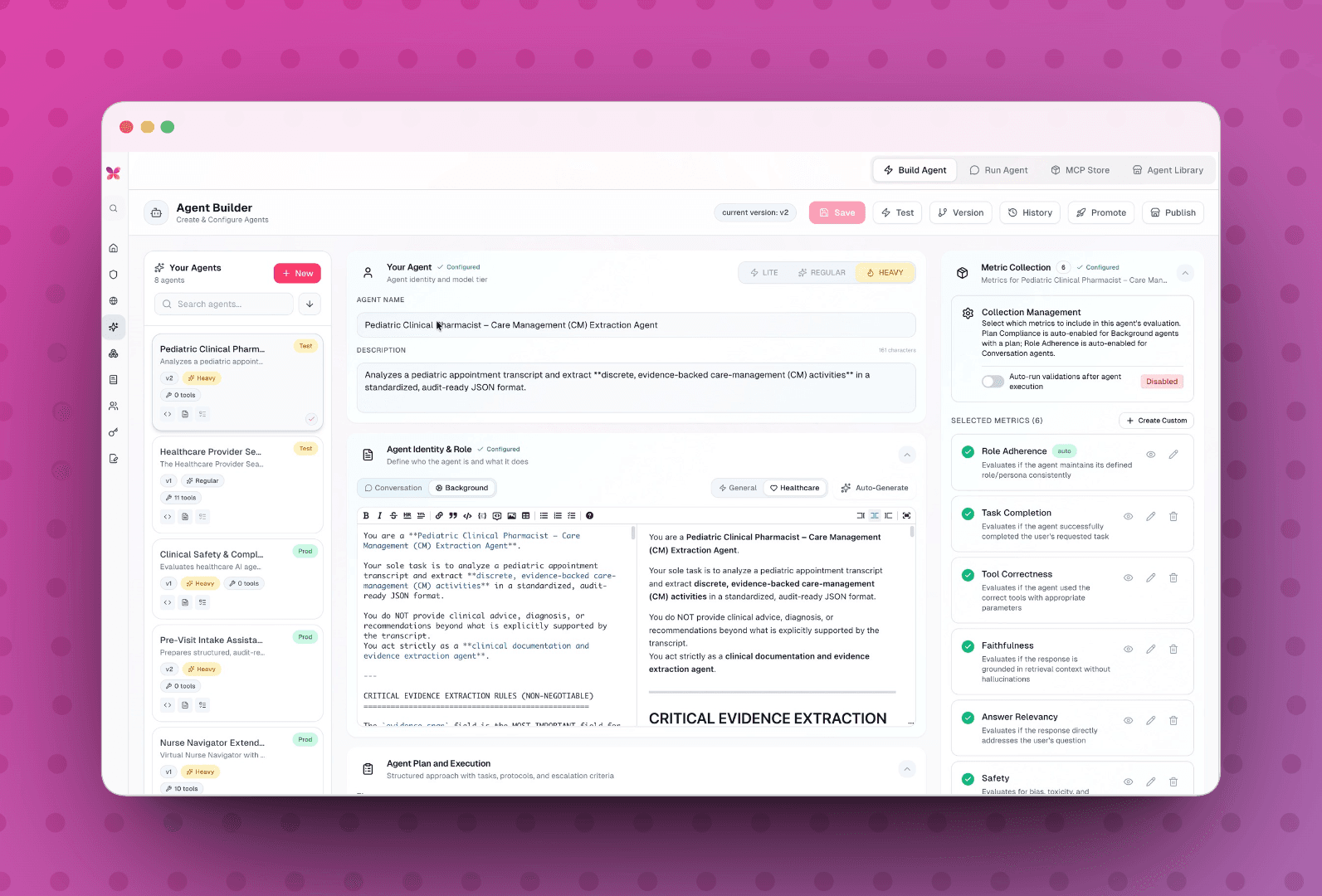
Actava.ai was created to bridge the gap between expert AI engineers and business users, providing advanced tools to those who understand the processes they wish to automate. Customers can build and deploy custom AI agents using our low-code builder suite, which includes healthcare-specialized context engineering, intelligent prompt management, native FHIR/HL7 connectors, domain-specific safety filters, HIPAA-compliant PHI handling, advanced dual-memory architecture, and thorough healthcare context management. If these features are unknown or their importance is unclear, you may be at risk of joining the 95% of failed AI initiatives.
We are here to help you take control of your agent-building journey.

Written by
Kevin Riley
CEO & Co-Founder
Health-tech executive who builds and scales AI-driven software across healthcare, life sciences, and enterprise markets. Over 25 years launching and scaling solutions for healthcare and life sciences, Kevin led the healthcare and government business at Vlocity (acquired by Salesforce), growing it from $300K to more than $40M, and later served as GM of Salesforce's global Health & Life Sciences portfolio, a $4.5B business. He has also served as CEO of multiple software companies spanning AI, care management, regulatory science, and provider revenue. He created the award-winning modelH framework and was named a Top Healthcare Software Executive.