Blog
Why Healthcare AI Demands a Higher Level of Testing
As we look toward the rest of 2025 and into 2026, the industry is waking up to a stark reality: We can no longer let AI grade its own homework.
By Weiran Yao
The era of simple chatbots in healthcare is over. We have rapidly graduated to sophisticated, autonomous agents capable of clinical decision support, patient triage, and complex care coordination. These agents don’t just answer questions; they access sensitive data, orchestrate workflows, and make consequential decisions.
But with this power comes a level of risk that traditional software testing simply cannot handle.
In the consumer world, if an AI hallucinates a recipe, dinner is ruined. In our world, if an AI hallucinates a diagnosis or exposes a patient cohort to a prompt injection attack, the consequences are legal, financial, and clinical catastrophes. As we look toward the rest of 2025 and into 2026, the industry is waking up to a stark reality: We can no longer let AI grade its own homework.
The "Trust Us, Bro" Era is Ending
Miles Brundage, a former OpenAI insider who recently launched the AI Verification and Evaluation Research Institute (AVERI), put it best: “AI labs are writing their own report cards, and no one is checking their work.”
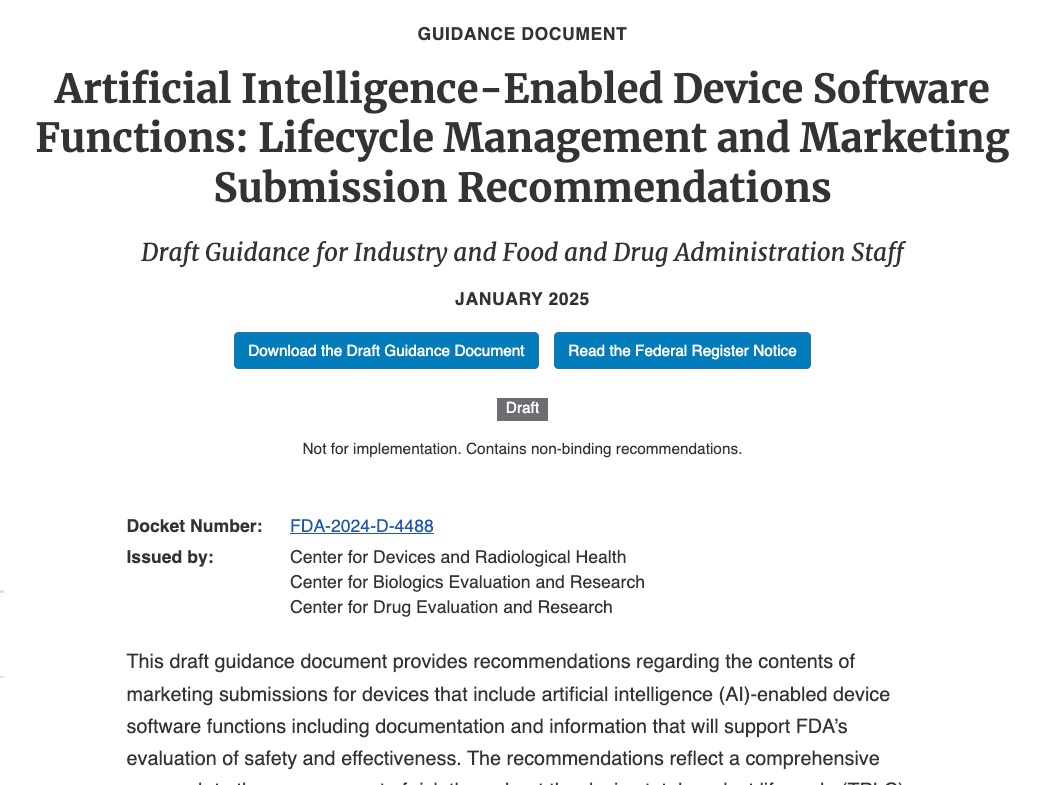
In healthcare, this "trust us, bro" approach is untenable. We are seeing a convergence of pressure from insurance companies, investors, and regulators who are tired of vague assurances. The FDA has already issued draft guidance on labeling for AI/ML-enabled products, and we are navigating a growing patchwork of state laws that impose strict rules on marketing and use.
As noted in recent industry analysis, AI governance is moving from a "backroom checkbox" to a strategic engine. It used to be treated like infection control—important and steady, but quiet. Now, it is becoming urgent and visible. By 2026, governance will not just be about compliance; it will be a defining discipline of operational excellence.
The Perfect Storm: Why Standard Testing Fails
At Actava.ai, we see healthcare organizations facing a critical testing challenge I call the "Perfect Storm of Complexity."
Agents Need Adversarial Validation: Modern agents are too complex for standard QA. They require rigorous "Red Teaming"—simulating adversarial attacks and stress-testing under extreme conditions to find vulnerabilities that only emerge in the wild.
Real Data is Off-Limits: Privacy regulations (HIPAA, GDPR) make using actual patient data for testing legally perilous. Yet, synthetic data often fails to capture the chaotic nuance of real clinical environments.
The Stakes are Higher: Healthcare systems must be flawless across multiple dimensions simultaneously.
This creates a gap between the promise of AI and its safe deployment. This isn't a technical problem; it’s a validation problem.
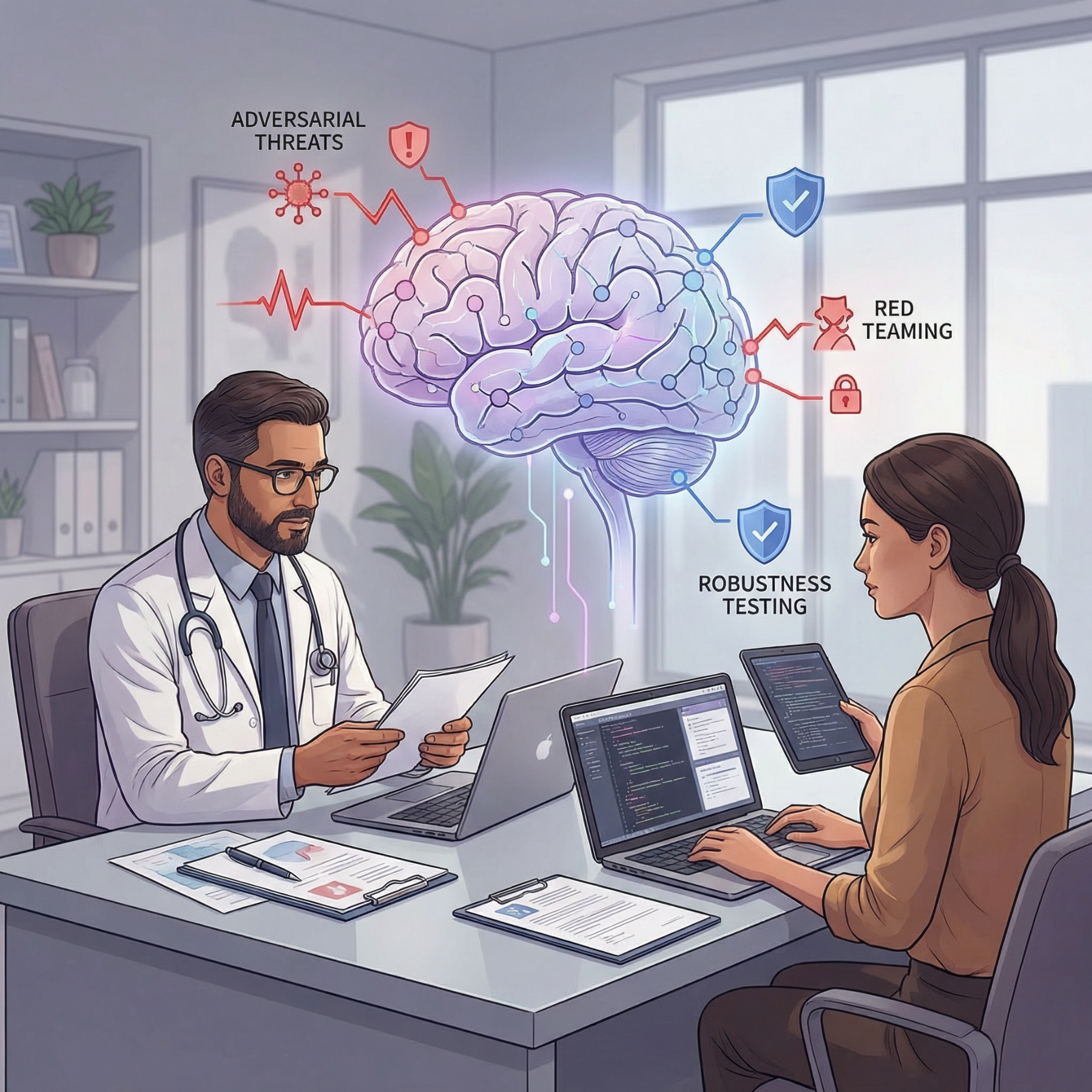
The 6 Pillars of Healthcare AI Assurance
To bridge this gap, we need to move toward what I call "Military-Grade Testing." This isn't about bureaucracy; it's about survival. Comprehensive red teaming for healthcare AI must rigorously evaluate six specific pillars:
Security: Can the model defend against prompt injection, data poisoning, and jailbreaks that could expose Protected Health Information (PHI)?
Robustness: How does the agent handle edge cases and ambiguous clinical inputs designed to exploit weaknesses?
Bias & Fairness: Are we detecting discriminatory patterns in diagnosis or resource allocation before deployment?
Ethical Alignment: Does the AI prevent medical misinformation and adhere to clinical standards of care?
Performance Under Stress: Is the system resilient against malformed data and high-volume queries?
Regulatory Compliance: Is there continuous validation against HIPAA, FDA, and CMS regulations?
What Executives Need to Know
For technical and non-technical leaders alike, the conversation is shifting from "Can we build it?" to "Can we trust it?"
Validation is no longer just for the engineers. Executives need real-time visibility into safety and accuracy. They need to know if their AI is producing evidence-based outputs. They need to know if they are audit-ready for the FDA or state regulators. Most importantly, they need Strategic Confidence. Leaders need to be able to replay and compare AI interactions to understand performance trends. They need a predictable ROI with quantifiable risk management.
The industry is currently facing a shortage of qualified auditors—people with the rare combination of technical AI expertise and governance knowledge. That is why the responsibility falls on healthcare organizations to adopt independent, automated, and adversarial testing frameworks.
Those who solve the validation puzzle will gain a massive competitive advantage. They will scale AI safely across departments without multiplying risk. Those who don't face a future of regulatory action, patient harm, and reputational damage that no algorithm can fix.
It’s time to stop grading our own homework. It’s time to test like lives depend on it—because they do.

Written by
Weiran Yao
CAIO & Co-Founder
AI research leader with deep expertise in large-scale model training, reasoning engines, and multi-agent systems. At Salesforce AI Research, Weiran led the post-training team behind the xLAM large action models, along with the Agentforce planning engine and the CodeGenie agent, and drove the pre-training of Salesforce's CoDA code diffusion model. He recently spearheaded open-source releases including Enterprise Deep Research, Webscale-RL, and CoDA-1.7B, advancing applied AI from research into production at enterprise scale. A CMU Ph.D. in Machine Learning, he has published 70+ papers, holds 13 U.S. patents, and serves on NeurIPS, ICML, ICLR, and ACL committees.