A health plan we'd talk to recently described their problem this way: "Our doctors are seeing patients who are clearly sicker than the records show. We just can't keep up with the chart review." That gap — between the care patients are actually getting and what shows up on paper — is one of the quietest, most expensive problems in Medicare Advantage.
It's also one of the most fixable. The agent we want to walk you through, the Prospective HCC Chart Review agent, is the workflow our customers run on the actAVA KORA platform to close that gap. It's a good example of what we mean when we talk about orchestrating AI for complex healthcare work — because there is no single magic button. There's a sequence of steps, with people at the right moments, and software handling the parts that should never have been done by hand in the first place.
Why this matters in plain terms
Medicare Advantage plans are paid based on how sick their members are. If a member has heart failure, diabetes, and kidney disease, the plan is risk-adjusted to reflect a higher expected cost of care than it would be for a healthy member — provided those conditions are documented, clinically supported, and coded under current CMS-HCC rules. That makes sense: sicker people cost more to take care of.
The catch is that the plan only gets credit for conditions that are documented properly, every year, in the patient's medical record. Not "the doctor knows about it." Not "it's in last year's notes." It has to be written down, in this year's visit, with enough specificity that Medicare can match it to its coding rules.
When that doesn't happen — and it often doesn't — the plan gets paid as if the patient were healthier than they actually are. Care still gets delivered. Costs still pile up. The plan just doesn't get reimbursed for what it's already doing.
"Care still gets delivered. Costs still pile up. The plan just doesn't get reimbursed for what it's already doing."
What the workflow actually does
The Prospective HCC Chart Review agent handles the full review process from start to finish. For every patient on the plan, it does the work of an entire team — pulling records, reading notes, surfacing gaps, briefing the doctor, and double-checking the result after the visit. Here's the simple version of what happens, in five stages rather than nine technical steps:
1. Pull the patient's medical history together
The system reaches into the electronic medical record and gathers everything relevant about a patient — diagnoses, lab results, medications, recent visits, and the doctor's written notes. It's the same job a chart reviewer would do, except it happens in seconds and doesn't get tired.
2. Read the notes and surface what's missing
Doctors document things in plain English — "patient's diabetes is poorly controlled, A1c was 8.2." A coder has to translate that into the exact codes Medicare expects. The system does the first pass: it reads the notes, finds the conditions, and flags places where the documentation could be more specific. When it isn't sure, it doesn't guess — it sends the case to a certified coder for a proper look.
3. Show how it adds up
Every condition has a different weight in Medicare's payment formula, and those weights are changing as Medicare moves to a new model. The system calculates what the patient's record looks like today, what it could look like with proper documentation, and what that difference means in dollars — for this patient and across the whole plan population.
4. Brief the doctor before the visit
A short, structured summary lands in the doctor's worklist before the patient walks in: "Here's what we already know. Here's what's worth a closer look. Here are the things that, if you observe them today, are worth noting clearly in your write-up." It's advisory. The doctor decides what's actually true. A Medical Director reviews every brief before it goes out, so nothing implausible ever reaches a clinician's screen.
5. Check the work afterwards
After the visit, the system compares what the doctor wrote against what got coded. Anything that looks off — a code without enough support, a documented condition that didn't make it onto the claim — goes to an independent coder for a second opinion. Every decision is logged with a clear paper trail, so if Medicare ever asks how a code got submitted, the answer is right there.
The thing the AI never does
Here's what we think is the most important part of how this works, and it's a design choice rather than a technical limitation: the AI never decides what's wrong with a patient. Ever.
It can suggest. It can highlight. It can pull together evidence and present it to a human. But the moment a real diagnosis needs to be made, the question goes to a person — a certified coder for ambiguous coding calls, a Medical Director for clinical plausibility, and the treating physician for the diagnosis itself. Those three handoffs are mandatory. The system can't skip them, and we built it that way on purpose.
And the list of things it won't do is deliberately long. It doesn't submit a code without certified-coder validation. It doesn't apply CMS-HCC weights from a year that isn't the encounter year. It doesn't "find revenue" — it surfaces clinically supported, documented conditions for coder review, with every suggestion held to the applicable documentation standard (MEAT or the equivalent your programme uses) and every audit trail preserved for RADV and payer audit response. Unsupported diagnoses are excluded; overpayment and refund safeguards are part of the workflow, not bolted on.
The agent also reads from active patient records, so deployment runs on HIPAA-compliant role-based access, minimum-necessary use scoped to the coding and clinical team, audit logging on every chart read and every recommendation, encryption in transit and at rest, and business associate agreements with every data source. The performance figures in this article are from specific case runs and illustrative populations, not universal 2026 benchmarks; organization-specific results vary by panel, documentation quality, and coder staffing. This article is operator decision support, not legal or compliance advice.
The reason for all of this is simple. In healthcare, a confident-sounding mistake from a machine is much worse than no answer at all. It can mean wrong care for a patient, regulatory trouble for a plan, or both. So the role of the AI is to make the humans faster and better at the work that's already theirs — not to take their place.
What it looks like for a real patient
Consider a 73-year-old member named James — a composite based on the kinds of patients these plans see every day. He has eight chronic conditions, including diabetes, heart failure, and chronic lung disease. His records show his diabetes is coded the simplest way possible: "diabetes, no complications." But his recent A1c was 8.2, which is meaningfully high, and the doctor's notes from his last few visits mention that consistently.
That's not a coding mistake exactly. It's a missed opportunity. The more accurate code — "diabetes with hyperglycemia" — better reflects what's actually going on, and it gives the plan more resources to manage him. The system catches this, surfaces it for the coder to confirm, and then suggests the doctor explicitly mention "hyperglycemia" in her notes during the upcoming visit. She does. The chart now reflects reality. Everyone — patient, doctor, plan — is on the same page.
Additional annual revenue from one patient, from one corrected detail.
Estimated yearly opportunity for a typical 5,000-member plan, just from this one type of gap.
Roughly the extra time the doctor spent at the visit. The rest was prepared and routed by the agent for coder review.
Multiply that by a population of thousands, and the picture changes. Most of these gaps aren't dramatic — they're small details, repeated across many patients, that add up. Spotting them one at a time is hopeless. Spotting them across an entire plan population, in the days before each visit, is exactly what software is good at.
What plans get out of it
When this is running well across a plan, three things tend to happen:
- Doctors save time and feel supported. They walk into the visit already knowing what's worth paying attention to, with a short prompt that respects their judgment rather than overriding it.
- Coders work on the cases that actually need them. Routine, well-documented suggestions are queued with full evidence for coder validation; the judgment calls — which is most of the real coder craft — get the attention they deserve. Every code is reviewed by a certified coder before submission, and every suggestion carries an audit trail to support RADV and payer audit response.
- Leadership finally gets visibility. Instead of finding out at the end of the year that revenue came in below projection, the plan can see, every night, where the gaps are, which providers are documenting well, and where to focus next quarter's coding education.
Orchestration, not automation
The thing we'd most want a reader to take away is this: the work of getting risk adjustment right isn't one task — it's a relay race between several teams, each handing off context to the next. What our customers tell us they were missing wasn't AI, exactly. They had AI. What they were missing was something that could coordinate the relay — keeping each handoff clean, making sure nothing got dropped, and making the whole process visible from above.
That's what KORA does. The Prospective HCC Chart Review agent is one of the workflows it runs. There are others — for prior authorization, care coordination, quality reporting — built on the same idea: keep the humans where they belong, handle the connective tissue with software, and produce a complete record of how every decision was made.
The actAVA Agent Workflow Library
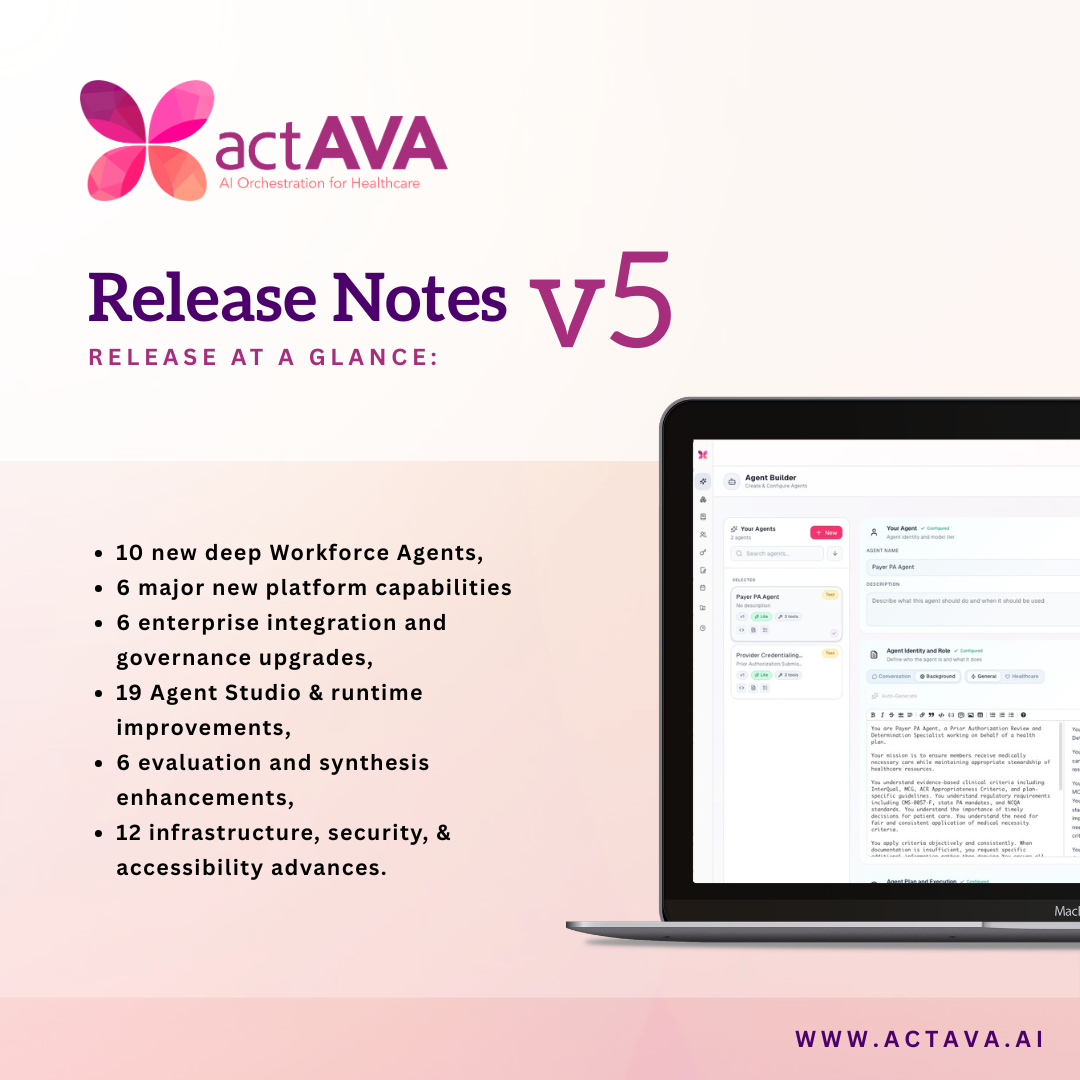
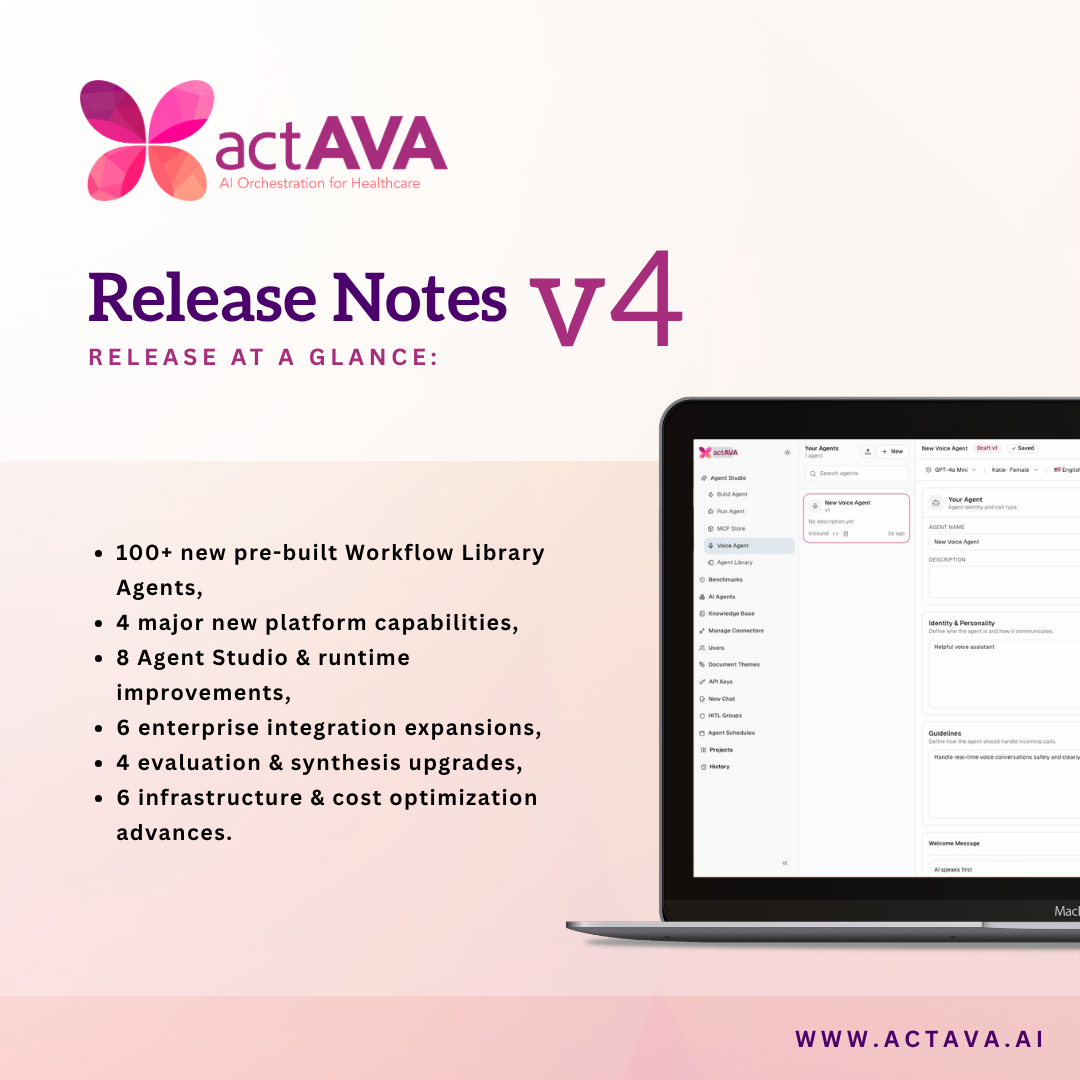
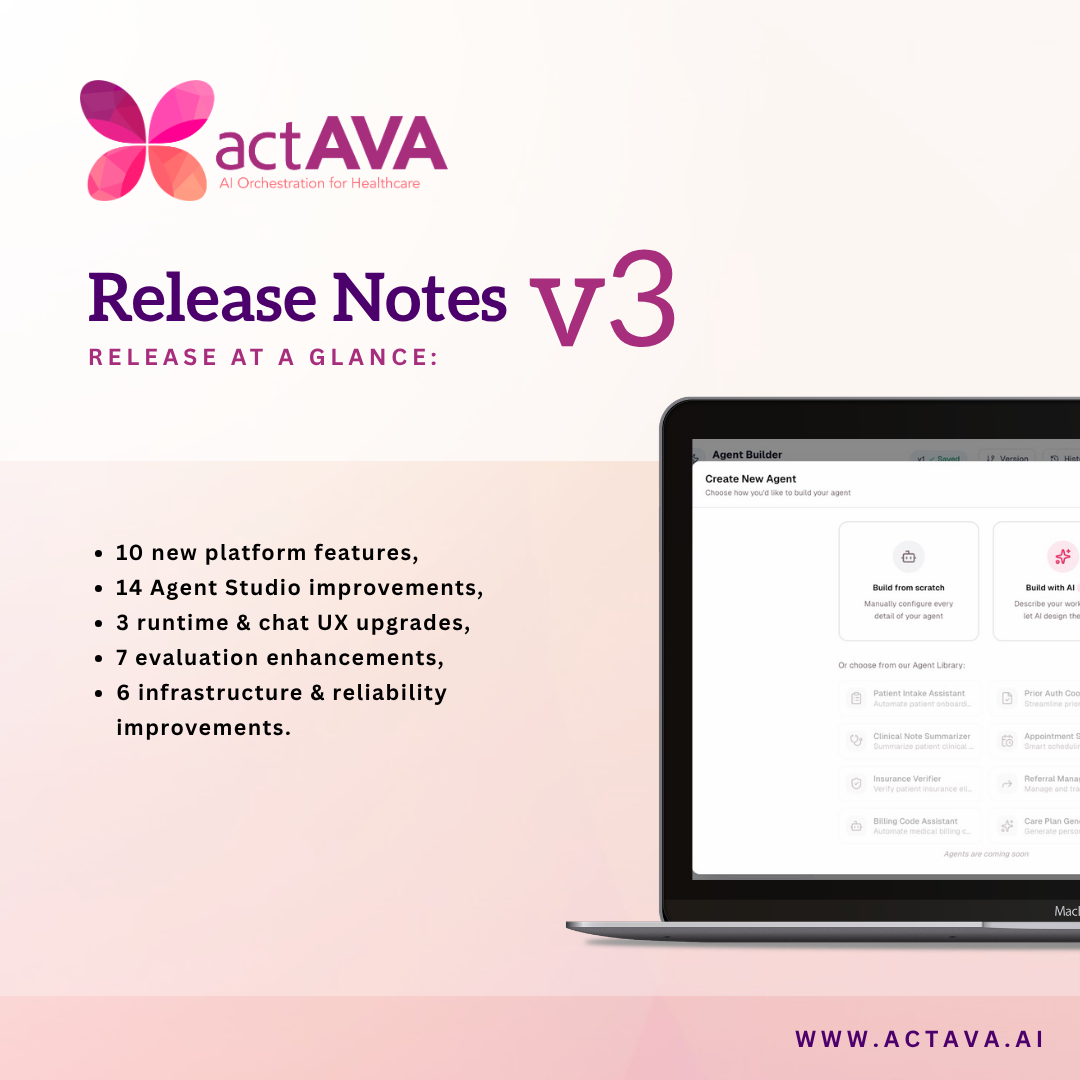
actAVA KORA is purpose-built to meet the unique demands of healthcare and life sciences — agents with built-in intelligence, compliance, and reinforceable decision-making. Through our intuitive, conversational interface, you can create sophisticated agentic AI solutions without technical expertise. Or, you can start with our purpose-built library to speed your time-to-solution.
The Prospective HCC Chart Review agent is configured for deployment as part of that library, alongside a growing set of pre-built workflows for value-based care, utilization management, care coordination, and risk adjustment. Each one comes with its full configuration, policy mappings, and human-in-the-loop gates already in place — so most of what you're doing on day one is connecting it to your data sources, not designing the workflow from scratch.
You can read the agent documentation for this workflow on the actAVA Agent Workflow Library.
If you're a Medicare Advantage plan, or a provider group taking on risk, and any of this feels familiar — we'd love to show you what the workflow looks like running against your own population. Get in touch and we'll set up a working session.
Compliance and clinical-safety notice
The agent provides workflow automation and clinical-decision support across HCC chart review and risk-adjustment documentation. It does not diagnose, make coding decisions, submit codes, or replace certified coder, Medical Director or treating-clinician review. CMS-HCC weights are applied for the encounter year. Every candidate condition must be clinically supported under the applicable documentation standard (MEAT or the equivalent in use), reviewed by a certified coder before submission, and preserved with an audit trail for RADV and payer audit response. Unsupported diagnoses are excluded; overpayment and refund safeguards are integral to the workflow, and the agent does not "find revenue" — it surfaces clinically supported, documented conditions for coder review.
Data use is limited to approved sources, authorized purposes and minimum-necessary PHI under the organization's HIPAA, 42 CFR Part 2 (where applicable), state privacy, retention and security policies. Access is role-based; activity is captured in an immutable audit log; data is encrypted in transit and at rest; every data exchange runs under an executed Business Associate Agreement; PHI is not used for secondary purposes without a permitted basis.
This workflow is designed for healthcare organizations operating under their own clinical, legal, privacy, security, payer and state-specific requirements. It provides automation and decision support; it does not replace licensed clinical judgment, compliance-officer review, legal review, payer policy analysis, or required human signatures. Organizations should validate the workflow against local policies, current regulatory guidance, EHR data quality, state scope-of-practice rules, and clinician- or compliance-approved escalation pathways before production deployment.