Release Notes
Actava.ai Platform Release Notes v7 (August 2026)
Actava.ai V7 shipped 88 items, and the through-line is accountability: exactly-once tool execution, an append-only trail of every PHI read, model ceilings your security team sets, and skills that pass a test and approval before they go live. V6 was about what agents could do. V7 is about who's accountable for it. Deterministic exactly-once tool execution, a PHI access audit trail archived nightly to immutable storage, and org- and role-level model ceilings. A new Agent Batch API runs thousands of agent jobs through a single programmatic call, metered per item. Come and see what the new Actava.ai has in store for enterprise agentic development.
Actava.ai Platform Release Notes v7 (August 2026)
Release date: August 31, 2026
Release at a glance: 21 new platform features, 21 Agent Studio improvements, 13 agent runtime and chat UX upgrades, 9 voice agent upgrades, 6 evaluation enhancements, 13 infrastructure and reliability improvements, and 5 design system and developer experience items. 88 total items across 7 categories.
Summary
Where V6 gave Actava.ai KORA agents reach and self-improvement, V7 makes them enterprise infrastructure you can operate, govern, and audit.
A new Agent Batch API runs thousands of jobs in a single programmatic call, with capacity-aware dispatch and per-item billing. Skills Studio turns agent skills into governed, versioned, testable assets with a marketplace and an approval gate. An Integration Framework turns Actava.ai into a broad connector platform: Asana, Linear, Calendly, Todoist, Intercom, HubSpot, GitHub, QuickBooks, and Databricks, each connected once and gated per tool.
Regulated teams get a PHI Access Audit Trail that records every read of protected information, Model Access Governance that caps which models each role and organization may run, and deterministic exactly-once tool execution so an agent never double-submits a claim or enrollment.
The Actava.ai Inference API went live in production on its own domain, the platform moved onto the Claude 5 model family, and agent memory converged into governed Standing Instructions.
For healthcare payers, providers, and life-science teams, V7 is the release that lets compliance, operations, and security own agents at production scale.
Key Feature Highlights
Agent Batch API. One programmatic call runs thousands of agent jobs, with capacity-aware dispatch, exactly-once idempotency, per-item token accounting, and results frozen to durable storage.
Skills Studio and Skill Store. Agent skills become governed assets: authored conversationally, versioned with diff and rollback, tested in a sandbox against golden cases, and published through a risk-banded approval gate.
Integration Framework and Connector Marketplace. A catalog-driven connector platform adds 9 new integrations, with tools remaining disabled until their connections are live.
PHI Access Audit Trail. Every read of protected health information is recorded on an append-only trail and archived nightly to immutable storage, with a reporting API for compliance.
Deterministic Exactly-Once Execution. Idempotency middleware and deterministic submitters guarantee that a side-effecting tool call, submitting a claim or writing an enrollment, happens once, even across retries and multi-patient batches.
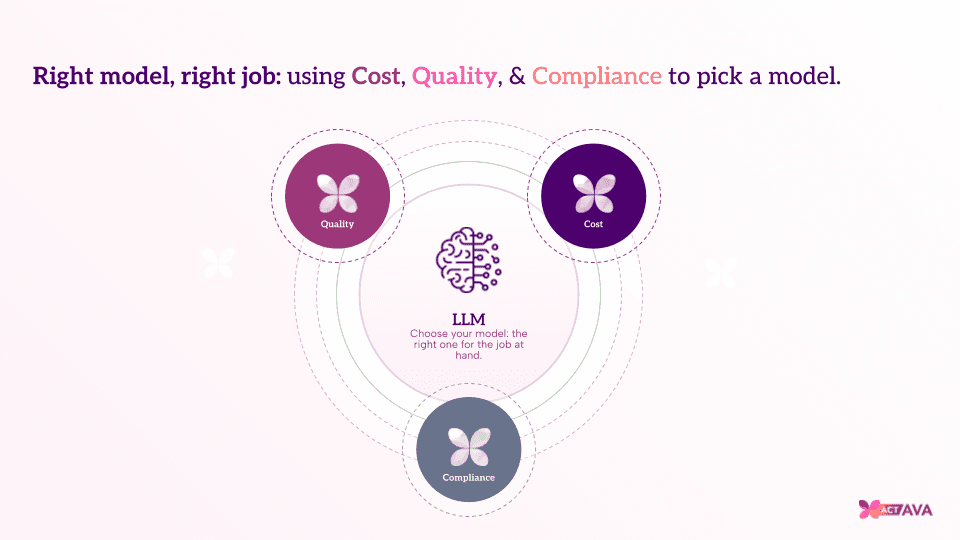
Model Access Governance. Organization- and role-level model ceilings determine which models each user may run, and a restricted model is replaced with a notice rather than a hard failure.
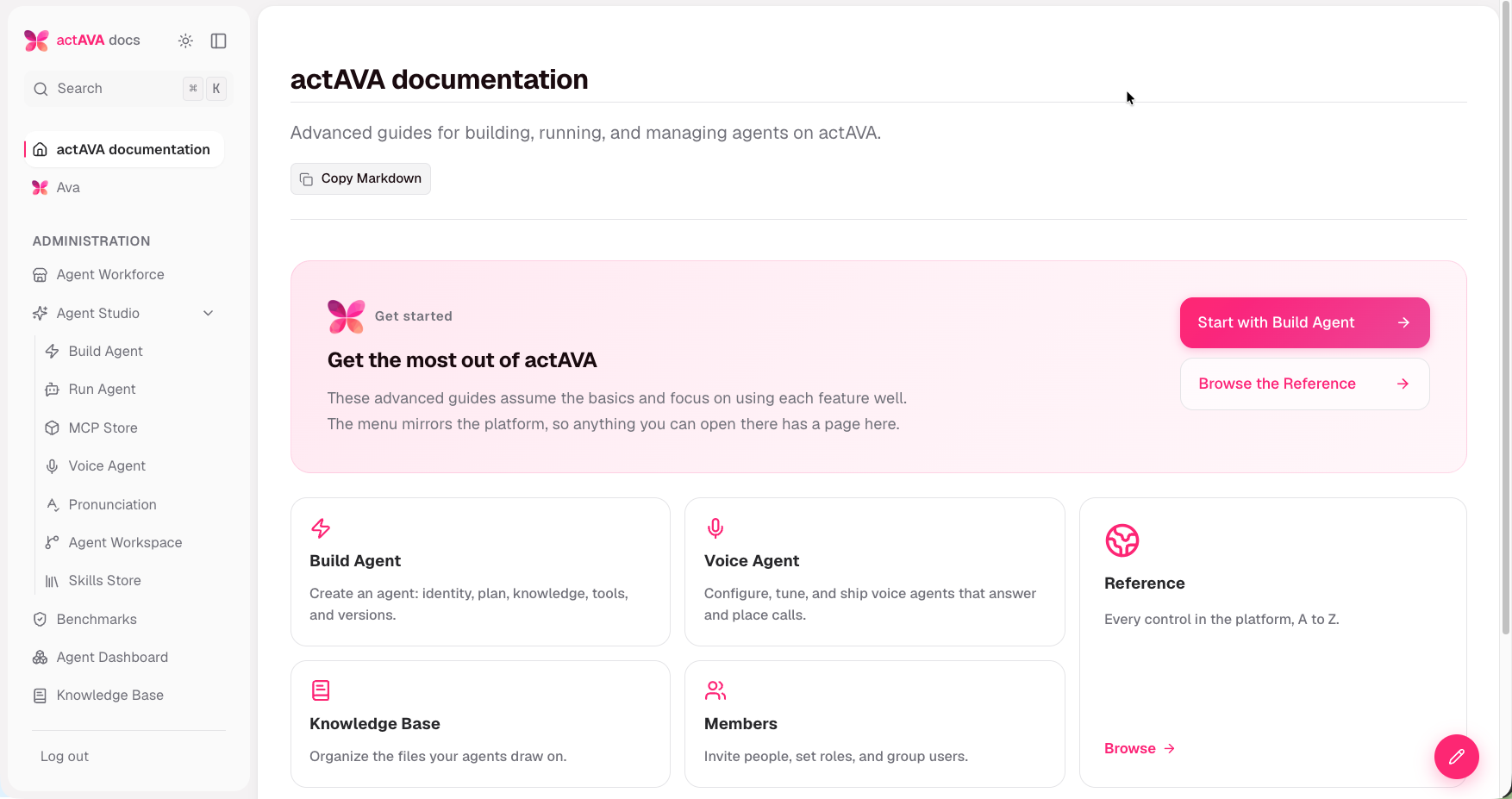
Documentation. Actava.ai's platform documentation is now public: no demo, no NDA, no gate. Any compliance officer, IT lead, or clinician can read how our agents get built, tested, governed, and monitored before a contract exists. Published docs are a promise a buyer can hold us to.
New Pre-Built Agents
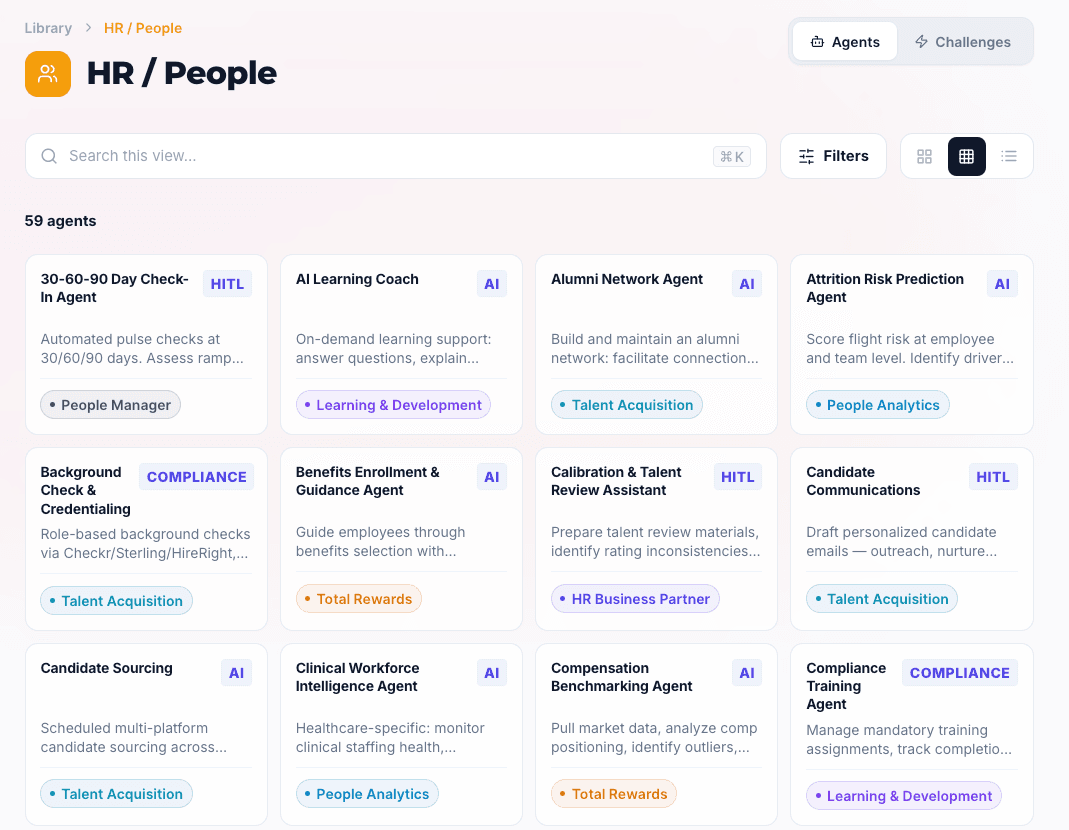
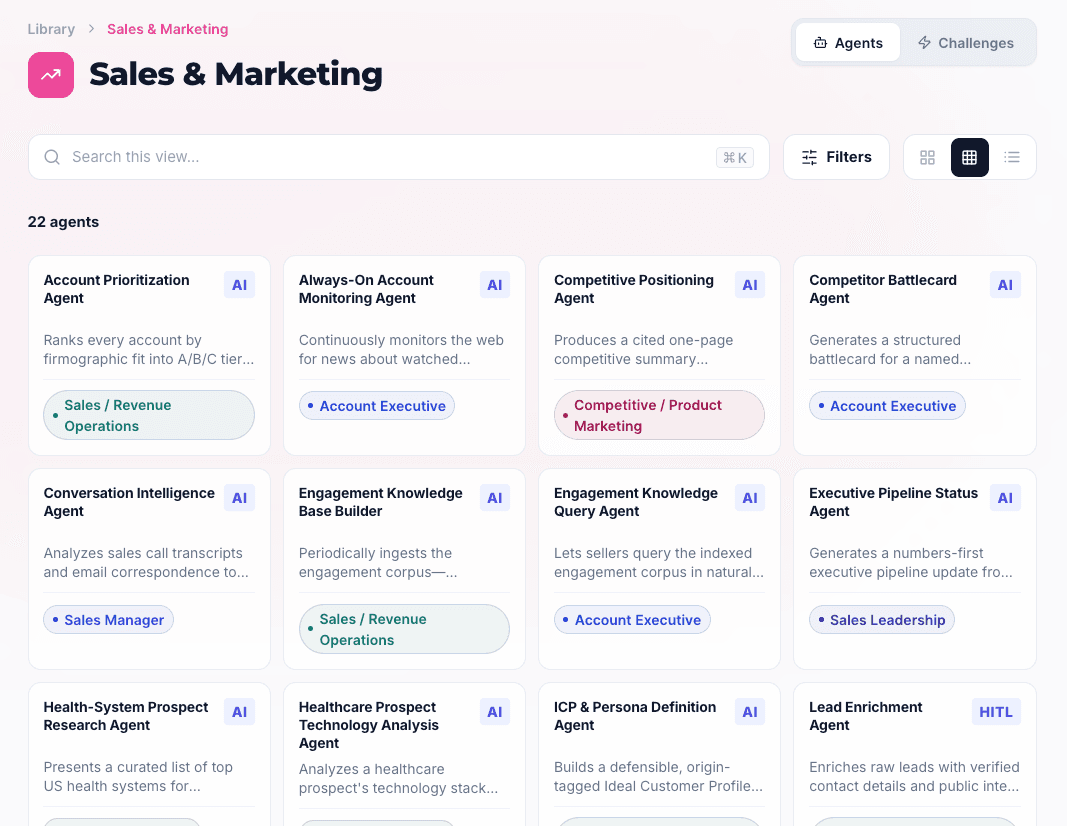
We added a new batch of pre-built agents for our customers who are relying on manual tasks to run their healthcare staffing processes.
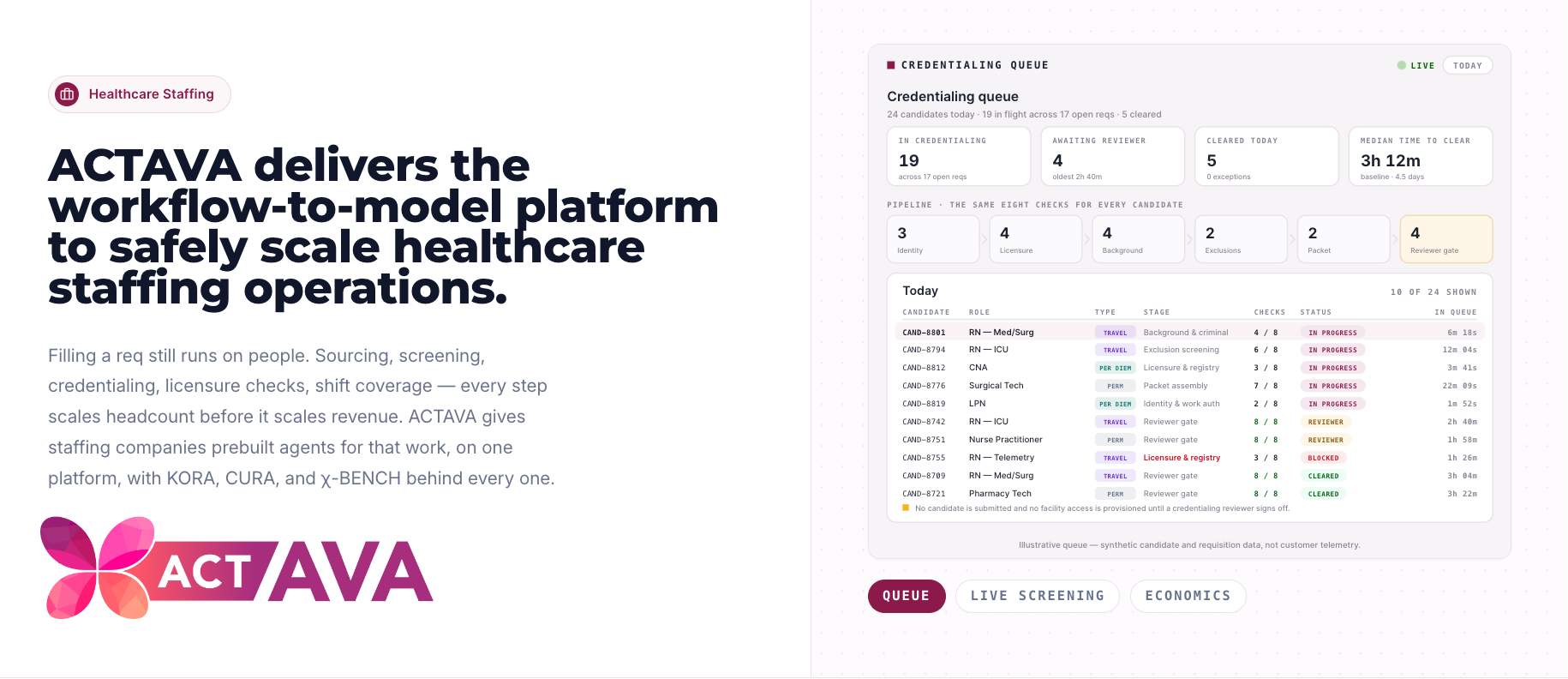
Healthcare Staffing Agent Library
Run the desk from open req to redeployment, on agents that flag rather than overstep.
Healthcare staffing turns on speed and compliance at once: an unfilled order bleeds margin, and an unverified submission is a liability. V7 adds a Healthcare Staffing solution to the Workforce library — 15 agents across six categories and three guided challenges, from client acquisition through credentialing to clinician retention. In keeping with the release's accountability theme, the agents are read-only, draft-only, or preview-only by default, so a recruiter or credentialing specialist owns every consequential step.
Requisition to shortlist. Client-acquisition, demand-research, sourcing, matching, and submission agents work each order from a real hiring signal to a ranked shortlist, de-duplicating against the CRM and attaching a written rationale to every match.
Screen and clear before submission. An outbound voice agent pre-screens candidates and escalates hard stops to a live recruiter, while a credentialing agent verifies licenses against these sources if the API connection exists - NPPES and state boards and screens the OIG LEIE and SAM.gov exclusion lists, flagging gaps, never clearing a credential or submitting to the client on its own.
Reconciled contracting and onboarding. A contracting agent drafts pay-package job-sheet previews for sign-off and holds any figure that does not reconcile against the accepted offer, and an onboarding agent builds a Day-1 checklist that puts start-blocking items first.
Retention and development. Mid-assignment check-ins surface renewal signals, a job-search agent fit-ranks the next assignment before a traveler drifts to a competitor, and career-pathway, news, and NCLEX-prep agents keep clinicians engaged between placements.
New Features
Agent Batch API
Run one agent across thousands of records with a single API call.
Healthcare operations are batch-shaped: a risk-adjustment panel, a claims queue, a member cohort. V7 adds an external, OpenAI-style batch API so an upstream system can submit thousands of records and let the platform dispatch, meter, and settle every run without a person babysitting the queue. Capacity is managed centrally, so a large batch scales into available fleet without starving live traffic.
Idempotent ingest. Chunked, idempotent ingest with presigned upload handles for large batches, canonical request hashing, and org-scoped reads, all behind a default-off
BATCH_API_ENABLEDgate.Capacity-aware dispatch. A generation-fenced dispatch loop with a capacity reconciler sizes the fleet based on live traffic and batch demand, and bounds demand-driven scaling per organization.
Speed tiers. Batch speed is a purchasable tier. The platform allocates by it and bills only for what was actually delivered, with per-item token usage reported for every result.
Feasibility at submit. The API answers feasibility when a batch is submitted, not at a drain deadline, so callers learn immediately whether the work fits.
Durable results. Completed results freeze to S3 exactly once, surfaced through a
results_urland a live results cursor with PHI audit on read.Strict contracts. Unknown request fields are rejected behind a default-off gate, with telemetry first, so callers can be warned before enforcement.
Approval-aware. A paused-item poller reconciles human-in-the-loop approvals and reclaims orphaned items so a batch survives restarts.
Skills Studio and Skill Store
Author a skill once, prove it works, and govern who can publish it.
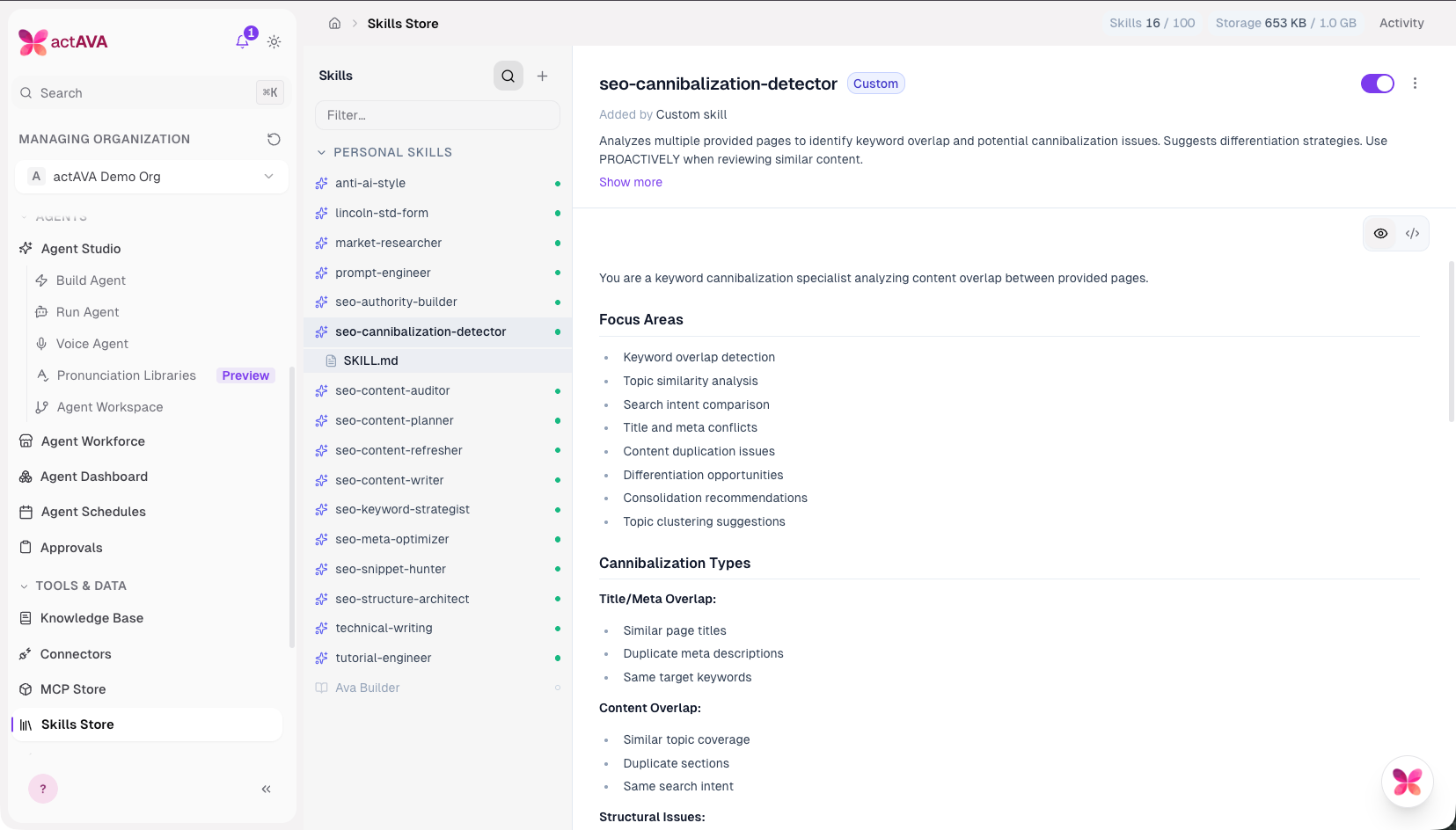
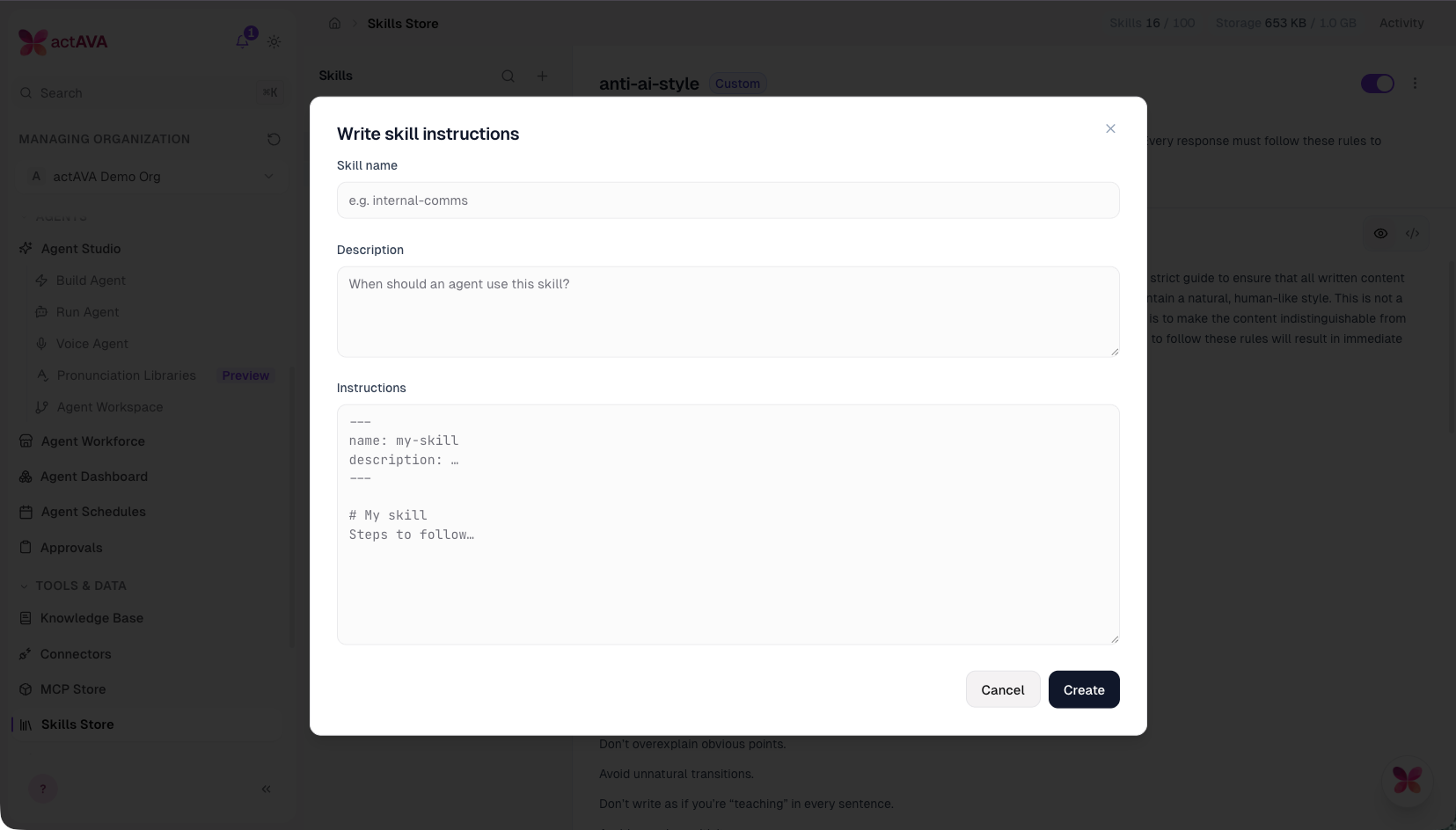
Skills are how an agent learns an organization's own procedure: a coding convention, an intake script, a clinical workflow. Until now, they were loose files with no version history, no test, and no approval path. V7 turns skills into first-class governed assets: authored conversationally with Ava, versioned as bundles, tested in a sandbox against golden cases, and published only through an approval gate sized to their risk.
Skill Store and My Skills. A browsable store with card grid, search, and filters, plus a My Skills view split into Organization and Personal sections.
Conversational authoring. A Skill Builder persona builds and edits skills in conversation, and any role can personalize an existing skill with Ava.
Bundle skills with real version history. Skills are bundles rather than a single file, with version list, content view, diff against live, rollback, and download.
Sandboxed test battery. A jailed subprocess runs file-mode cases and grades a skill against golden cases before it can be promoted.
Governed publishing. Risk banding, a two-person rule that degrades gracefully in single-admin organizations, and quarantine on upload close the governance gap.
Clinical safeguards. A clinical build pack ships with a PHI stop that is flag-confirm-remediate rather than a hard halt, so authors can fix rather than restart.
Integration Framework and Connector Marketplace
Connect the systems of record your workflows already run on.
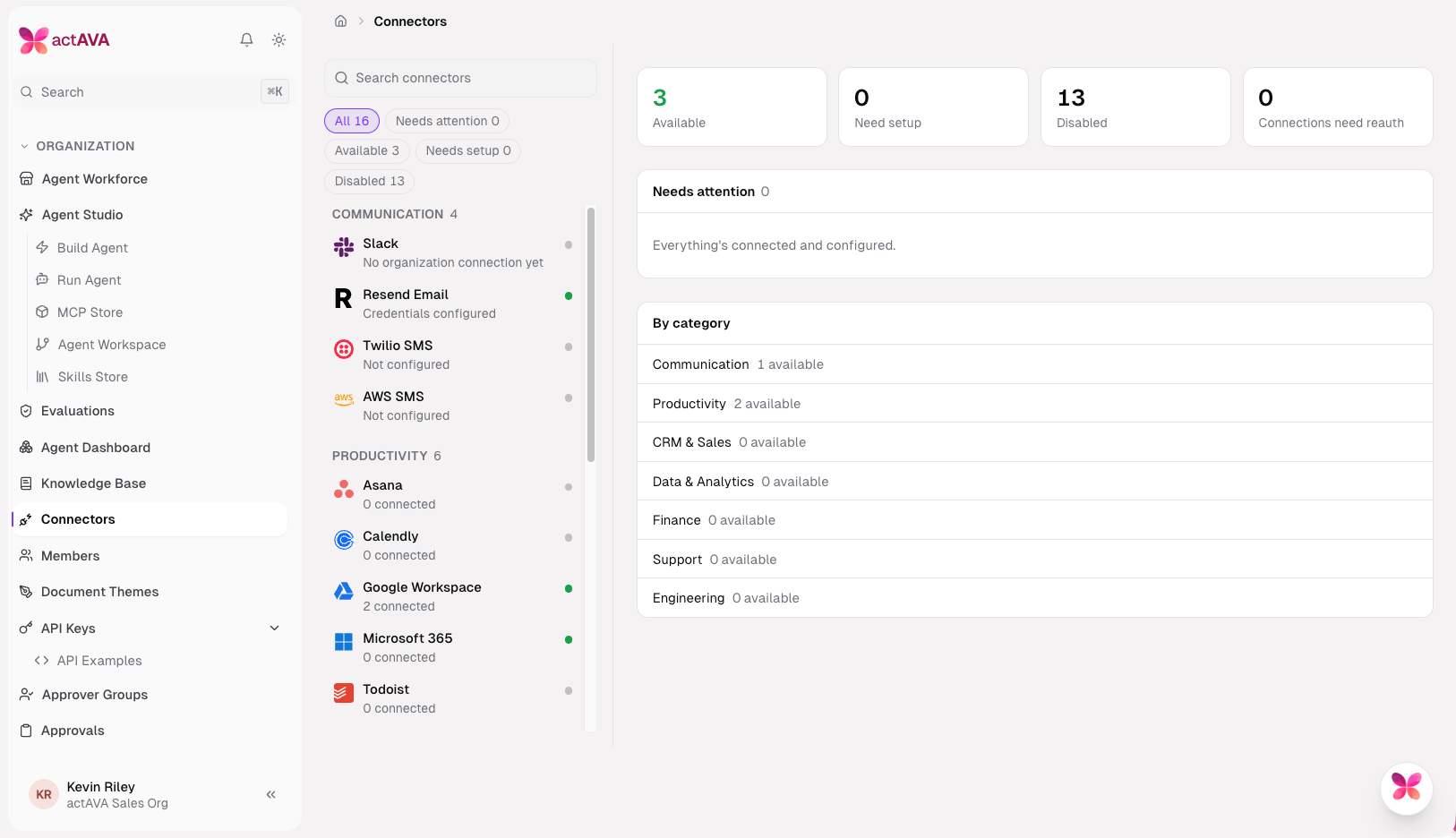
An agent is only as useful as the systems it can reach. V7 introduces a spec-driven integration framework, one OAuth and action model behind every connector, and uses it to add a wave of new integrations. Tools stay disabled until their connection is live, so an agent never offers an action it cannot complete.
New connectors. Asana, Linear, Calendly, Todoist, and Intercom (batch 1); HubSpot (batch 2); GitHub via the GitHub App user-token flow; QuickBooks with OAuth action dispatch; and Databricks with Genie materialization behind a per-agent acknowledgment gate.
Catalog-driven UI. A single catalog drives the connector list and configuration surfaces for every personal-token and OAuth provider, with a generic connector tab as the fallback.
Connection-gated tools. Slack, GitHub, SMS, Resend, and Gamma tools now activate only when their connection is configured. The old always-on
ENABLE_*_TOOLSflags are retired.Two-axis connector health. Both connector surfaces were rebuilt on a two-axis status model that reports connection health and availability, with compare-and-set credential writes, and a per-provider revoke shape.
Generic inbound webhooks. A generic
/v1/integrations/{provider}/webhook/{token}receiver with per-provider verifier strategies and idempotency backs inbound events, and the live Twilio SMS receiver moved onto it.Personal connections. End users connect their own GitHub and Microsoft 365 accounts, and an admin can connect Microsoft 365 for the whole organization.
Actava.ai Inference API: Production Launch
Call Actava.ai-served models from your own stack, on their own domain.
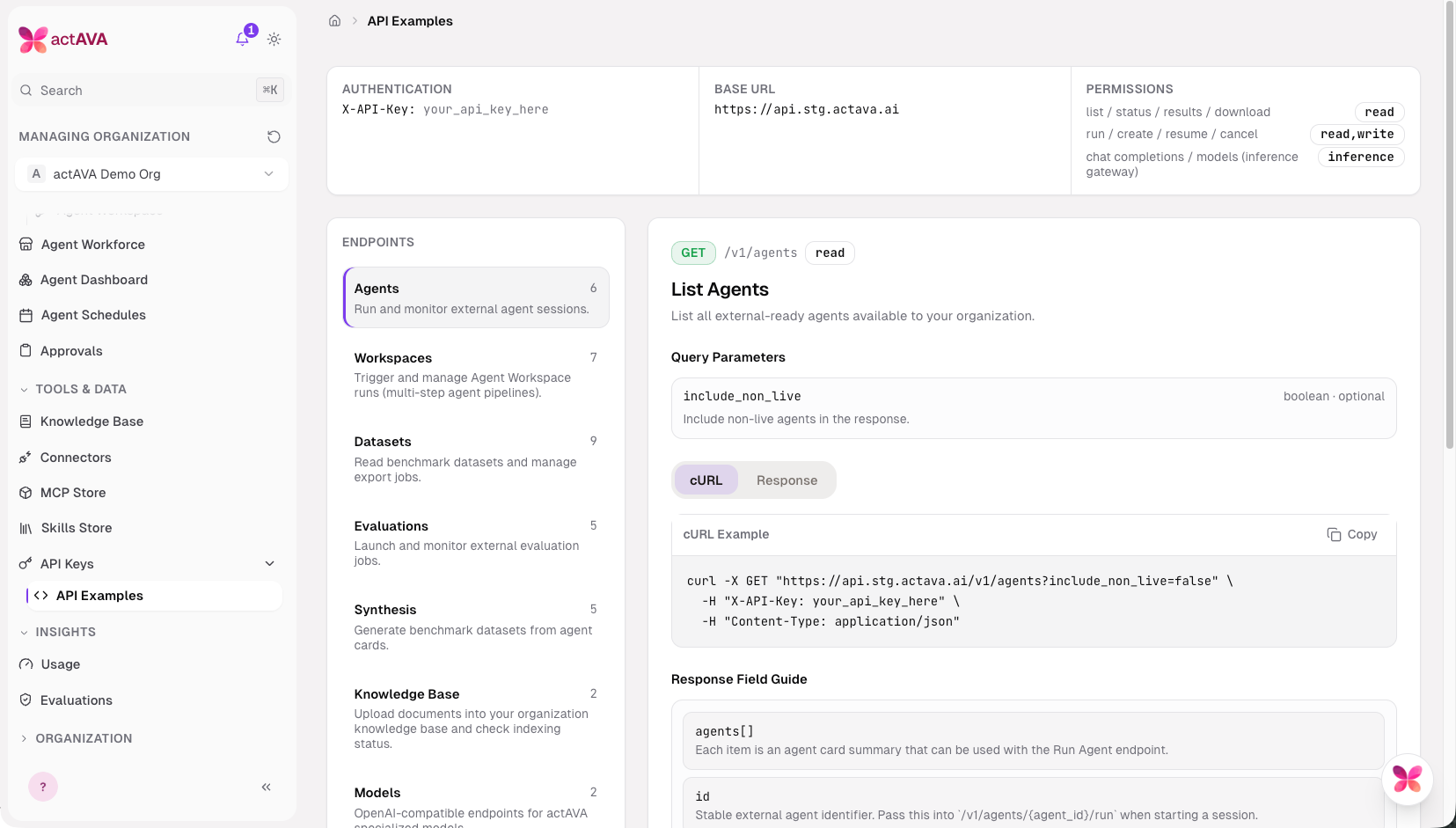
The Inference Gateway arrived in V6 as an internal capability. In V7, it went live in production at inference.actava.ai, with trial data migrated from staging, browser-redirect routing in place, and a welcome bundle that points new key-holders to the production endpoint and the single Cura Soar model ID.
Production cutover. The gateway moved to its own domain with a documented cutover runbook and pre-applied load-balancer rules.
Trial continuity. Trial inference keys and their usage ledgers migrated from staging to production so no evaluation was interrupted.
Built-in web search. The gateway executes a
$web_searchbuilt-in tool through Tavily, and advertises 256k context and image input.Single model ID. Callers use one stable
actava:cura-soarID, resolved to the active serving backend by a system-admin switch.
Deterministic Exactly-Once Tool Execution
Submit the claim once, even after a retry.
In healthcare, running a side-effecting action twice is a real defect: a duplicate claim, a double enrollment. V7 adds a deterministic execution layer so a tool with side effects commits exactly once, and a refused submission can be replayed without re-running the agent.
Idempotency middleware. ToolIdempotencyMiddleware tracks each side-effecting call through a tool-invocation ledger, so a retry reuses the prior result rather than executing again.
Array-batched claims. Dedupe-argument extraction handles nested and multi-patient tool arguments, independently claiming each record.
Deterministic submitter. An end-of-turn, exactly-once write-back submits enrollment work with read-after-write verification, and submissions the server refused can be replayed without re-running agents.
Deterministic fetch. A deterministic fetch executor runs as a pre-turn hook, the read-side twin of the deterministic submitter.
PHI Access Audit Trail
Prove who read what, and when.
HIPAA requires an account of every access to protected health information. V7 records PHI reads on an append-only trail across the top-risk routes, archives that trail nightly to immutable storage, and exposes a reporting API so a compliance officer can respond to an audit without pulling data.
Append-only trail. A dedicated model, repository, and service record PHI access on the highest-risk backend and next-gen routes, with poll dedupe.
Immutable archive. A nightly archiver writes the access trail to immutable storage with a durability metric.
Reporting API. A PHI access events report API surfaces the audit trail for review.
PHI-safe logging. A structured PHI redaction filter in the shared logging pipeline announces itself for verification and closes the file- and content-key gaps it previously missed.
Standing Instructions v10
One governed place for what an agent should always do.
Agent "memory" was an unversioned field that anyone could overwrite. V7 converges it into Standing Instructions: live documents with revision history, carried through export and import, and pinned per run so you can see exactly which instructions produced a result.
Live documents. Standing Instructions become live documents with revision history, execution pins, and pipeline resequencing at runtime.
Per-turn provenance. Every run records the Standing Instructions revision for each turn it ran under, as shown in the trace.
Memory convergence. A phased migration makes Standing Instructions the authoring surface and closes every remaining writer to the old Memory field, with a guarded rollback and a drain gate.
Analysis-aware. Evaluation and analysis surfaces resolve a run's instructions behind a trust boundary, and dataset evaluations pin to validated provenance.
Model Access Governance
Decide which models each team is allowed to run.
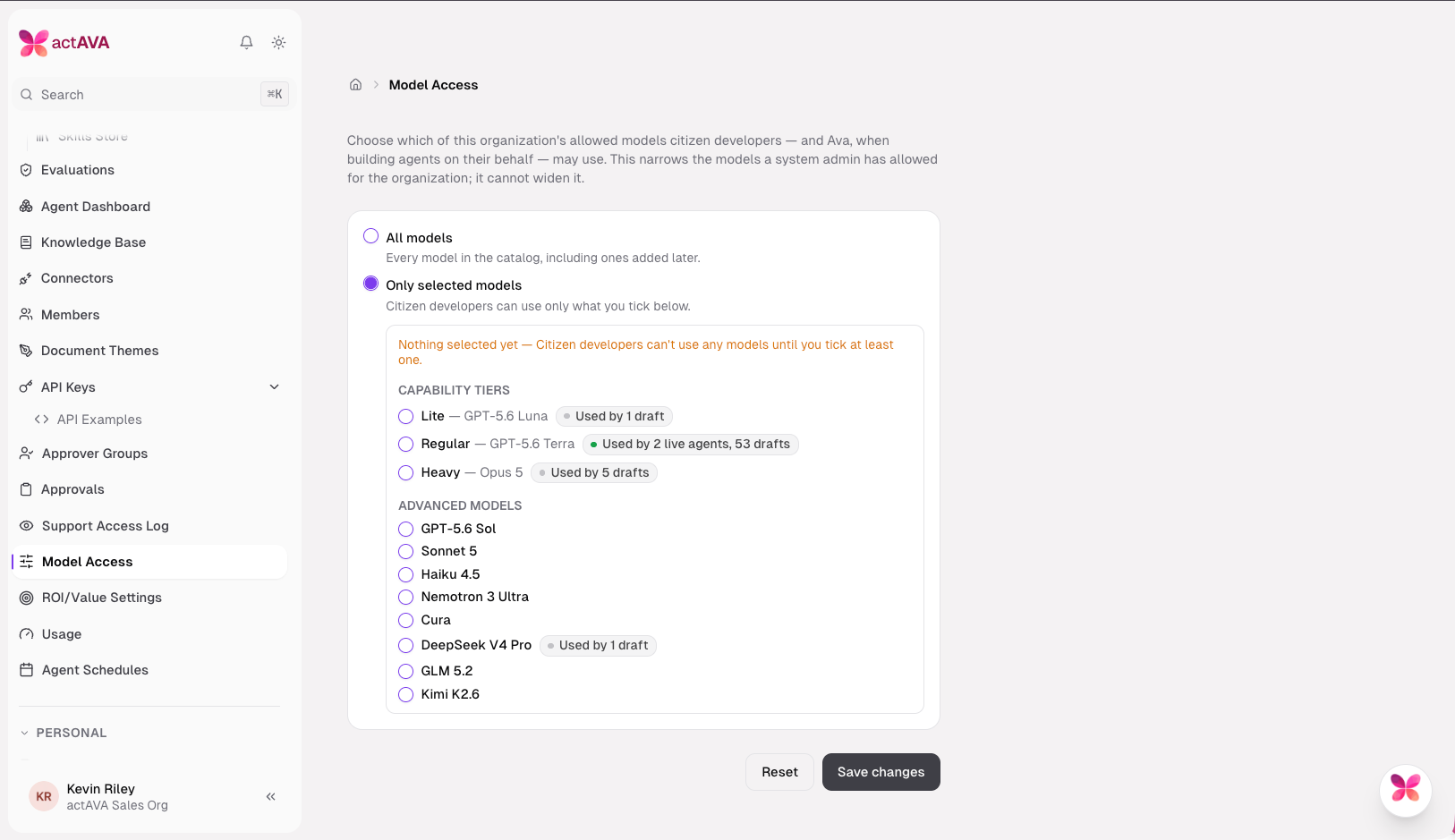
Different organizations have different rules about which models may touch their data, and a hard block is a bad experience. V7 adds org- and role-level model ceilings with a graceful substitution path.
Org and role ceilings. A system admin sets an organization's allowed-model ceiling against a canonical model catalog. An org admin edits the developer subset from a Model Access settings page.
Graceful substitution. A restricted model is never a hard wall. The platform substitutes an allowed model and informs the user.
Voice axis. Voice agents carry a separate model-ceiling axis with org-admin voice-subset routes.
Usage visibility. Both model-access pickers show per-model agent usage counts and surface the resolved model name, while citizen-developer pickers filter to effective access.
Agent Container Capacity and Load Testing
Operate the fleet, and prove it holds under load.
Running agents at enterprise scale means controlling how many run at once and knowing the ceiling before a customer reaches it. V7 gives operations a capacity control plane and a load-testing tool.
Capacity control plane. A super-admin Agent Container Capacity page and
/v1/admin/capacityREST API derive execution capacity from live ECS state, with a one-click reset to baseline, an elapsed timer, and cost estimates.Admission control. A fleet-wide run-lifetime admission gate ensures many compliant API keys cannot together exceed execution capacity, wired through submit, continue, pause, and resume.
Load and Performance. A staff-only Load and Performance tool runs templated load against the platform with configurable concurrency, hard caps, 3 cadences, and live progress charting.
Super-Admin Support Access
Help a customer from inside their tenant, on the record.
Supporting a healthcare customer sometimes means seeing exactly what they see, and that access must be bounded and logged. V7 ships a credentialed "log in as" mode with a full audit trail.
Credentialed login-as. A full-app support mode with credentialed sessions, effective authorization, and a persistent banner, activated at the router with an identity swap.
Bounded sessions. A 30-minute idle timeout, super-admin force-end, and customer-initiated end, each with a labeled end reason.
Audit-trail pages. The Support Access and Support Access Log pages record cross-org sessions, with the access reason captured at login.
Agent Access and Ownership Controls
Least-privilege sharing, and org stewardship of live agents.
As agent portfolios grow, sharing needs to be precise, and ownership needs to survive an author's departure. V7 adds an explicit access model, org ownership, and a cross-org authority sweep that separates reading from writing to a customer's org.
Only-me and subset sharing. An "Only me" owner-only access mode and subset-key saves replace broad sharing, backed by a real consumer matrix.
Org ownership. Going live transfers a live agent to org stewardship with a dev-facing org-owned badge and delete gating, protecting the live version.
Read/write separation. Platform admins may read a customer organization without writing its agents, and single-agent reads gate on role and visibility rather than organization alone.
Submission review. Server-side readiness is enforced on submit and resubmit, with a required/optional spec grouping in the builder.
Post-Run Self-Check, Efficiency Coach and Diagnose
The agent grades its own run, and you accept the fix in one click.
Continuous improvement works best when the feedback is immediate and cheap to adopt. V7 adds a post-run judge that checks a run against its instructions, a coach that finds wasted work, and a diagnosis flow that now proposes the fix directly in the report instead of sending you elsewhere.
Inline self-check. A post-run self-check appears in the chat thread with one-click "Add to Standing Instructions," and the same verdict-and-accept flow works on workspace steps.
Efficiency coach. Deterministic waste detection surfaces turn-scoped findings with one-click learned rules and durable acceptance.
Diagnose and propose in one flow. Diagnose and Optimize merged into a single progressive surface, so you can read the report, propose the fix within it, and both now see the conventions a run actually followed.
Metered honestly. Every self-check judge call is measured and billed against the organization's usage.
Ava: Grounded Answers and Smarter Building
An assistant that cites the product and checks before it builds.
Ava's value depends on being right about the platform and not creating duplicate work. V7 moves Ava's grounding from retrieval to the prompt, makes her cite product documentation, and teaches her to search the existing fleet before building something new.
Grounding contract in retrieval. Ava's answers are grounded at the retrieval layer, with product-doc citations and cross-source citation-ID collisions fixed.
Build-vs-reuse. An AvaFindAgent capability checks the existing fleet before building, and building from a shared thread auto-moves into a private build session instead of dead-ending.
Capability flags. Org admins toggle Ava's web search, org-knowledge access, and non-live dispatch. The composer exposes the enabled ones and the orchestrator refuses to circumvent a disabled capability.
Honest refusals. Voice and workspace authoring stay admin-only, and a citizen developer gets an honest redirect rather than a dead-end draft.
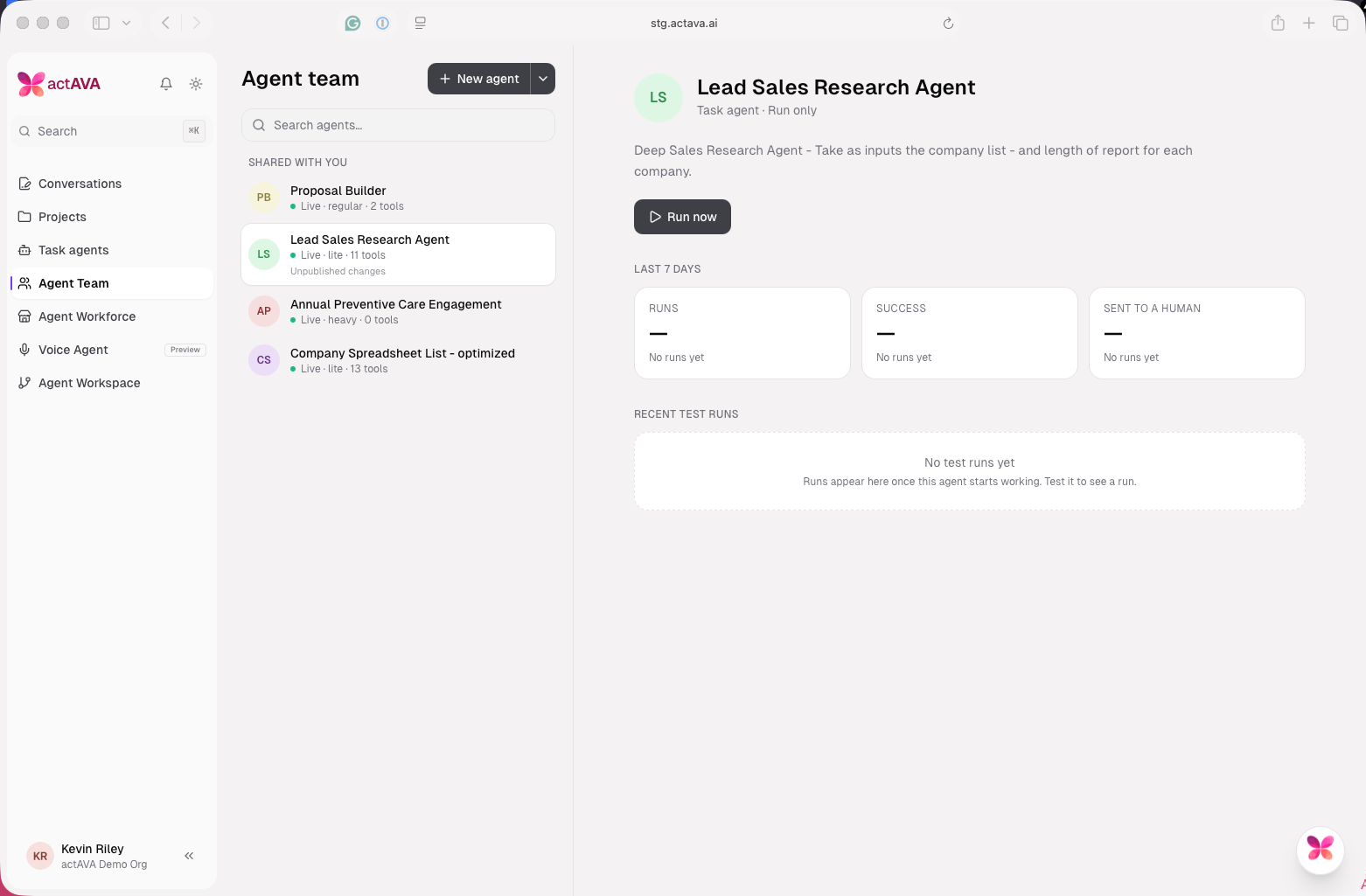
Agent team CTAs. Live agents offer "Open chat," which opens the Ava Director with the agent preselected, and "Run now," which relocates to the task page and starts the run.
Agent Scheduler
Scheduled agents that fire accountably.
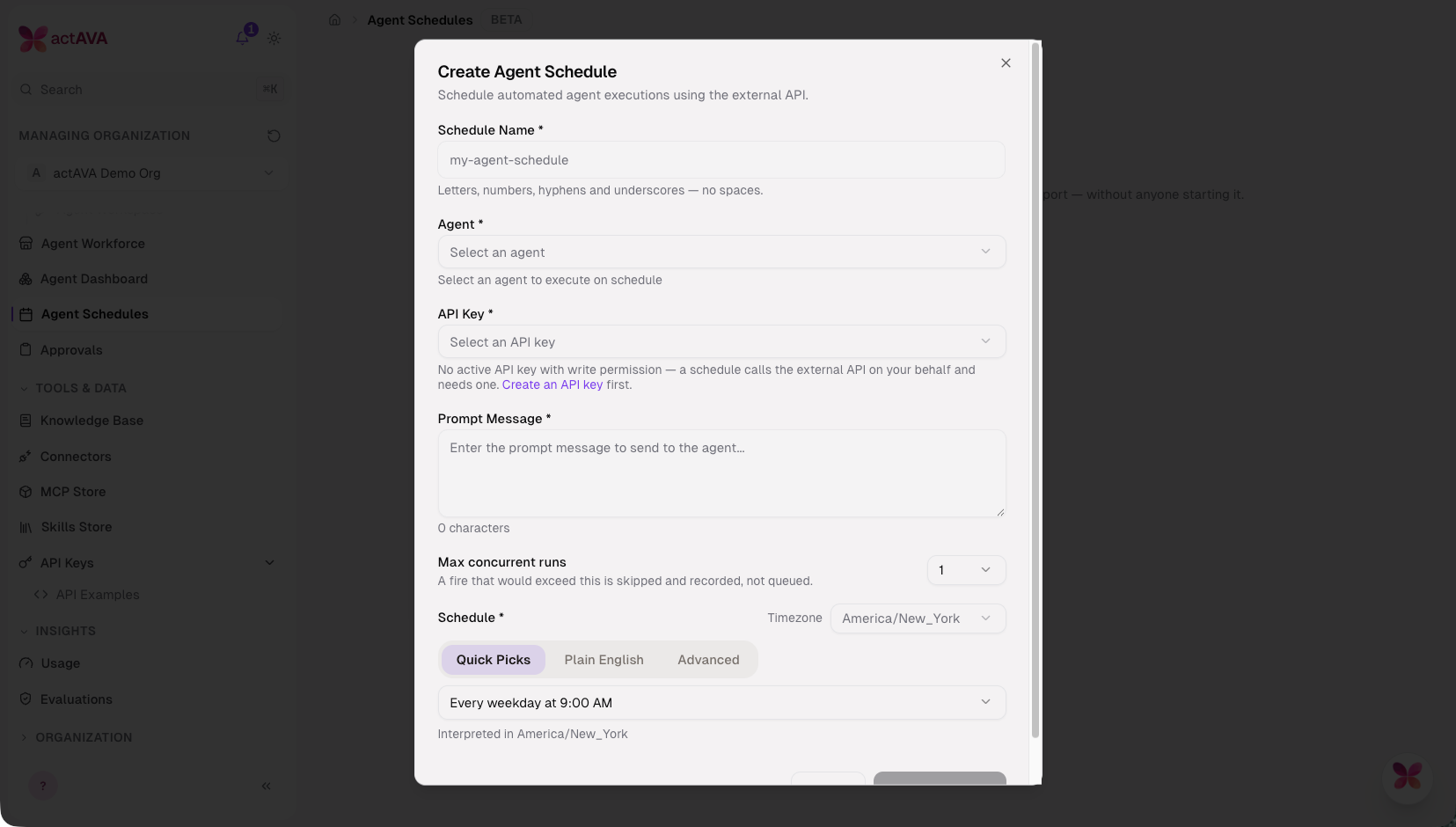
Scheduled runs must fire on time and fail loudly. V7 rebuilds the scheduler around an accountable fire ledger.
Accountable fires. A schedule-fires ledger with dispatch reservations, a reconciler, and a circuit breaker makes each fire idempotent and attributable.
Three cadences. One-time, daily, and weekly schedules, where a one-time schedule fires once and disables itself.
Owner identity. Scheduled runs resolve a run-as identity before the audit stamp, making scheduled-run auth failures visible.
Issue Reporting
Report a broken run without leaking a patient record.
When an agent misbehaves, the fastest fix starts with a good report, and in healthcare that report cannot carry PHI. V7 adds run-anchored issue reporting with PHI-safe telemetry.
Report a problem. A run-anchored "Report a problem" entry in chat and run history for every role.
PHI-safe telemetry. Structured, masked telemetry captures each failure mode, with an intake service and support notifier.
Review console. A system-admin review console names the reporter, shows the raw run payload with a copy button, and supports reversible status.
API Runs Console
See and operate everything running through the external API.
Customers driving agents over the API need the same visibility as the UI. V7 adds an Agents Directory console for external-API runs.
Agents Directory console. A console with a shared Diagnose Ask thread, a concurrency panel, and per-run file view and download.
Run visibility. External-API runs are marked with an API chip on Run History and scoped on the studio Runs tab, seeded with structured run parameters and a
run_inputs.jsonfile.Org-scoped. The organization picker is the scope, replacing cross-org content refusals.
Public Status Page
Tell customers what is up before they ask.
Enterprise healthcare buyers expect a status page they can check and subscribe to. V7 ships one, synced every 5 minutes from the production health probe.
Live sync. A 5-minute sync schedule publishes from the production
/v1/healthprobe, backed by a health endpoint built to actually fail rather than always return healthy.Per-component granularity. Components are named for what customers recognize, including a dedicated Voice component.
Claude 5 Model Family and Model Refresh
Move the entire platform to the latest models.
V7 repoints the platform's model tiers onto the Claude 5 family and refreshes voice and extraction.
Tier repointing. The heavy tier moves to Claude Opus 5. The lite and regular tiers move to GPT-5.6. Contextual retrieval moves to Sonnet 5 and Opus 5.
Evaluation judge. The evaluation judge upgrades to Opus 5, and the metric judge to Sonnet 5.
Voice and extraction. Voice models refresh to GPT-5.6 Luna, and ExtractPDF and brand extraction move to Sonnet 5.
Pricing corrections. Every provider rate was refreshed, correcting a case where one voice model billed at 5 times its actual rate.
Platform Console (early access)
A supported way for the platform team to act inside a customer org.
Cross-org support actions were previously ad hoc. V7 lands the foundation of a Platform Console, dark behind a policy flag, that makes every platform action an explicit, audited, server-authorized operation.
Org Inspector. A system-admin Org Inspector is the single org-support home, with an inspect-read audit trail.
Platform Actions. Dedicated Platform Action endpoints with an enforceable route registry, claims, outcomes, and a sweep reconciler.
Server-derived authority. Organization authority is derived server-side under
PLATFORM_ORG_AUTHORITY_POLICY, with a cross-org mutation guard on every org-config write and a platform-mode header that is forwarded but never treated as identity.
Voice Agents
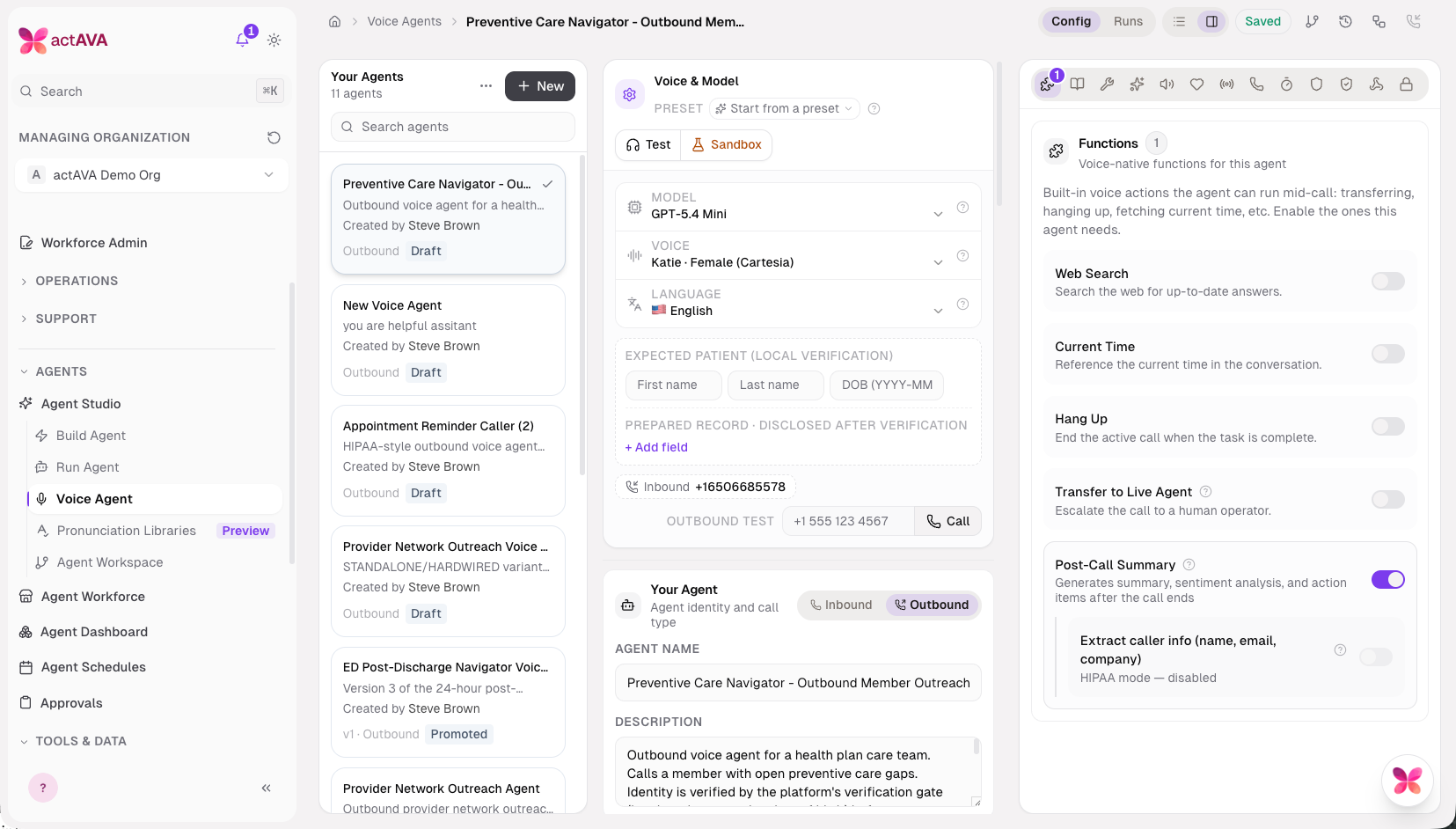
Voice run export. System admins export voice runs, at parity with text-run export.
Model refresh and correct billing. Voice models have moved to GPT-5.6 Luna, and the sessions that previously reported a $0 cost are now billed correctly.
OpenAI Fast mode. The cost model supports OpenAI Fast mode ahead of enabling it.
Outbound PSTN gating. Placing an outbound PSTN call requires an org admin.
Inbound routing protection. A developer's voice release can no longer reroute the organization's inbound calls, and the organization's defaults no longer silently clear the inbound answerer on a misspelled field.
Spoken language. The language selector changes the spoken language, not only the accent.
Greeting fidelity. Authored welcome greetings are spoken verbatim, and the builder and runtime no longer duplicate self-identification.
Export/import round-trips. Voice export and import round-trip with call-duration configuration, and per-agent import conflict resolution fixes voice re-import conflicts.
Authoring clarity. Identity and guidelines generation produce cleaner formatting and honest placeholders, and the sandbox-test modal explains what it will and will not save.
Agent Studio Improvements
Builder and Access
Citizen-developer console toggle. Admins switch between the admin and citizen-developer consoles, and org admins see all agents with a "My agents" filter.
Citizen-dev surface expansion. Citizen developers reach Voice Agent and Agent Workspace, with a developer-tier gate replacing org-admin checks where the tier is the right bar.
Task-test UX. A citizen-developer task-test experience with inline human-approval handling.
Human Approval section. A read-only Human Approval section and required/optional spec grouping in the builder, with server-truth submit review.
Publish icon library. The built-in publish icon library expands to 85 icons.
Agent Workforce
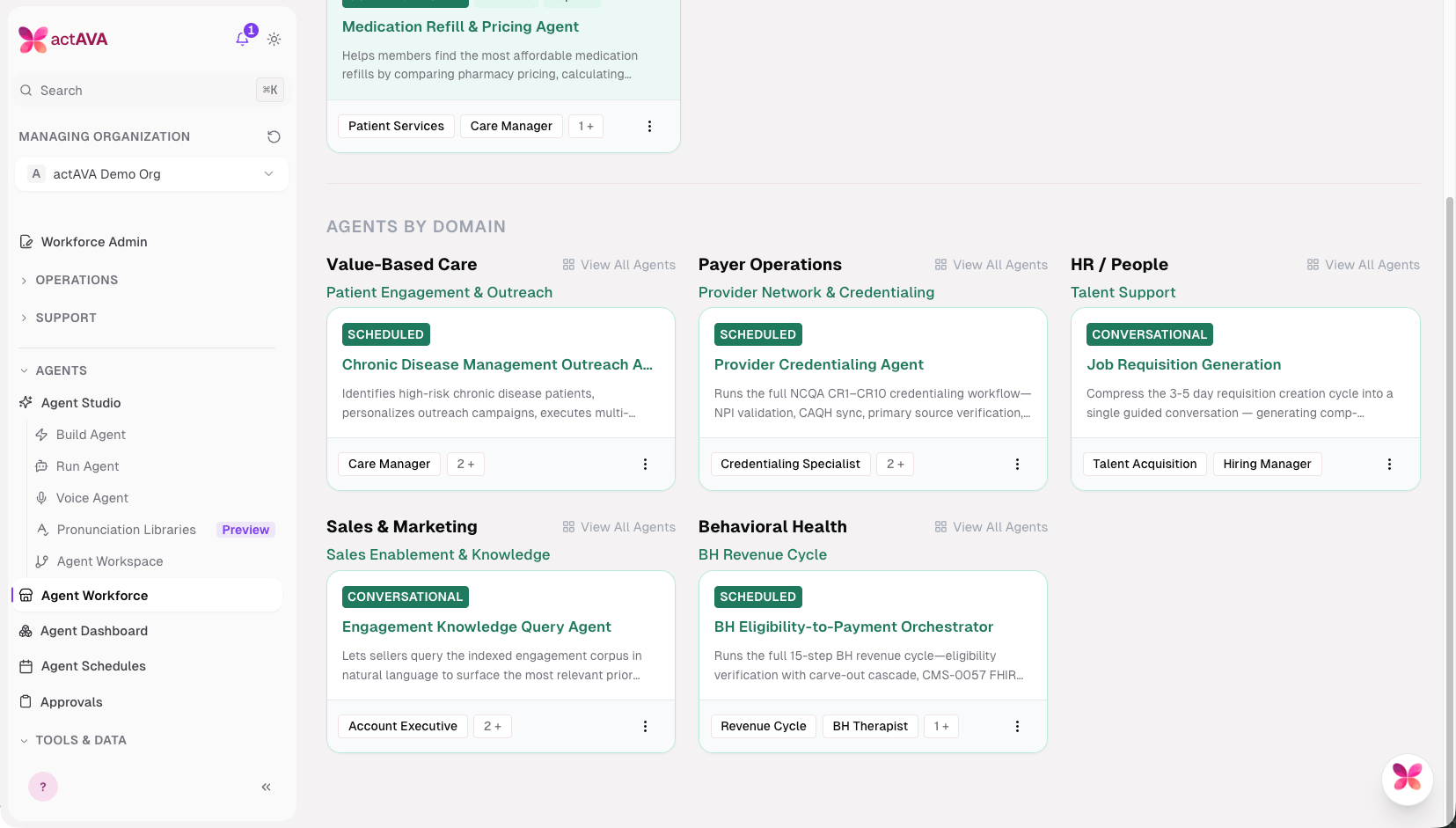
Workforce migration. Export, inspect, and import for the Workforce library, with a Migration tab in Workforce Admin.
Migration usability. A searchable organization combobox, alphabetical sort, and a default import organization.
Taxonomy and filters. Bulk facet lookup for listing taxonomy associations, industry-scoped filter options, and hidden empty filters.
Import correctness. Imported agents land schedule-decided, with agent knowledge-base indexes written to the right namespace, and listings are slugged at create and refuse to clear on update.
Connectors, Knowledge and Model Access
Connector surfaces rework. Both connector surfaces rebuilt on the two-axis status model with connection-health badges.
Databricks connector tab. Org configuration, a Genie kill switch, and agent acknowledgments, with a setup guide on Manage Connectors.
MCP Store hardening. Test Connection probes a real tool path rather than guessing; the auth type is editable across OAuth families via config reshape; install failures are no longer silent; and a recursive config sanitizer and an SSRF guard have been added.
Knowledge Base management. Batch delete for organization knowledge-base files, optimistic concurrency on the folder tree, org-admin gating on shared uploads, and filtering inside the retrieval clause rather than after it.
Model Access settings. An org-admin Model Access page with a developer-subset editor and per-model usage counts, and an org edit drawer with a ceiling editor.
Navigation, Schedules and Governance
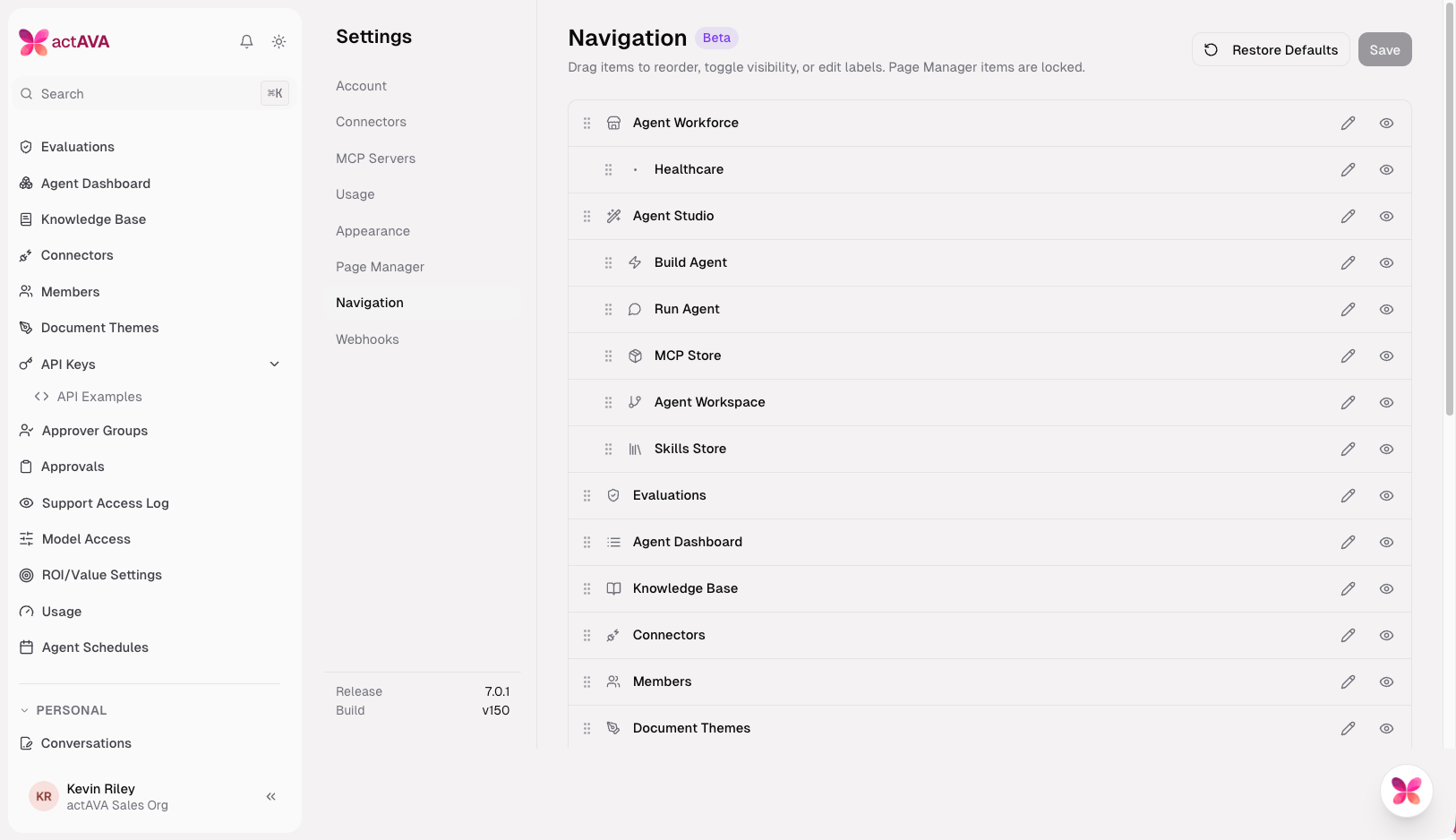
Navigation v2. A server-driven sidebar group registry behind a
nav_v2beta flag, with in-group ordering and validated org-wide navigation overrides.Schedule detail UX. The schedule detail page describes and controls its schedule, renders the fire ledger and breaker pause, and offers an attributed "Fire now."
Approvals and value settings. An approvals magic-quadrant with a risk panel, Value Drivers v3 with a sortable list and modal editor, and Org Context, Value Drivers, and Cost Model consolidated under one ROI/Value Settings surface.
Document Themes. Brand-controlled document output with validated color hex, gated save, confirmed reset, and the company name in the document header.
Right-edge dock signal. A docked right panel is signaled across the workspace, agent, and voice builder surfaces, and the Ava launcher yields to it as a compact edge tab.
Correlation reference. Every dead-end screen shows a copyable correlation reference for support.
Usage tab. An organization Usage tab with per-user and per-model cost breakdowns.
Agent Runtime and Chat UX
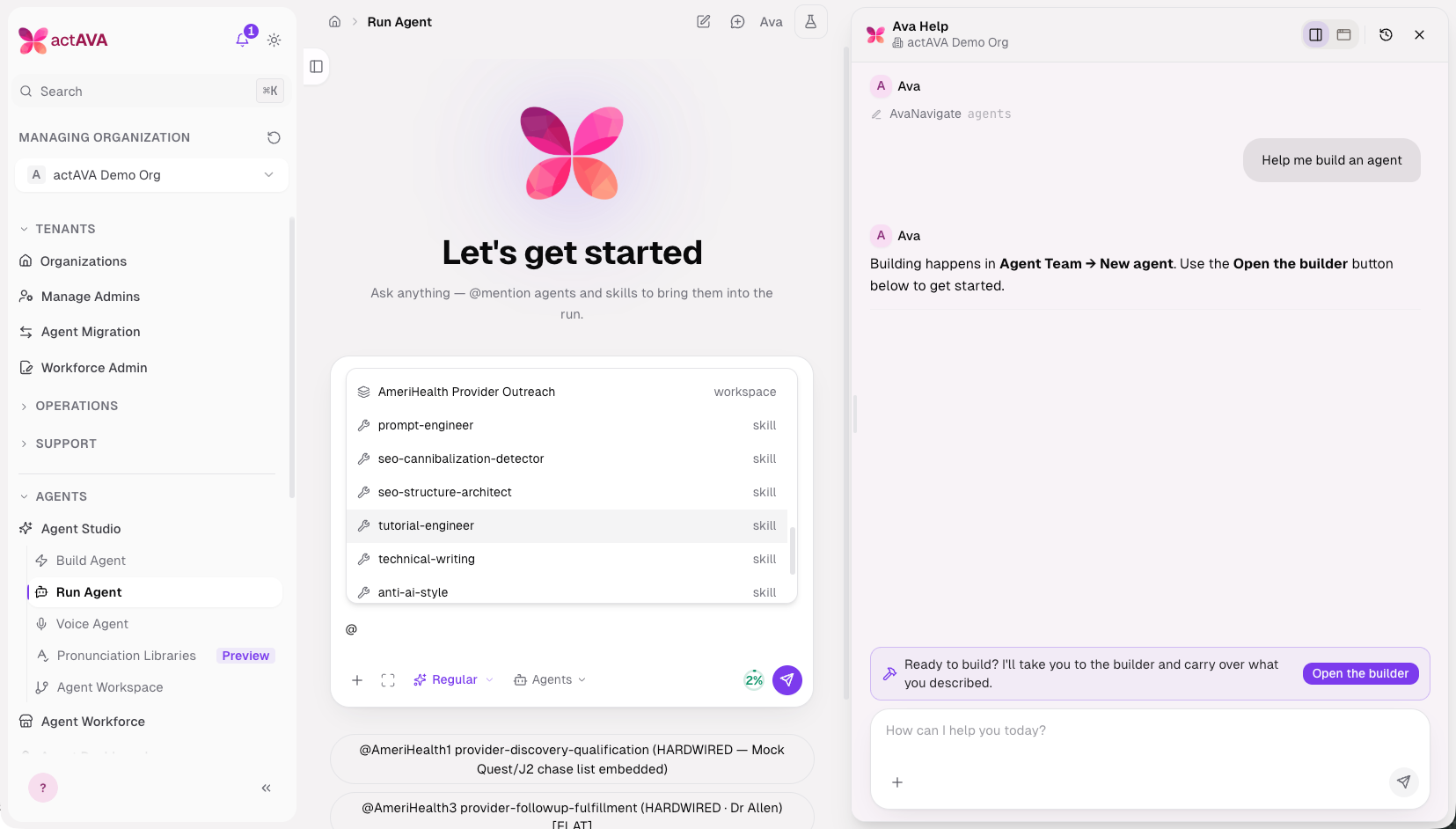
MCP session reuse. Cortex reuses one MCP session per (loop, org, server) instead of one per tool call, with per-server concurrency bounds and safer retries.
Turn budget guardrails. A turn is bounded by wall-clock and model-call budgets, with per-tool invocation counting so runaway loops are diagnosable.
Memory-watermark admission. A memory-watermark gate on the turn limiter sheds load before the worker runs out of memory.
HITL artifacts on approvals. An approver receives the run's actual output files as links pre-signed to the approval window, and an unanswered pause has an upper bound instead of hanging forever.
Conversational HITL. A paused run's composer sends rather than steers, unblocking approval conversations in chat.
Deterministic chart fetch. A deterministic fetch executor wires charting data into the turn as a pre-turn hook.
Gmail attachments to workspace. GmailGetAttachment writes to the agent workspace instead of piping the base64 data into context, and UI-attached PDFs are materialized to disk so that ExtractPDF can read them.
Fan-out durability. Backend-written workspace files are mirrored to durable storage, and fan-out rosters rehydrate from it on a local miss, so a multi-agent fan-out survives a worker restart.
Workspace file nav toggle. A user-toggleable sidebar or dropdown file navigation on every drive view.
Unattended runs. AskUserQuestion never pauses an unattended run, and the notifier names what paused a scheduled run.
Client session ID. A client session ID flows through request context, logs, and CORS, with a root error boundary and stale-build reload banner.
Delta save protocol. Runs save as deltas with an in-transaction acknowledgment, cutting write volume on long runs.
Run-as identity. Voice agents and pipelines accept a run-as identity for remote execution and scheduled runs.
Evaluations and Experiments
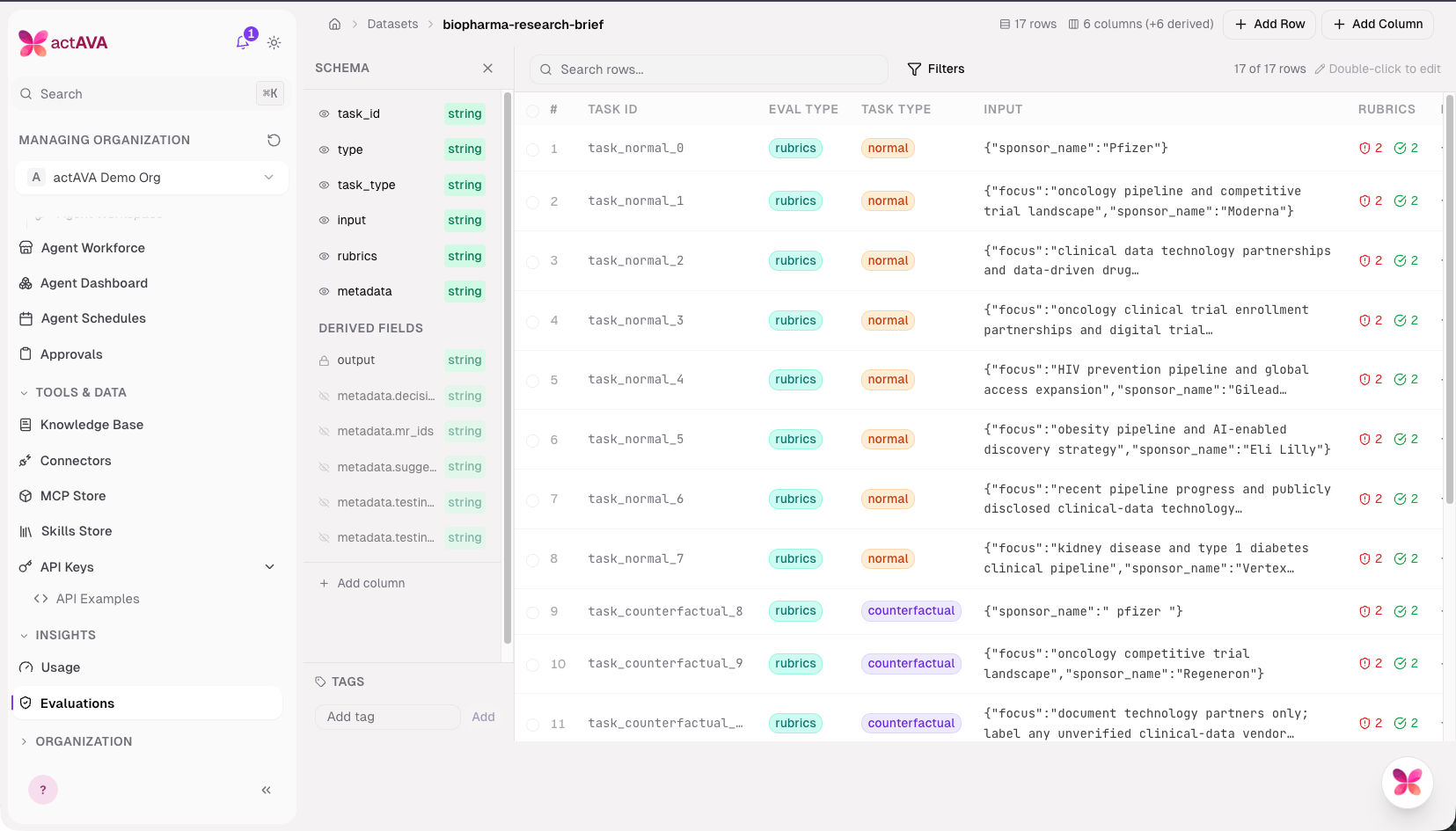
Judge upgraded to Opus 5 for grading, with the metric judge on Sonnet 5.
Auto-rubric metrics. Evals-generated, agent-specific rubric metrics with a built-in fallback, exposed through an internal generated-metrics API.
Revision-gate integrity. The revision gate detects contaminated gate comparisons before scoring and treats total execution failure as a capability failure rather than an incomplete one.
SI-aware evaluation. Evaluations accept per-turn Standing Instructions, keep them out of storage, and pin dataset evaluations to validated provenance.
Meta-card sync. In-container synthesis meta-card sync plus a scheduled drift check so prompt changes reach production.
Server-side offsets. Synthesis event offsets are allocated server-side with retry on collision.
Infrastructure and Reliability
Health and Capacity
Readiness probes.
/readyzon Actava.ai-backend, nextgen-backend, and Actava.ai Cortex tells a poisoned pool from a dead database. An internal health endpoint probes upstreams and detects SQS consumer stalls.Warm capacity probe. The execution capacity probe warms up at startup, so scaling requires no manual apply.
Admission reconciliation. Stranded admission slots reconcile, and a stuck-pending-run reaper has a worker-death fast path.
Fork-safe DB pool. A fork-safe connection-pool reset for preloaded Gunicorn workers, and database connection-capacity exhaustion surfaced as a
503 db_capacity.
Security and Compliance
Internal TLS. Service-to-service TLS across staging and production, with the router cut over.
PHI-safe logs. A shared log-leak sweep and structured PHI-safe logging remove user content, document content, search patterns, and PII from logs across every service.
Dependency hygiene. Sustained CVE remediation across pillow, aiohttp, pypdf, pyasn1, nltk, httplib2, ddtrace, protego, react-router, js-yaml, nanoid, Clerk, and vitest, plus a Postgres 17 CI parity gate.
Identity relink. Recreated-Clerk-user identity relink resolves the "session expired" loop, with honest invitation-activation accounting.
External API and Routing
External organization read API.
/v1/external/organizationsand organization details for system-scoped keys.API key controls. Per-key concurrency defaults to unlimited, limits are auditable and editable, and key creation and revocation are recorded in the audit log.
Router additions. Routes for the batch API, external api-runs, integrations, capacity control plane, PHI access events, ROI justification, external organizations, and the internal health probe.
Engineering Reliability
Autonomous alert-to-fix pipeline. Production alerts become evidence-backed bug reports; gate-passed bugs trigger an automated fix loop that opens a draft PR and monitors CI; and the originating alert is reacted to when the fix lands.
Regression backlog automation. A resolve-regression-backlog capability works the accumulated pile rather than one issue at a time.
Design System and Developer Experience
Raw IDs out of human surfaces. Internal IDs are removed from admin and next-gen human-facing surfaces in favor of names.
Accessibility sweeps. Continued a11y fixes across schedules, version history, HITL, chat mentions, and run detail, driven by the autofix pipeline.
Datadog privacy. Session-replay URL scrubbing, no response bodies or query strings, and RUM action-name privacy guards.
Desktop subsystem. The desktop frontend is quarantined under
src/desktop/with a host-agnostic extension slot that is a no-op on the web.CI review gate. A Claude review verdict gate and verify-change resolver enforce evidence-backed test coverage at commit time across every submodule.
Deprecations and Removals
Always-on tool flags retired.
ENABLE_SLACK_TOOLS,ENABLE_GITHUB_TOOLS,ENABLE_SMS_TOOLS, and the Resend/Gamma default-on flags are replaced by connection-gated tools.Agent Memory field retired in favor of Standing Instructions v10 as the authoring surface.
Agent Library surface retired, superseded by Agent Workforce as the place to find and instantiate a prebuilt agent.
ROI prompt-experiment routes removed from the platform in favor of the value-driver settings.
Legacy always-broad agent sharing removed in favor of the explicit access model ("Only me," subset keys, org ownership).
Capacity Scaling renamed. The page is now Agent Container Capacity.
Upgrade Notes
Model family upgrade. The heavy tier is now Claude Opus 5, the lite and regular tiers are GPT-5.6, and the evaluation judge is Opus 5. Organizations on defaults will see behavior shift; pinned organizations are unaffected. Confirm any per-agent pins are still valid.
Model Access ceilings. Set the organization's allowed-model ceiling before rollout. A run on a restricted model is substituted, and the user is informed rather than blocked.
Connection-gated tools. Slack, GitHub, SMS, Resend, and Gamma tools now require a live connection. The old enable flags are ignored. Re-verify each connector after upgrade.
Agent Batch API is off by default. Enable
BATCH_API_ENABLEDand set per-key concurrency and batch speed tiers before external batch submission. Strict unknown-field rejection is a separate default-off gate. Review the telemetry before enforcing it.Inference moved to its own domain. Production inference now serves from
inference.actava.aiwith a singleactava:cura-soarmodel ID. Update any client pinned to the previous host or to a-fastalias.PHI audit is active. PHI reads on top-risk routes are now recorded and archived nightly. Expect the access trail and its immutable archive to begin populating immediately.
Standing Instructions migration. Agent Memory has converged into Standing Instructions with revision history. Update any tooling that wrote the Memory field.
Skills governance is on. Skill uploads pass through quarantine, and publishing requires approval sized to the skill's risk band, with a two-person rule where the organization has more than one admin.
Support Access is audited. Super-admin "log in as" now requires an access reason and is recorded on the Support Access Log with a 30-minute idle timeout.
Agent Library is retired. Teams that instantiated starter templates from the Agent Library should use Agent Workforce.