Blog
AI Adoption Nearly Doubled. Value Didn't. Here's How Healthcare Closes the Gap.
GenAI adoption nearly doubled in a year, 19% to 35% fully implemented. Russell Reynolds found 67% report productivity gains, only 25% report profit. In healthcare, closing that gap takes AI training, mature governance, and agents that do real administrative work.
By Kevin Riley
New research from Russell Reynolds Associates shows GenAI adoption surging while profit and revenue impact stall. The gap isn't a model problem. It's a harness problem and a people problem, and healthcare can close both.
Russell Reynolds Associates just published research on what they call the gap between AI adoption and value realization, and the numbers tell a story every healthcare executive will recognize.
Adoption is booming. 35% of leaders report GenAI fully implemented in day-to-day workflows, nearly double the 19% from a year earlier. Only 9% of teams haven't started at all. 90% say C-suite AI literacy is non-negotiable for the next generation of executives.
Then comes the uncomfortable part.
Two-thirds of organizations are getting productivity. Only a quarter are getting profit. That 42-point spread is the value realization gap, and it's where most AI programs quietly stall.
Russell Reynolds puts the diagnosis in one line: "Action without strategy is ultimately more about keeping up appearances versus true value realization."
What leaders say they actually need
Here's the finding that should reframe every AI roadmap conversation. When leaders ranked the skills that matter most for the AI era, technical literacy came in near the bottom at 17%. Strategic thinking topped the list at 55%, a full 24 points ahead of anything else.
Leaders aren't asking for more tools. They're asking for judgment about what's worth doing, and for the discipline to govern it. The same research shows why: data quality confidence sits stuck at 40% year over year, only 29% trust their board's AI expertise, and just 27% of stakeholders actually reference their organization's AI policies in daily work.
The prescription Russell Reynolds lands on is to move "beyond experimentation and tool deployment toward disciplined and systematic AI transformation." Stronger data foundations. Real governance. Talent strategies rebuilt around AI. Leaders who can tell the difference between motion and progress.
We agree. And in healthcare, the gap they describe is wider than in any other industry.
Healthcare's version of the gap is three gaps
At ACTAVA we've run more than 200 conversations with payers, providers, and health-tech operators, and the adoption-to-value gap shows up in three specific places.
- The people gap. Only 17% of healthcare professionals report having any AI training. You can't have humans in the lead if they don't understand what they're leading.
- The process gap. Only 1 in 5 healthcare organizations has mature AI governance, despite wide co-pilot adoption. Desktop sidekicks are not enterprise agents running safely at scale.
- The technology gap. On χ-BENCH, our AI simulation and benchmarking suite, the best frontier agents clear roughly 33% of real healthcare administration tasks. The model alone cannot be your digital workforce.
And the stakes keep rising. 61% of healthcare leaders are already building agentic AI initiatives or have secured budget for them. 85% plan to increase agentic AI investment over the next 2 to 3 years. 98% expect roughly 10% cost savings in that window, and 37% project savings above 20%.
That's a lot of expectation riding on programs that, per Russell Reynolds' data, mostly haven't learned to convert activity into P&L. Productivity theater is easy. Value realization is engineered.
Closing the gap takes a harness
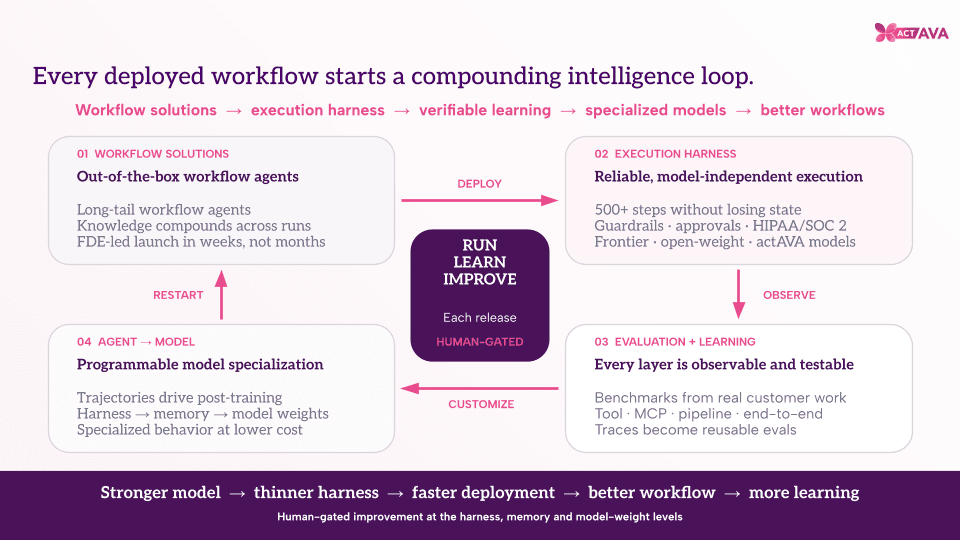
A frontier model is an engine. Nobody ships an engine to customers; they ship a vehicle. The harness is everything wrapped around the model that makes it accountable: the workflow grounding, the evaluation rubrics, the guardrails, the audit trail, the cost controls, the ROI reporting. It's how governed intelligence moves from complexity to clarity.
That harness is precisely the "disciplined and systematic" layer the research says is missing, and it's what ACTAVA built for healthcare, on four pillars: Build, Test, Learn, and Guide.
- Build. ACTAVA KORA, the agent building and orchestration suite: a guided low-code studio for chat, background, and voice agents, with a pre-built healthcare workflow library and connections into your systems of record. Non-technical teams build; IT doesn't become the bottleneck.
- Test. Every agent runs against custom rubrics and χ-BENCH before and after deployment, with every trajectory logged and testable for hallucination, prompt injection, and bias.
- Learn. Reinforcement learning on real agent runs, with humans approving every change, plus token optimization and real-time ROI dashboards that answer the CFO's question before it's asked. CURA, ACTAVA's 1-trillion-parameter healthcare model, sits alongside switchable models from Anthropic, OpenAI, DeepSeek, and more, so you pick the right model per workflow and never rent your future from a single vendor.
- Guide. ACTAVA CHRYSO, the governance and compliance suite: AI policy management, role-based workforce training, an agent registry, quota controls, and audit trails. It's how the people gap and the process gap close together.
Just as a human workforce needs HR, your digital workforce needs a system of record for accountability. That's the harness's job.
And it takes people in the field, not just software
Here's the part most platforms skip. Russell Reynolds found leaders ranking strategic judgment far above technical skill, because the hard question isn't "can we build an agent?" It's "which of our 40+ workflow families should become agents first, and how do we prove it worked?"
That's why ACTAVA pairs the platform with forward-deployed experts: healthcare industry specialists who sit with your teams, map the workflows that matter, and accelerate agents into production. They bring the judgment the research says is scarce, so your first 90 days produce measurable value instead of another pilot.
The 90-day arc is deliberate. Start quickly: plan the agent roadmap, build from the library, integrate through the MCP store. Run safely: set policies, evaluation rubrics, and human-in-the-loop controls. Grow intelligently: monitor consumption in real time and measure every agent's business impact against a customizable ROI framework.
The prize for getting this right
Why does closing the gap matter so much in healthcare specifically? Because the economics are unusually stark. A knowledge task that costs $15 to $25 in labor converts to roughly $1 to $2 in tokens once an agent runs it. A 10-to-1 spread, sitting inside an estimated $83B of excess administrative spend per year, most of it in long-tail workflows no vendor serves.
Rent a per-seat tool, and the vendor keeps that spread. Own the workflow and the inference underneath it, and the savings, the control, and the data stay with you.
Adoption was the easy half. The organizations that realize value in the next 3 years will be the ones that put a harness around their AI and experts beside their teams, so every agent is governed, benchmarked, and accountable for ROI from day 1. Kevin Riley, Co-Founder and CEO, ACTAVA
Russell Reynolds closes with a warning: 74% of leaders believe organizations that don't fundamentally transform will cease to exist within a decade. In healthcare, where the status quo is thousands of staff hand-processing prior auth, claims, UM reviews, and appeals, that's not hyperbole. It's arithmetic.
The gap between adoption and value is real. It's also closeable, with the right harness and the right people in the field.
Close your adoption-value gap in 90 days
See how ACTAVA pairs a healthcare-native agent lifecycle platform with forward-deployed experts to move your AI program from activity to measurable ROI.
Start a conversationThe AI factory for healthcare. Master your agentic future.

Written by
Kevin Riley
CEO & Co-Founder
Health-tech executive who builds and scales AI-driven software across healthcare, life sciences, and enterprise markets. Over 25 years launching and scaling solutions for healthcare and life sciences, Kevin led the healthcare and government business at Vlocity (acquired by Salesforce), growing it from $300K to more than $40M, and later served as GM of Salesforce's global Health & Life Sciences portfolio, a $4.5B business. He has also served as CEO of multiple software companies spanning AI, care management, regulatory science, and provider revenue. He created the award-winning modelH framework and was named a Top Healthcare Software Executive.