Blog
Building an AI-Native Health Organization From Day One
An AI-native health organization is designed so machine intelligence can take part in the ordinary work of care and operations from the beginning. Five principles for building against that definition, from machine-legible knowledge to governance installed on day one. Plus why redesigned work beats a bigger model budget.
By Frank Wang
"AI-native" gets stapled onto every health tech pitch now, and it's starting to mean nothing. Here's a definition worth keeping, plus five principles to build against.
A chatbot bolted onto a patient portal. A team that runs a lot of ChatGPT and feels good about it. A pile of GPU spend with a slide that says "frontier models." None of these tell you whether an organization is actually built for machine intelligence.
So start with a definition. An AI-native health organization is one designed so machine intelligence can take part in the ordinary work of care and operations from the beginning.
Healthcare makes that harder than almost any other industry. Your knowledge lives in EHR silos, faxed referrals, PDF policies, curbside consults, and the heads of nurses who've worked the floor for 20 years. Most of it isn't legible to a machine. The clinical stakes mean you can't just point a model at a problem and hope. And the regulatory weight (HIPAA, state privacy law, payer rules) means governance can't be an afterthought you add in year three.
That's also why the opportunity is real. When intelligence gets cheaper and more available, a lot of the hidden labor in a health organization can shrink: prior-auth prep, chart summarization, first-draft documentation, referral triage, intake, coding review, and parts of care coordination. The work that stays is judgment, taste, and the exceptions that actually need a human.
How we got here
Every organizational era optimized for how information moved. Industrial firms coordinated labor and capital when information was slow and expensive to gather. The software era digitized the record of the business and then formalized it into schemas, suites, permissions, and departmental handoffs. Health systems inherited the most extreme version of that: dozens of systems of record, each guarding its own slice of context, stitched together with brittle integrations and a lot of human relay work.
The last software cycle rewarded teams that turned workflows into software. The next one rewards teams that turn parts of work into systems a machine can read, run, and improve. The curbside consult is still fine social technology. It's a terrible system for retaining knowledge, because your AI can't see the hallway.
The market data backs the shift. In McKinsey's 2025 State of AI survey, 88% of organizations report using AI regularly, but only about 6% see significant enterprise-level impact. The single factor most tied to real EBIT impact from generative AI is redesigning workflows, and high performers are nearly 3 times as likely to say they've fundamentally rebuilt how work gets done. Value shows up where organizations reshape the work, not where they paint a model onto old routines.
The real shift: health organizations used to win by turning workflows into software. Now they win by turning parts of the work into machine-readable, machine-executable, and machine-improvable systems.
What "AI-native" actually means here
Two clarifications, because both get lost.
First, AI-native is an operating model, not a product category. A company can sell healthcare AI and still run internally on siloed files, undocumented decisions, and manual coordination. Selling the thing and living the thing are different.
Second, AI-native does not mean fully autonomous. In practice it means machine participation where it pays, human review where it matters, and clear rules for crossing that line. In a clinical setting that line is not optional. It's the whole design.
Here are five principles we use when we help teams build for it. They aren't the only ones, but they're a strong place to start.
The five principles
Make the organization machine-legible
This is the foundation. If context lives only in people's heads, it doesn't really belong to the organization yet.
Default to plain text and Markdown for durable knowledge. It sounds trivial until you try it and find how much critical knowledge is trapped in proprietary formats, screenshots, and one person's memory. If you record a care-coordination call, transcribe it and store it somewhere searchable. If you make a policy decision, write it down. If a process recurs, document it. If a tool holds critical knowledge, connect it.
Then resist the overcorrection. "Everything is text now, structure is dead" is how you build an AI-native junk drawer. You still need naming conventions, version history, ownership, access controls, and clear states like draft, approved, and deprecated. In healthcare that discipline is how you stay auditable. Context management becomes part of management.
An agent is only as trustworthy as the knowledge it can read. Getting your clinical and operational context into legible, governed form is the groundwork the whole Actava.ai platform is built on.
Choose tools by visibility and portability
Founders and health-system buyers often ask the wrong tool question. They ask which platform is most powerful. The better question is whether the tool's data and context are visible to a machine and portable out of the box.
A tool that traps your context in a proprietary silo costs you twice: once at integration, and again every time you want your AI to actually use what's inside. Favor standard interfaces (MCP, skills, published APIs) over one-off integrations that break the moment a vendor ships an update. The ecosystem is finally moving from brittle custom connectors toward shared interfaces. Pick the tools that already live there.
Keep agent systems simple. Make context legible. Add complexity only when you have evidence it helps. Current models are genuinely capable, but they don't perform equally well everywhere, so build for portability and you keep the freedom to route work to whatever performs best.
Actava.ai KORA is the agentic development lifecycle suite: it builds production-ready agents through standard interfaces, without custom engineering for every use case, so your context stays portable instead of locked to one vendor.
Build expert loops before administrative layers
This one is a favorite. The instinct in most organizations is to build the administrative scaffolding first: the dashboard, the approval chain, the status meeting. In an AI-native org, you invert that. You capture the expert's judgment first, in a loop the machine can learn from.
Concretely: get your best coder, your sharpest utilization reviewer, your most careful discharge planner into a tight loop with the agent. The agent drafts, the expert corrects, the correction gets captured, and the next draft is better. That feedback is the most valuable asset you're producing, and most teams throw it away. Build the loop that keeps it before you build the org chart around it.
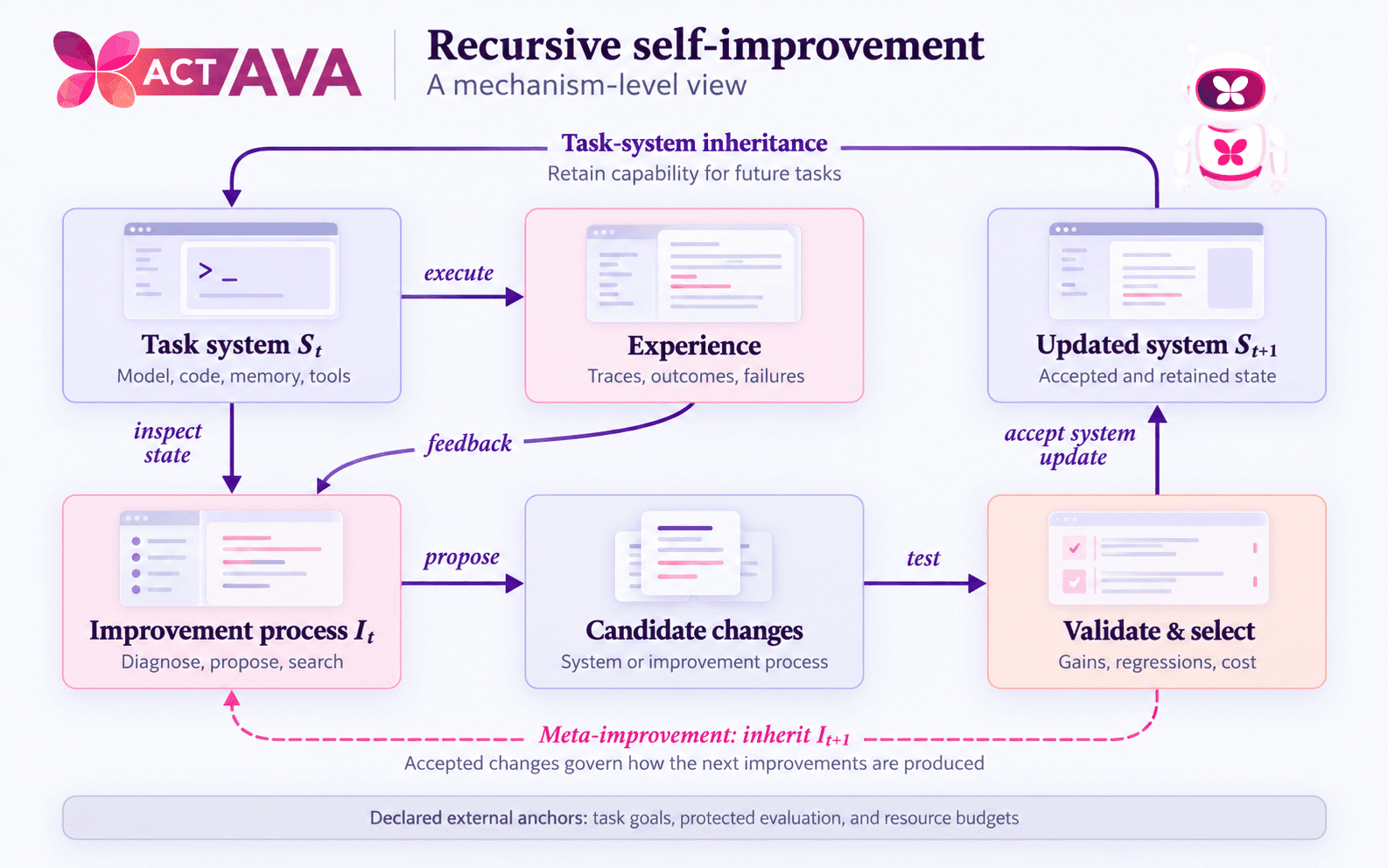
This is the Learn pillar in practice: turning expert corrections into validated, auditable improvements instead of one-off fixes that evaporate. χ-BENCH lets you simulate and benchmark those changes before they reach production.
Organize around outcomes, not handoffs
Most health workflows are a relay race of handoffs: intake passes to scheduling, scheduling to prior auth, prior auth to clinical, clinical to billing. Every handoff is a place where context gets dropped and time gets lost. Those handoffs made sense when the only way to move information was to move it person to person.
Design around the outcome instead: the patient gets scheduled, the auth gets approved, the claim gets paid clean. When an agent can carry context across what used to be four departments, you can collapse the relay into a single accountable flow with humans reviewing the moments that matter. The evidence from teams investing in AI is flatter structures over time, with fewer layers built purely to relay information and more roles built around judgment and ownership.
Install evaluation, permissions, and review from the start
In healthcare this principle is the price of entry. You cannot bolt governance onto an autonomous system after it's already touching patient data and clinical decisions.
From day one, every routine an agent runs should be evaluated against known-good outcomes, scoped by permissions that respect the minimum-necessary standard, and reviewable by a human with the authority to override. Build the evaluation suite before you scale the agent, so you're ready ahead of an incident instead of reacting to one. Know what "good" looks like, measure against it continuously, and keep a clear record of who saw what and who was allowed to act.
This is what Actava.ai CHRYSO is built for: governance and compliance inside the agent lifecycle, with role-based access, audit trails, and human-in-the-loop review. Paired with χ-BENCH for validation against benchmarks, evaluation becomes part of the factory rather than a chore you run at the end.
Final thoughts
None of this requires you to be a five-person startup with no legacy systems. Greenfield teams have a cleaner runway, sure. But an established health organization can pick one workflow, make it legible, wrap it in an expert loop, and govern it properly, then use that as the template for the next.
The organizations that win the next decade will be the ones that redesigned enough of the work for machine intelligence to actually help, with governance solid enough to trust it. Using the most AI was never the point. That's the whole game: removing the hidden chores that keep clinical and operational teams from doing the work that moves care forward.
From engineered chaos to governed intelligence. That's the transformation worth building for.
Actava.ai: The AI factory for healthcare. Master your agentic future.
Where are you on the ladder?
If you want an honest read on what's missing before AI becomes operational in your organization, that's the conversation we have every day. Actava.ai moves AI from pilot to production with greater control, lower risk, and clearer ROI.
Talk to Actava.ai
Written by
Frank Wang
CTO & Co-Founder
AI engineering leader who turns frontier research into market-defining enterprise products across agentic and vertical platforms. As Head of Engineering at Salesforce AI Research, Frank led breakthrough work on autonomous agents, deep research agents, agent orchestration, and the Agentforce advanced RAG & reasoning engine, post-training the agent, reasoning, deep research, and RAG models behind them. Earlier, as employee #11 and founding engineer at Vlocity (acquired by Salesforce in 2020), he built core platform technology in enterprise software — inventing the award-winning Salesforce OmniStudio Mobile Platform and six vertical industry applications, and growing OmniStudio into a platform spanning 14+ industries that has helped more than 100 large enterprises.