Blog
From Chatbots to Teammates: Understanding the 3 Stages of AI Evolution
If you feel like the world of Artificial Intelligence is moving at lightspeed, you aren’t alone. We’ve moved far beyond simple "question and answer" boxes. We are now entering the era of Agentic Workflows, where AI doesn't just talk, it acts. To understand where we are and where we’re going, it helps to look at the three distinct levels of how AI works today.
By Steve Brown
If you feel like the world of Artificial Intelligence is moving at lightspeed, you aren’t alone. We’ve moved far beyond simple "question and answer" boxes. We are now entering the era of Agentic Workflows, where AI doesn't just talk—it does. To understand where we are and where we’re going, it helps to look at the three distinct levels of how AI works today.
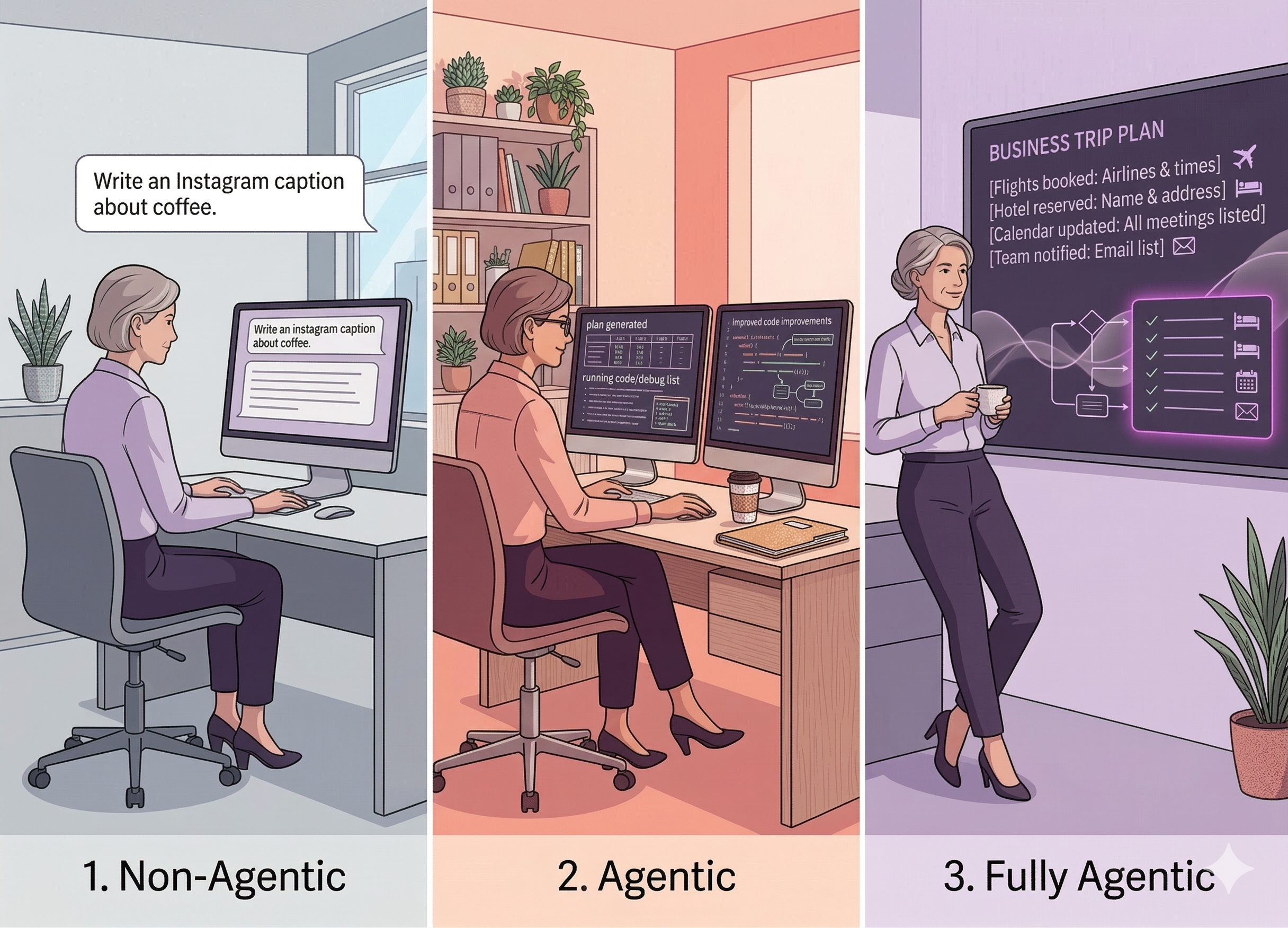
1. The Non-Agentic Workflow: The "One-Shot" Wonder
This is the AI experience most of us are familiar with. It’s the standard "input-output" model, much like using a search engine or asking a basic question to ChatGPT.
How it works: You provide a prompt, the Large Language Model (LLM) processes it, and it gives you a direct answer.
The Limitation: It is a static, one-step interaction. The AI doesn't plan ahead, it doesn't use external tools, and it doesn't check its own work for mistakes unless you tell it to.
Example: You ask, "Write an Instagram caption about coffee." The AI writes the caption and immediately stops. Its job is done the moment the text appears.
2. The Agentic Workflow: The Iterative Assistant
This is where things get interesting. In an agentic workflow, the AI becomes an active participant in the process. Instead of just giving a final answer, it iterates.
How it works: When given a goal, the AI generates a plan. It might use tools—like running a piece of code or calling an API—to see if its answer actually works. If it finds an error, it self-corrects and tries again before showing you the result.
The Benefit: This leads to much higher quality. The AI is no longer just "predicting the next word"; it is working toward a refined outcome.
Example: GitHub Copilot. It doesn't just suggest a line of code; it looks at your entire file, suggests improvements, and can even help debug the code it just wrote.
3. AI Agents: The Self-Directed Problem Solver
This is the "holy grail" of current AI development. Fully agentic systems don't just follow a single path; they manage themselves. These are autonomous systems that can handle complex, multi-layered projects from start to finish.
How it works: You give the agent a high-level task (e.g., "Organize my business trip").
The Benefit: The agent then:
Analyzes your context (emails, calendar, and preferences).
Defines its own sub-goals.
Executes tasks across multiple apps (booking flights, notifying your team, updating your calendar).
Uses a feedback loop to ensure every step meets your standards.
The Result: A fully optimized, end-to-end solution with minimal human intervention.
Why This Matters
The transition from Non-Agentic to Fully Agentic systems is more than a technical upgrade; it is AI’s transition from a "search tool" to a "digital teammate".
We are moving away from a world where we spend our time prompting AI, and toward a future where we simply manage the high-level goals that the AI achieves for us. As these Actava.ai Deep Agents evolve, they prove they are certainly "not your father’s Oldsmobile".
Actava.ai was built by healthcare and AI veterans specifically to bridge this gap.
Our KORA platform doesn't ask healthcare organizations to become AI companies. It gives them a factory to build, test, and continuously improve AI agents within the constraints and demands that define healthcare. And they can create and apply these deep agents to their products and their team’s productivity.
Here is how the end-to-end deep agent lifecycle works in Actava.ai.
Orchestrate low-code enterprise agents. Every agent knows what it's allowed to do, who it can serve, and what systems it can touch. Role-bound permissions, hallucination-resistant knowledge, native integrations into your existing stack.
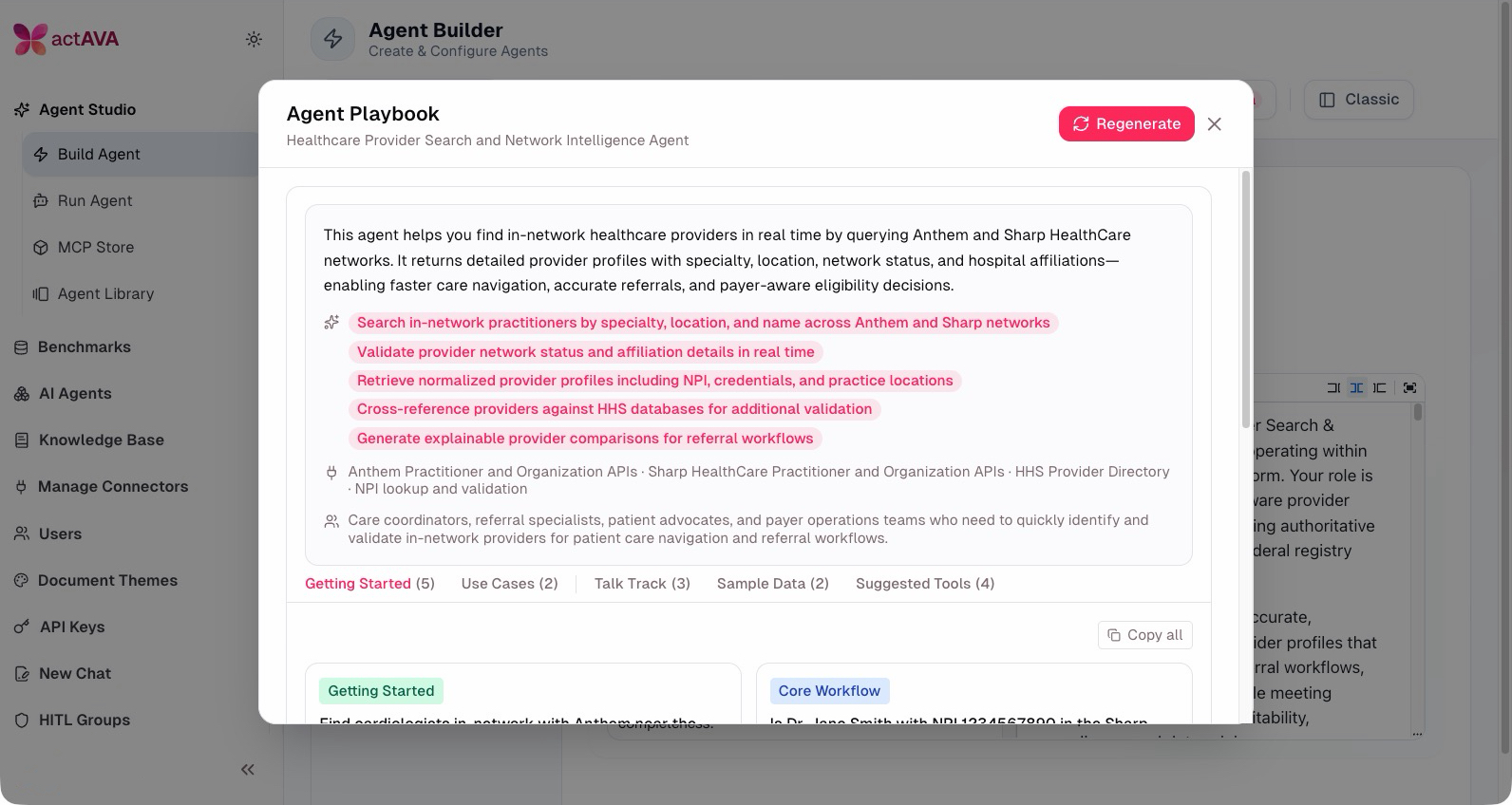
Evaluate guardrails before deployment. Our platform reverse-engineers how each agent makes decisions and stress-tests it against edge cases, adversarial inputs, and simulated real-world scenarios. That's how you get beyond pilot.
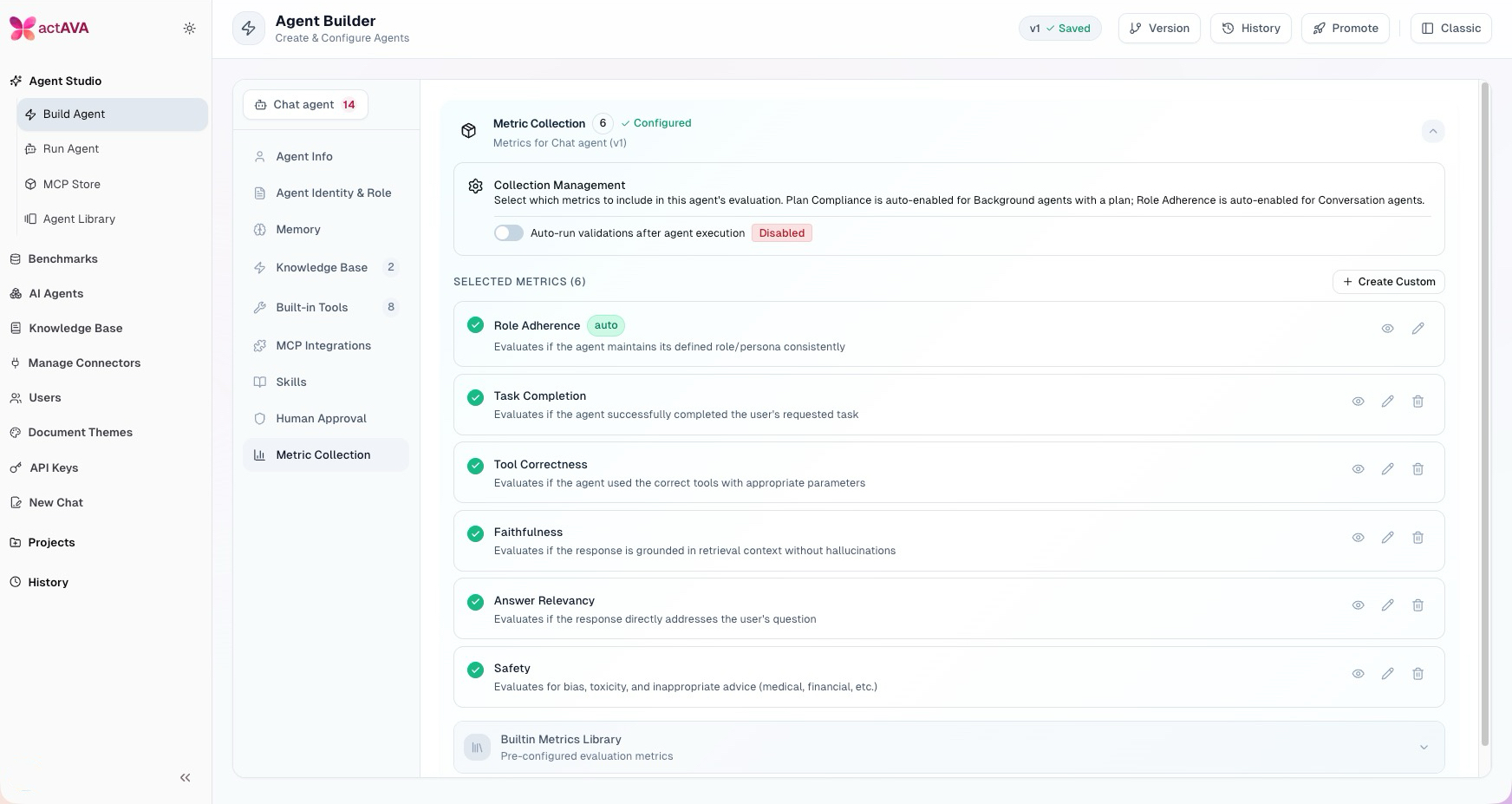
Reinforce with self-optimizing performance. When a gap is identified in production, it becomes a refined insight that feeds directly back into the agent's knowledge base. Your agents get smarter with every task and more valuable the longer they run.

Written by
Steve Brown
Chief Customer Officer
Technology executive who transforms horizontal platforms into vertical industry solutions across global enterprise markets. Over 25 years, Steve has built high-performing pre-sales, solution engineering, and enablement teams in enterprise software. At Salesforce, he served as SVP of Global Solution Engineering for Industries, growing the team past 200 and achieving 200% revenue growth in FY22. At Actava.ai, he leads forward-deployed engineering, delivering agentic AI infrastructure that bridges business needs and technology. He scaled Vlocity's global solution engineering team from 10 to 120, helping drive Salesforce's $1.33B acquisition; he holds a B.Sc. in Computer Science from Western Ontario.