Release Notes
Actava.ai Platform Release Notes v1 (February 2026)
The February ’26 Actava.ai Release empowers organizations to advance toward becoming an Agentic Enterprise by seamlessly integrating AI agents with human expertise. This release equips every team with the insights, automation, and resources needed to confidently enhance customer experiences. It also helps administrators control the costs of their agentic solutions.
By Deon Metelski
Actava.ai Platform Release Notes
Feb 11, 2026
The February ’26 Actava.ai Release empowers organizations to advance toward becoming an Agentic Enterprise by seamlessly integrating AI agents with human expertise. This release equips every team with the insights, automation, and resources needed to confidently enhance customer experiences. It also helps administrators control the costs of their agentic solutions.
New Features
Organization Quota Management
Organization Quota Management enables enterprises to efficiently monitor and control the allocation of AI agent resources across teams and departments. By leveraging intelligent automation, organizations can set customized usage limits, track performance, and optimize resource distribution based on real-time needs and strategic priorities. This ensures that AI capabilities are used effectively, prevents overconsumption, and supports compliance with organizational policies, all while maintaining scalability as the enterprise grows.
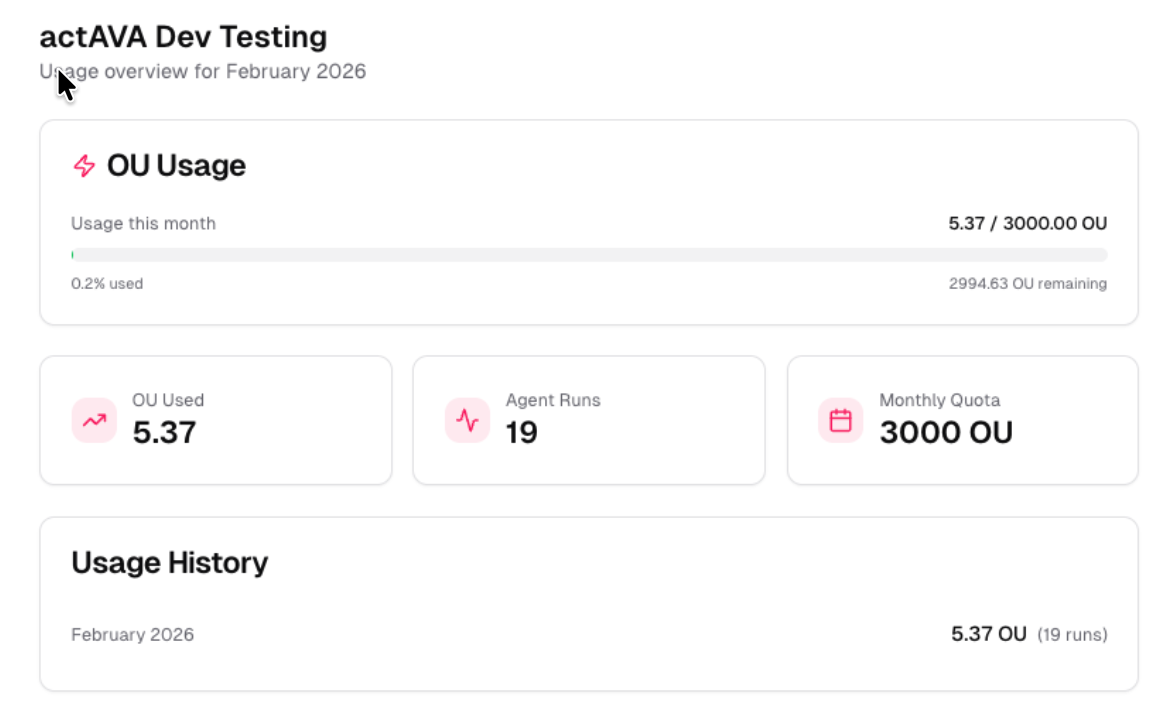
Usage Visibility: Organization members can view their quota allocation and monthly consumption.
Progressive Warnings: Automated banners appear at 50%, 80%, and 100% quota usage
50% and 80% warnings are dismissible by org admins
100% warning persists until resolved
Human-in-the-Loop (HITL) Enhancements
Our new Human-in-the-Loop (HITL) features allow organizations to combine the speed and efficiency of AI with essential human oversight. These enhancements enable users to set up checkpoints for expert review, ensuring that critical decisions and complex tasks are validated before completion. By integrating approval workflows, real-time feedback, and exception handling, HITL features promote transparency, accuracy, and accountability. This approach not only helps maintain high standards of quality and compliance but also fosters trust in AI-driven processes by keeping human expertise at the core of automated solutions.
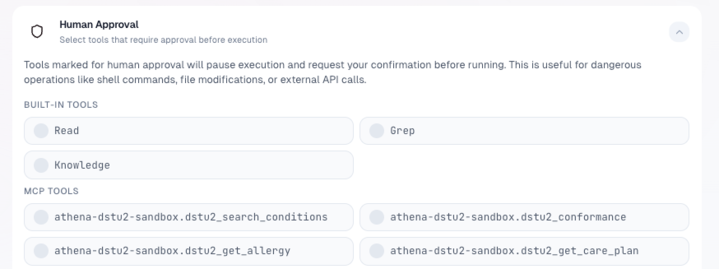
Session Persistence: HITL state now persists across browser refreshes and cache clears
Parallel Tool Call Support: When multiple tool calls occur simultaneously, users can approve or deny each individually
Per-Tool Configuration: Configure HITL requirements on any tool (MCP or built-in) from the agent settings
Multi-Step Runner Improvements
We’re excited to announce the latest Multi-Step Runner improvements for Actava.ai, designed to streamline your agent-building workflow and boost productivity. With this release, artifacts generated at each step are now easily accessible for review, download, and copying, enabling greater transparency and flexibility throughout the process. Step handoff documents enable seamless context transfer between steps, ensuring continuity and improved collaboration. Additionally, async compaction has been optimized to no longer block other browser sessions, delivering a smoother, more efficient user experience.
Artifacts generated at each step are now accessible for review, download, and copy
Step handoff documents allow context transfer between steps
Async compaction no longer blocks other browser sessions
Healthcare MCP Server Library
AI models are powerful, but they don't natively "speak" healthcare protocols like FHIR (Fast Healthcare Interoperability Resources) or HL7. Without an MCP server, an AI is just a brain without access to the patient's chart. Model Context Protocol is an open standard that simplifies how AI models (e.g., large language models, or LLMs) access and use external tools and data sources. It serves as a standardized communication protocol between AI applications (clients) and external systems (servers), enabling AI models to leverage information and functionality beyond their own internal capabilities.
We have just added 7 new purpose-built MCP servers to our Actava.ai library.
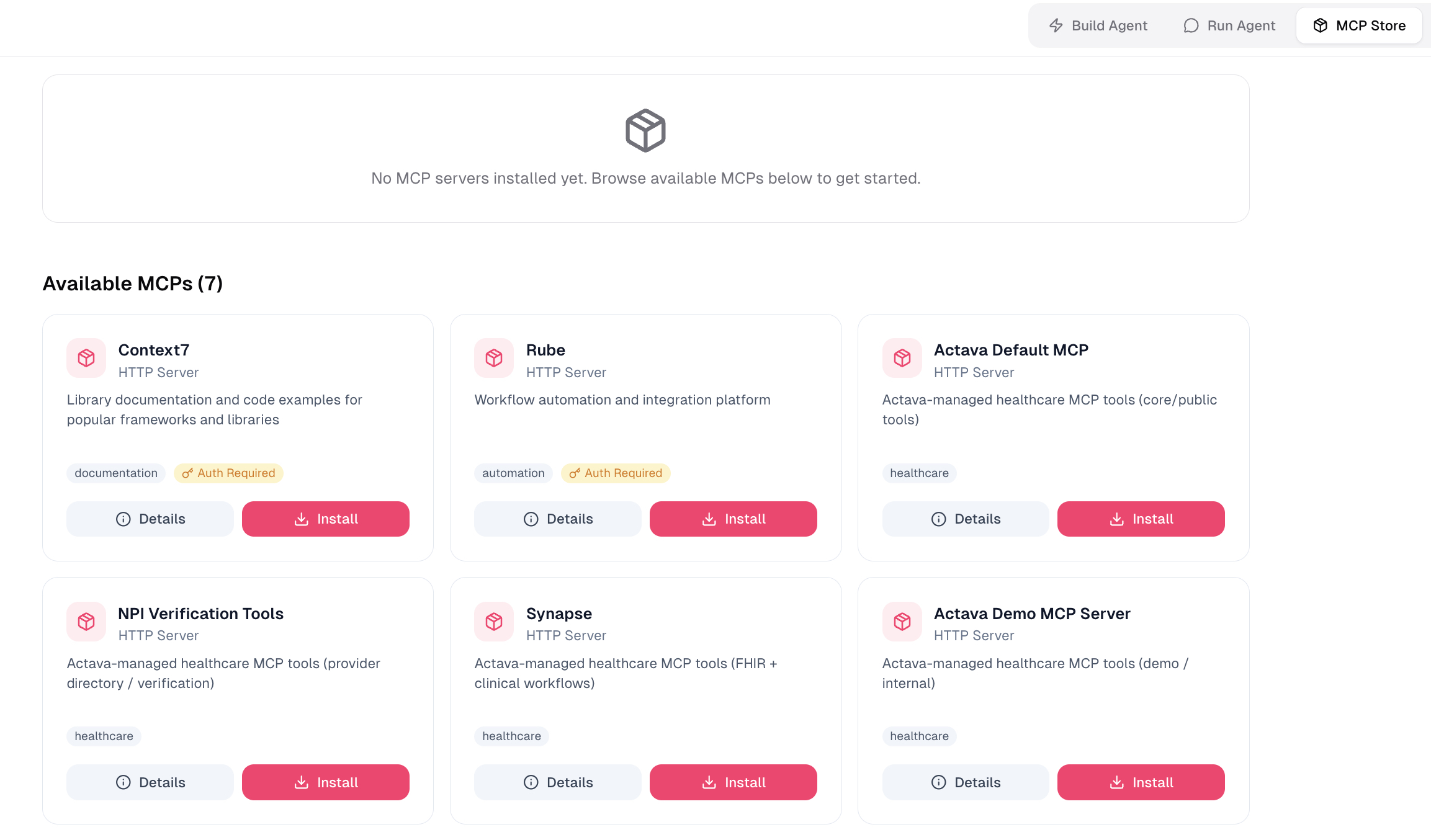
NPI Verification & Prior Authorization
Payer Directories (Anthem, Sharp)
Medicare Coverage
CMS Tools (ICD-10 codes, etc.)
Each server includes improved descriptions and production-ready tooling
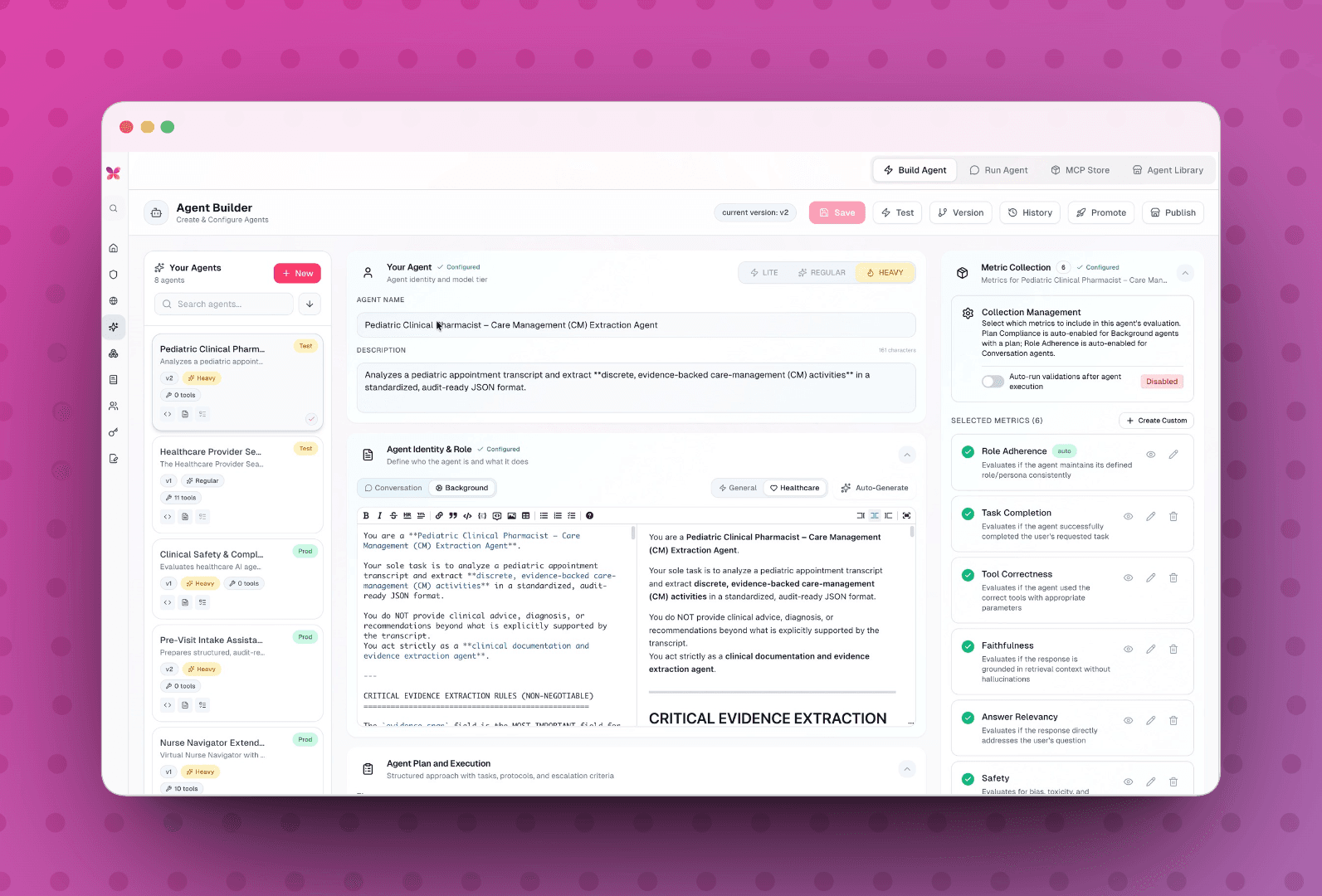
Agent Metrics Configuration
To truly capture the value of AI orchestration in healthcare, we need to shift our focus from ROI to ROAI, or return on agent. Traditional ROI works well for "tools"—static software like an EHR system or a digital billing portal. You pay for a license and expect a specified percentage of administrative savings. AI agents are different. They are dynamic, generative, and collaborative. Capturing their value requires measuring how they amplify human capability, not just how they cut costs. We have added a new feature for custom Agent Metrics Configuration.
New metrics section in agent configuration
Support for both custom metrics and built-in metrics
New Agents in the Library
Rather than building from scratch, use the Actava.ai library of prebuilt agents designed to address specific healthcare scenarios. Our library dramatically reduces implementation time and aligns agent building to best practices. It also ensures consistent quality across deployments and allows customization to meet specific workflow needs.
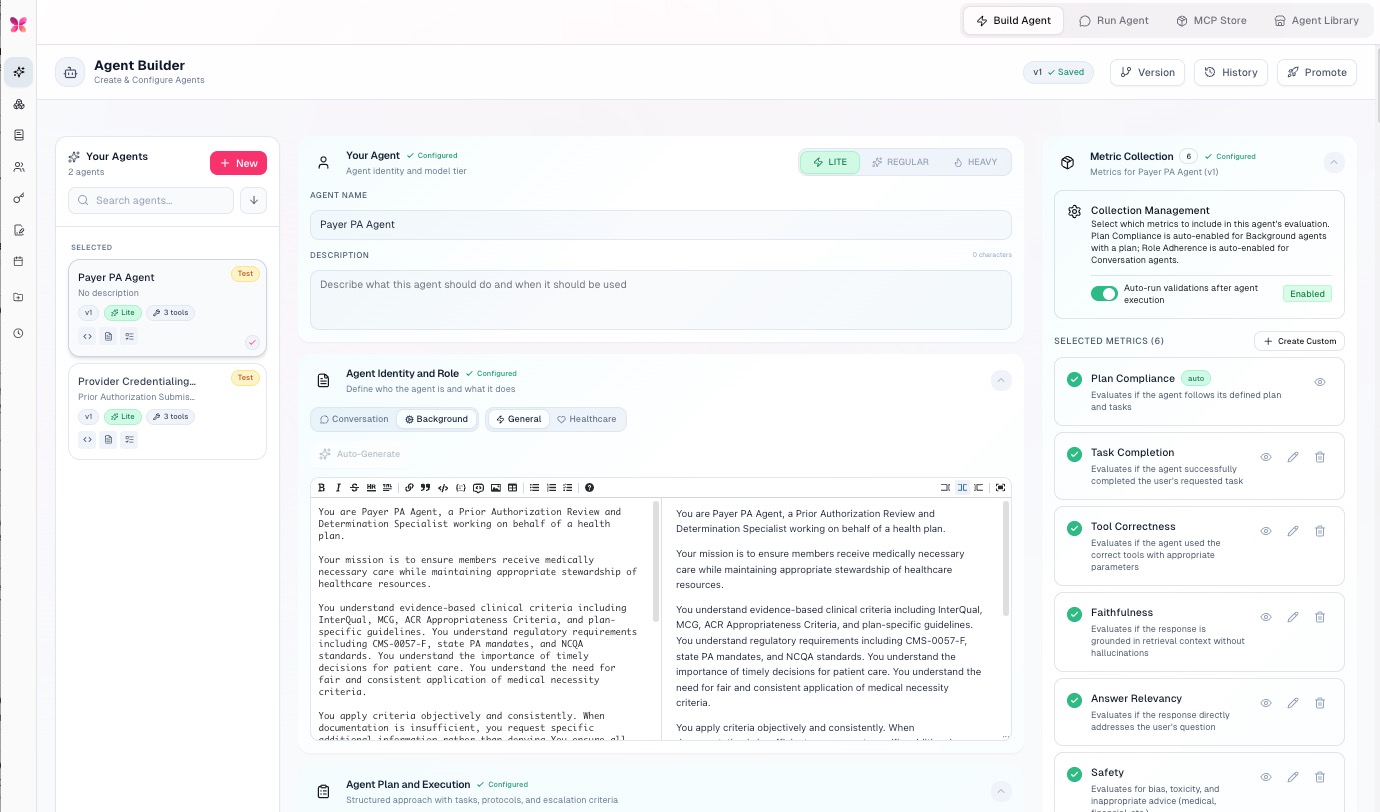
We continually add new agents to our Agent Library.
Payer Medical Policy Management Agents: Medical policy creation and management is the "brain" of a health insurance payer. It dictates what treatments are covered, under what conditions, and at what price. This process is traditionally slow, manual, and document-heavy, making it a prime candidate for Actava.ai’s deep AI Agents.
Payer Prior Authorization Agents: Health Plans face unprecedented pressure to modernize their prior authorization processes. CMS-0057-F mandates FHIR-based PA APIs by January 2027, with decision timeframes compressed to 72 hours (urgent) and 7 days (standard) starting January 2026. The regulatory environment demands automation while maintaining clinical accuracy and compliance—failure can result in member harm, regulatory penalties, and reputational damage. Actava.ai has some deep agents that help payers solve this problem.

Written by
Deon Metelski
Chief Product Officer
Product leader shaping agentic healthcare AI that feels human and interoperates across every clinical ecosystem. Previously a healthcare product leader at Zyter|TruCare, Deon has spent his career turning complex clinical and operational work into products clinicians trust. At Actava.ai he leads distributed teams to orchestrate safe, explainable AI agents across EHRs and connected ecosystems, translating clinical and operational needs into intuitive, dependable experiences. His work blends empathy with data, advancing healthcare AI through a product lens, and is driven by a commitment to access, interoperability, and measurable outcomes across the care continuum.