Blog
Actava.ai V7: Agents Your Compliance Team Can Actually Sign Off On
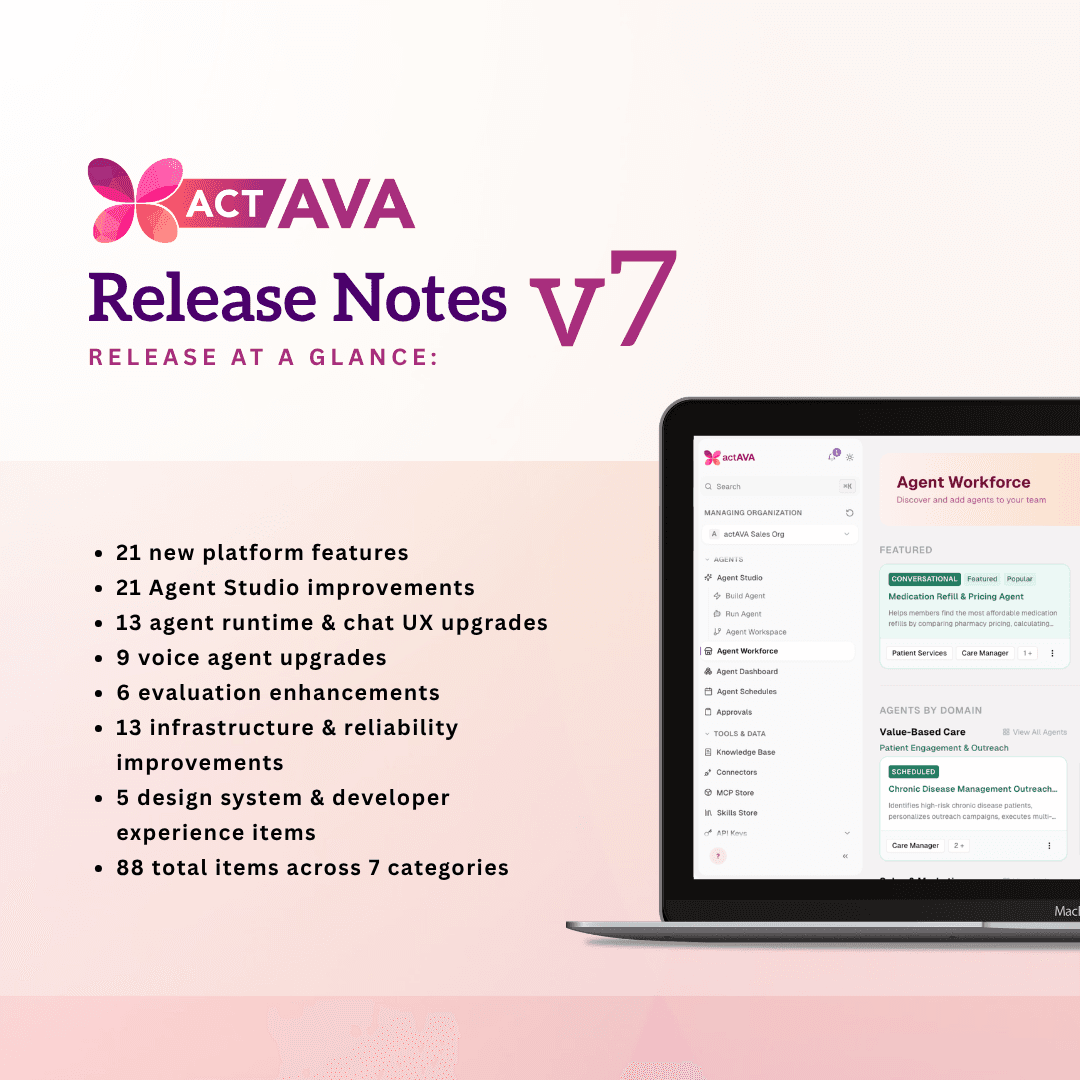
Actava.ai V7 shipped 88 items, and the through-line is accountability: exactly-once tool execution, an append-only trail of every PHI read, model ceilings your security team sets, and skills that pass a test and approval before they go live. V6 was about what agents could do. V7 is about who's accountable for it. Deterministic exactly-once tool execution, a PHI access audit trail archived nightly to immutable storage, and org- and role-level model ceilings. A new Agent Batch API runs thousands of agent jobs through a single programmatic call, metered per item. Come and see what the new Actava.ai has in store for enterprise agentic development.
V6 gave Actava.ai KORA agents reach and the ability to improve themselves. V7 makes them infrastructure: something operations can run at scale, security can bound, and compliance can audit without a data pull.
V7 shipped on August 31, 2026. It's 88 items across 7 categories, which is more than any blog post should try to cover.
So here are the six that change what your organization can do.
items shipped
new platform features
new integrations
infrastructure and reliability fixes
One API call, thousands of records
Healthcare work is batch-shaped. A risk-adjustment panel. A claims queue. A member cohort that all needs the same eligibility check.
The new Agent Batch API takes that whole job in a single programmatic call. An upstream system submits the records, and the platform dispatches, meters, and settles every run. Nobody sits watching a queue.
Three details matter for anyone who has been burned by a batch tool before. Capacity is managed centrally, so a large batch scales into available fleet without starving your live traffic. Feasibility is answered when you submit, not at a drain deadline, so you learn immediately whether the work fits. And every result reports its own token usage, so per-item cost is a fact rather than an estimate.
Completed results freeze to durable storage exactly once, with PHI audit on read. It's off by default behind a BATCH_API_ENABLED gate, so turning it on is your decision, not ours.
Skills become governed assets
A skill is how an agent learns your organization's own procedure. Your intake script. Your coding convention. The way your utilization review team actually works a case.
Until V7 those were loose files. No version history, no test, no approval path. That's a governance hole and we're glad to be closing it.
Skills Studio turns skills into first-class assets. You author one conversationally with Ava, version it as a bundle with diff and rollback, and test it in a jailed sandbox against golden cases before it goes anywhere near production.
Publishing runs through an approval gate sized to the skill's risk band, with a two-person rule that degrades gracefully if your organization has exactly one admin. Uploads land in quarantine first.
The clinical build pack ships with a PHI stop that flags, confirms, and remediates instead of hard-halting. An author fixes the problem rather than starting over.
The Skill Store makes skills browsable and shareable across your organization. The approval gate makes that safe. You need both, or you have either chaos or nothing.
Submit the claim once. Even after a retry.
Running a side-effecting action twice isn't a rough edge in healthcare. It's a duplicate claim, a double enrollment, a call from a member who got charged twice.
V7 adds a deterministic execution layer. Idempotency middleware claims each side-effecting call through a tool-invocation ledger, so a retry re-uses the prior result instead of acting again. Dedupe extraction handles nested and multi-patient arguments, claiming each record independently.
An end-of-turn deterministic submitter writes back enrollment work with read-after-write verification. If the server refused a submission, you can replay it without re-running the agent.
This is unglamorous plumbing and it's probably the single item on this list that saves your team the most cleanup.
Prove who read what, and when
HIPAA requires an account of every access to protected health information. Most teams answer that with a data pull and a spreadsheet, several days after someone asks.
V7 records PHI reads on an append-only audit trail across the highest-risk routes, archives that trail nightly to immutable storage with a durability metric, and exposes a reporting API on top of it.
A structured PHI redaction filter now sits in the shared logging pipeline across every service, and it announces itself so you can verify it's running. The file-key and content-key gaps it previously missed are closed.
A compliance officer can answer an access question from the reporting API. That's the whole point.
Decide which models each team may run
Different organizations have different rules about which models may touch their data. A hard block is a bad way to enforce them, because the user just hits a wall with no path forward.
Model Access Governance sets model ceilings at the organization and role level against a canonical catalog. A system admin sets the organization ceiling; an org admin edits the developer subset from a Model Access settings page. Voice agents carry their own separate ceiling.
When someone requests a restricted model, the platform substitutes an allowed one and tells them what happened. No wall, no mystery.
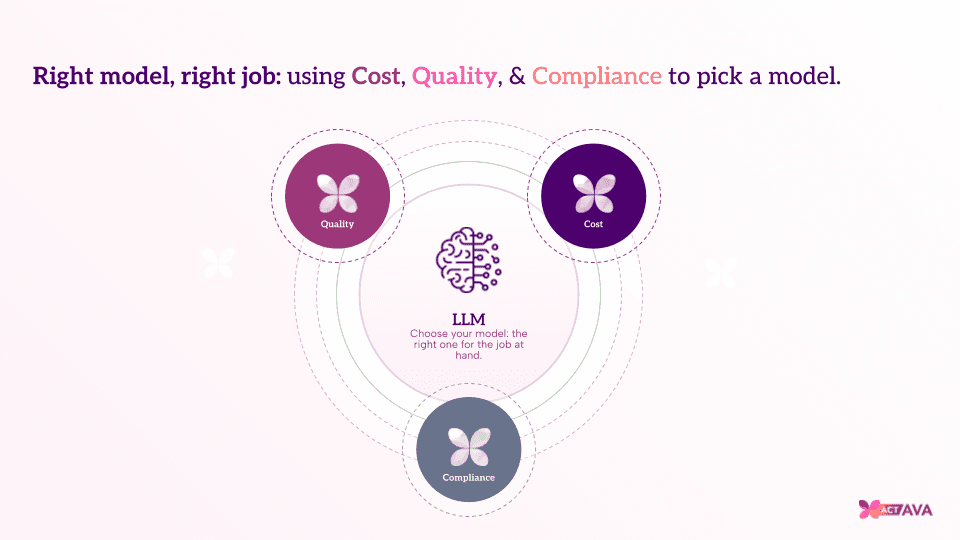
Underneath, the whole platform moved onto the Claude 5 model family. The heavy tier is Claude Opus 5, lite and regular are GPT-5.6, contextual retrieval runs on Sonnet 5 and Opus 5, and the evaluation judge upgraded to Opus 5. Voice moved to GPT-5.6 Luna.
We also refreshed every provider rate, which corrected a case where one voice model was billing at 5 times its actual cost. If that affected you, it's fixed.
Connect the systems your work already runs on
An agent is only as useful as the systems it can reach. V7 introduces a spec-driven Integration Framework, one OAuth and action model behind every connector, and uses it to ship a wave of new ones.
Nine new integrations
Asana, Linear, Calendly, Todoist, Intercom, HubSpot, GitHub, QuickBooks, and Databricks. Databricks includes Genie materialization behind a per-agent acknowledgement gate and an organization-level kill switch.
Tools stay disabled until their connection is live, so an agent never offers an action it can't complete. Slack, GitHub, SMS, Resend, and Gamma tools are now connection-gated, and the old always-on ENABLE_*_TOOLS flags are retired. Re-verify each connector after you upgrade.
End users can connect their own GitHub and Microsoft 365 accounts, and an admin can connect Microsoft 365 for the whole organization.
The rest, briefly
A few more things worth knowing about.
The Actava.ai Inference API went live in production on its own domain at inference.actava.ai, with trial keys and usage ledgers migrated from staging so no evaluation was interrupted. Callers use one stable actava:cura-soar model id, and the gateway advertises 256k context, image input, and a built-in web search tool.
Agent memory converged into Standing Instructions: live documents with revision history, carried through export and import, pinned per run. Every run records which revision each turn ran under, visible in the trace. The old Memory field is retired.
Super-admin support access is now credentialed and on the record. A "log in as" session requires an access reason, shows a persistent banner, times out after 30 minutes idle, and lands on a Support Access Log with a labeled end reason. Your customer can end the session themselves.
Agents also grade their own work now. A post-run self-check appears in the chat thread with one-click "Add to Standing Instructions," an efficiency coach surfaces wasted work as learned rules, and Diagnose and Optimize merged so you read the report and accept the fix in the same place. Every judge call is metered honestly against your usage.
And there's a public status page, synced every 5 minutes from the production health probe, with a dedicated Voice component. Enterprise buyers ask for one. Now there's one to point at.
Before you upgrade
- Model tiers moved. Organizations on defaults will see behavior shift. Pinned organizations are unaffected, but confirm your per-agent pins are still valid.
- Set your model ceilings first. A run on a restricted model gets substituted, not blocked, so decide the ceiling before rollout rather than after.
- Re-verify every connector. The old enable flags are ignored. Tools without a live connection stay dark.
- Update inference clients. Anything pinned to the previous host or a
-fastalias needs to point atinference.actava.ai. - PHI audit is already on. The access trail and its nightly archive start populating immediately.
- Agent Library is retired. Teams that instantiated starter templates from it should use Agent Workforce.
The through-line
V6 was about what agents could do. V7 is about who's accountable when they do it.
Batch throughput without a capacity fight. Skills that pass a test and an approval before they ship. Side effects that happen exactly once. An audit trail a compliance officer can query directly. Model ceilings that a security team sets, not a developer.
That's the release where compliance, operations, and security can own agents at production scale, instead of watching a pilot from the sidelines and hoping.
See the full picture
All 88 items, including voice agent upgrades, runtime improvements, evaluation changes, and the full deprecations list.
Read the complete V7 release notes, or talk to our team about what V7 changes for your organization.