A chart making the rounds this month draws a 2×2 that healthcare executives should sit with for a minute. It comes from Andreessen Horowitz, and we found it by way of Be AI-Native and AI-Proof on Health Tech Builders, which is worth reading in full.
One axis is AI-Native: how much of your cost structure is actually rebuilt around models rather than bolted onto them. The other is AI-Proof: how much of your business survives when the models get better, cheaper, and more widely available. But the final boss mode is to become your own AI company as well. Actava.ai calls this AI-Commercialized.
The line under the title is the part worth reading twice:
Frontier models will produce the answer. They won't sign the order, hold the label, or post the reserves.
That's the whole argument compressed into one sentence, and healthcare is the industry where it lands hardest.
Two axes explain a lot. The third one explains who compounds. We'll get there.
The Framework
Four boxes, and only one of them is a business
Agentic Automation
Fast-growing, genuinely useful, structurally exposed. The core capability is rented from the labs, so margin compresses every time a model ships.
The Diagonal
An AI-native cost structure plus a license, a label, or a risk entity. The model does the work. Something you own carries the accountability.
Getting Squeezed
No signature and no AI advantage. Point solutions that nothing depends on, compressed from both directions at once.
Regulated Incumbents
Hold every signature that matters while using almost none of the AI advantage. Vulnerable to a faster version of themselves.
Most frameworks like this are a Rorschach test. This one isn't, because the axes are measurable and the healthcare mapping is uncomfortably specific.
Defining the Term
A signature is whoever gets sued when the answer is wrong
"Signature" is doing a lot of work in that chart, so let's make it concrete.
A signature isn't a document, and it isn't a form. It's the moment a named party legally accepts the consequences of a decision. One question finds it every time:
If this turns out to be wrong, who gets sued, fined, decertified, or told to give the money back?
Whoever that is holds the signature. A model can produce the answer. It cannot be the defendant.
The chart's own line names three of them without spelling them out. Sign the order is a clinician. Hold the label is a device manufacturer. Post the reserves is an insurer. Healthcare has more of these than any other industry.
| The signature | Who actually holds it | What happens when it's wrong |
|---|---|---|
| Physician order, under an NPI | A named clinician | Malpractice exposure, licensing board action |
| CLIA certificate | The lab director | Sanctions, suspension, loss of certification |
| 510(k) or De Novo | The device manufacturer | FDA enforcement, recall, injunction |
| State insurance license and reserves | The plan, as a legal entity | Regulator action, capital requirements, market exit |
| CMS risk adjustment attestation | A named plan officer | RADV audit findings and repayment |
| DEA registration | The prescriber | Civil and criminal exposure |
Every row names a human or a legal entity, and every row has teeth. That combination is the property no model can replicate, at any capability level, at any price. Software can't be a licensee, a defendant, or a balance sheet.
The inverse is worth saying too, because it's where people fool themselves. Not every form is a signature. Healthcare runs on paperwork that looks official and carries no consequence. If nobody is exposed when it turns out wrong, it isn't protecting your position. It's a habit with a signature line printed on it.
Real signatures are what push healthcare far to the right on the AI-Proof axis. They're also why the industry is so badly positioned to do anything with that advantage.
Strongest position on one axis. Near-weakest on the other. That's the Regulated Incumbents box, almost by definition.
Two Comfortable Misreadings
"We hold the license" and "we bought AI" are both wrong answers
The first misreading is the reassuring one. Yes, the attestation is real. No, it isn't a moat by itself. The caption on that quadrant says the quiet part: incumbents are vulnerable to a faster version of themselves. Not to a chatbot. To another licensed entity running the same regulated work at a structurally lower cost.
Look at the surface area. Administration consumes 15% to 25% of U.S. national health spending, and McKinsey puts the annual administrative-simplification opportunity at $265B. That's the ground the next decade gets fought on, and every competitor holds the same licenses you do.
A signature protects you from being disintermediated. It does nothing to protect you from being outrun.
The second misreading lives in the top-left box, and healthcare is full of it right now. Ambient documentation. Chart summarization. Coding assist. Denial-letter drafting. Useful products, some of them the best experiences in the industry. But strip the wrapper and the core capability is a frontier model anyone can call, priced by a lab that isn't you.
Frontier models arrive identical. Your closest competitor licenses the same weights, reads the same release notes, and gets the same upgrade next quarter. Whatever advantage sits inside the model, the whole market holds it at once.
The test is simple and slightly rude: if the model got 10× better tomorrow, would your business get bigger or smaller?
The Missing Axis
AI-Commercialized: the third dimension the 2×2 leaves out
Here's the extension we promised.
Native is about your cost structure. Proof is about your accountability. Neither one asks the question that actually decides who compounds: does your organization own any intelligence, or does it only call someone else's?
That's AI-Commercialized. It measures how much of what makes you unique has been converted into an asset you hold, rather than a prompt you send. Final boss mode isn't buying AI or surviving AI. It's becoming an AI company in your own right, on the narrow ground where you already know more than anyone.
How much of the cost structure is rebuilt around models instead of bolted onto them.
Are you cheaper per unit of work?
How much survives when models get better and cheaper for everyone at once.
Do you hold a signature nobody can synthesize?
How much of your unique knowledge is embodied in a model you own and control.
Is your advantage an asset or an API call?
Why it matters: the first two axes are defensive. You can hold both and still watch your position erode, because a cost structure can be copied and a license can be obtained. What can't be copied is the specific knowledge your organization has accumulated about how your work actually gets done.
That knowledge exists already. It just sits scattered. Medical policy exceptions. Delegated approval boundaries. The payer-specific quirks your appeals team carries in their heads. Prior decisions, escalation paths, and the system workarounds nobody ever wrote down.
As Dr. T. Y. Alvin Liu of Johns Hopkins Medicine puts it:
Institutional knowledge is a valuable asset. Yet it typically lives only in the heads of people who have been around for a long time and is buried in email chains and PDFs. It doesn't scale, and inevitably gets lost in the ether when people leave.
A frontier model knows an extraordinary amount about medicine and close to nothing about how your organization runs. It has never read your medical policy exceptions. That gap is not a pretraining problem. No lab is going to close it for you, because closing it would require your data, which is the entire point.
Most organizations paper over the gap with context engineering. Longer system prompts, bigger retrieval indexes, more documents stuffed into the window. It works, and it stops working the moment you turn the agent off, because nothing was retained. Institutional knowledge should compound inside the company rather than being repeatedly injected through prompts.
The alternative is a product-model optimization loop: proprietary expertise, purpose-built environments, evaluations, and reinforcement learning used to specialize a model around the actual product. Not a general model with your documents attached. A model shaped by your work.
The Upside
Stage 3 changes what you're allowed to sell
Here's the part that turns this from a defensive argument into a growth one.
A company on the first two axes sells a service. A company on the third can sell the intelligence itself. Once your specialized model outperforms every frontier option on a workflow you know cold, you can sell that capability as inference to others rather than only offering the tool as a service. The health system that solved its own coding accuracy problem becomes the place other health systems route that work.
The mechanism is unglamorous and slow, which is why it compounds. Your proprietary operating data gradually converts today's human judgment into tomorrow's machine intelligence. Every correction a reviewer makes this quarter is a capability next year.
And the surface area is enormous. Healthcare administrative work, the 15% to 25% of national health spending that nobody defends on clinical grounds, is one of the largest AI opportunities in any industry. It's also the work most densely packed with the kind of proprietary judgment a model can actually learn.
The Doctrine
Rent the general. Own the unique.
The first move is the aggressive one: saturate your workflows with agents.
Not one pilot in one department. Every repeating step of the work, at volume, under governance. That's what moving up the AI-Native axis actually looks like, and it's also the only way to generate evidence at the density a model can learn from. You can't specialize a model on 40 examples from a proof of concept.
The second move is knowing which model runs which workflow. That's a two-model posture, and it's simpler than it sounds.
Use a frontier model for business as usual. Broad medical knowledge, general reasoning, low-volume tasks, anything where competence across many jobs beats excellence at one. Renting is correct here, and paying per call is correct here.
Use a sovereign model to defend the moat. The workflows that are proprietary, high-volume, latency-sensitive, and tied to a signature you sign. That's where a specialized model you own earns its cost, and where a rented one structurally can't reach.
Worth being precise about the word. The sovereign-AI argument is no longer simply that open models are cheaper. That was the 2024 version, and it was mostly a procurement argument. The current version is about capability and control: a model specialized on your work beats a general model on your work, and you decide when it changes.
The evidence for that second claim is uncomfortable. On Actava.ai's own χ-BENCH v1.0 evaluation of long-horizon, policy-rich healthcare tasks, the best frontier configuration we tested reached 33.3% pass@1. Two out of three attempts failed. Frontier capability alone doesn't finish healthcare's long-tail work, and buying a better frontier model next quarter won't change that, because the missing input isn't capability. It's your context.
| Decide per workflow | Own a specialized model | Rent a frontier model |
|---|---|---|
| Proprietary data | Your policies, exceptions, and expert corrections decide whether the work lands correctly. | The task runs on medical and world knowledge every model already holds. |
| Cost at volume | High upfront, low per run. Training amortizes across thousands of long-tail runs a month. | No upfront, pay per call. Volume stays low enough that per-call pricing wins outright. |
| Speed | Latency sits inside a live call, a queue SLA, or a member waiting on an answer. | A few extra seconds cost nothing downstream. |
| Performance ceiling | Low floor, high ceiling. You start behind on one narrow job and climb past every frontier model on it. | High floor, low ceiling. You need competence across many jobs today. |
| Accountability | Full provenance. You show a reviewer what the model learned, from which evidence, and when. | Runtime guardrails and audit trails carry the accountability on their own. |
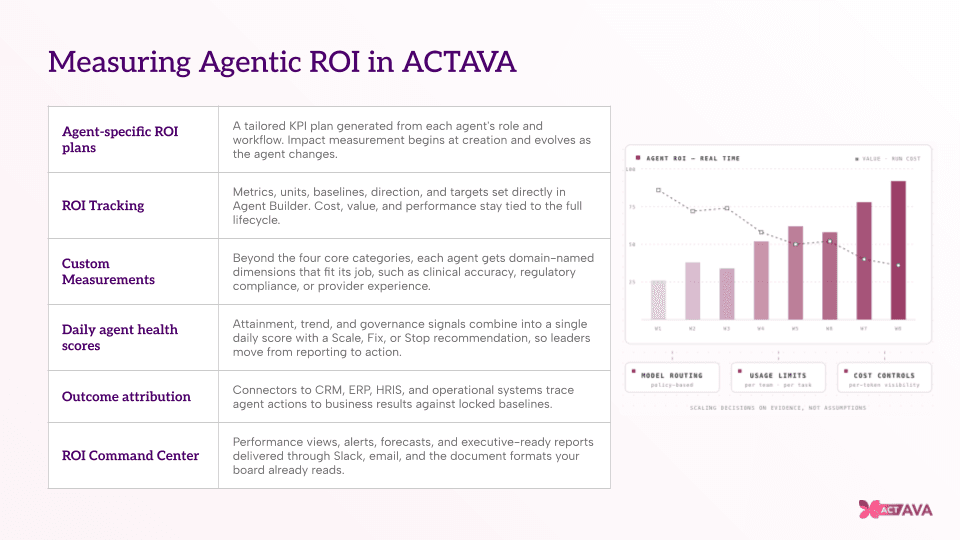
Most healthcare organizations land on both, which is the right answer. It only works if your platform is model-independent, so policy-based routing can send hard low-volume reasoning to a frontier model and the proprietary, latency-sensitive long tail to the model you own, without rebuilding your agents when either side changes.
Making It Load-Bearing
The diagonal isn't a position. It's an architecture.
People treat the diagonal as a category you belong to: you either have the license or you don't. In healthcare that's not how it works, because a signature only holds if the person on the hook can actually defend the decision they signed.
Put it plainly. A signed CMS attestation covering risk scores that agents helped generate is worth exactly as much as your ability to reconstruct, months later and under audit, what the agent saw, which model version produced the output, who reviewed it, and what they were looking at when they approved it.
Without that, you haven't extended the signature to the agent. You've quietly detached it, and the attestation is now a liability sitting on top of an unauditable process.
The same evidence that makes a signature defensible is the raw material for the model you own. That's the part worth internalizing: governance and commercialization are the same work. Every production run generates a tool call that failed at step three, a reviewer who corrected the agent's reading of a benefit exclusion, an appeal that cleared on the second attempt and not the first. Keep it and you have both an audit trail and a training set. Throw it away and you have neither.
Which is the second reason to saturate. Agents running across the whole workflow don't just lower your cost per unit of work. They generate the corrections, escalations, and near-misses that a specialized model needs and that no lab can source for you.
We call the loop Build, Test, Learn, Own. The stated goal is enterprise AI sovereignty rather than dependence on a single model vendor.
Actava.ai KORA executes the workflow
Context, tools, policies, approvals, human escalation, and runtime observability, so agents can finish regulated work. What you keep: a reliable production workflow.
Actava.ai χ-BENCH captures performance
Your hard cases, failures, and expert corrections become simulations, weighted rubrics, red-team probes, and regression tests. What you keep: repeatable evidence of what works and what breaks.
Production evidence feeds the loop
Trajectories, corrections, and escalations from real runs become training signal instead of log exhaust. What you keep: an asset that grows every day the workflow runs.
Actava.ai CURA produces the model
Authorized, customer-specific evidence teaches and evaluates a specialized model under your control, with Cura 1T as the healthcare teacher behind it. What you keep: intelligence competitors cannot license.
Actava.ai CHRYSO governs it
Role-based permissions, versioned audit trails, human approval workflows, and pre-deployment evaluation, so an agent that learns from your work stays traceable while it does.
- Healthcare workflow →
- Production trajectory →
- Expert correction →
- Evaluation and environment →
- Training signal →
- Specialized model →
- Improved workflow
Every pass around it makes the next one cheaper. That's what compounding looks like when it's built rather than promised.
Most organizations stop at Build. They deploy an agent, watch it work, and throw away the evidence it produced. That's the difference between running AI and commercializing it. It's also the difference between buying intelligence and building and owning it.
Proof
We ran the loop on our own model first
Asking a health plan to trust this loop without running it ourselves would be cheap. So we ran it.
Actava.ai CURA (Cura 1T) is a one-trillion-parameter healthcare model. We took the open-weight Kimi-K2.6 base and post-trained it through a self-improvement loop: supervised fine-tuning, reinforcement learning, trajectory evaluation, and iterative data-mixture adjustment. Each round targets a capability, trains on it, grades the resulting trajectories, reads the failures, and refines the next mixture from what it finds.
Every round passes through a human gate. The technical paper documents that process in full, including the rounds we reverted.
Cura 1T places first on 5 of 6 healthcare evaluation panels and second on the sixth. One reverted round lifted headline scores while damaging a held-out subset, and we published it. That gate is the point. An improvement you can't prove against held-out data isn't an improvement, it's a guess with better marketing.
Cura 1T is a research model, not a medical service, and not a substitute for a clinician. Benchmark scores don't establish safety for unsupervised clinical use.
The relevant part for your organization isn't the scores. It's that the loop that produced them is the same loop that produces a specialized model for your workflows, with Cura 1T serving as the healthcare teacher behind it. And it runs on your evidence, inside your boundary, on a timeline measured in weeks rather than the multi-year, multi-hundred-million-dollar program most health systems assume model ownership requires.
Why the Bar Is Rising
Regulatory fragmentation pushes all three axes at once
There's a reading of federal deregulation that goes: fewer rules, easier deployment, the signature matters less.
We think that's backwards. Loosening a federal baseline doesn't remove the requirement. It replaces one requirement with fifty, enforced by state AGs, state insurance commissioners, and plaintiffs' attorneys who don't need a federal rule to build a case.
Texas, Illinois, Utah, and Colorado already have AI laws on the books. Another 43 states introduced AI legislation in 2025. Gartner expects more than 40% of agentic AI projects to be cancelled by the end of 2027 on cost, unclear value, or weak risk controls.
Every one of those pressures raises the cost of ungoverned deployment, which pushes you right on AI-Proof, and raises the value of provenance you can actually show, which pushes you up on AI-Commercialized. Good news if you're built for it. Expensive news if you assumed the license alone would carry you.
- Who gets sued when your agent is wrong? Name the person or entity, and the specific license, attestation, or order they hold. If nobody is exposed, you don't have a signature.
- If the model got 10× better tomorrow, does your business grow or shrink? Growth means the model is an input. Shrinkage means it was the product.
- Do you own any intelligence, or only call someone else's? If every advantage you have is reachable through an API your competitor also holds, you're not commercialized. You're subscribed.
- Would your audit trail survive an audit? Pick one agent-assisted decision from 6 months ago and try to reconstruct it end to end. Time the exercise.
- Does this workflow generate valuable, reusable training signal? That's the diligence question for deciding what to commercialize. Your processes, policies, trajectories, and corrections are what become proprietary intelligence. A workflow that produces none of it is worth automating and not worth owning.
The Bottom Line
Own the signature. Rebuild the cost structure. Own the model.
The chart's insight isn't that regulation is a moat. Plenty of regulated industries have been flattened while holding perfectly valid licenses.
The insight is that accountability doesn't get commoditized by better models, and healthcare has more of it than any other sector. That's an inheritance, not an achievement.
The achievement is what you build on top of it. Saturate your workflows with agents. Rent the frontier for the work that's the same everywhere, own a model for the work that's only yours, and keep every piece of evidence in between, because it's the audit trail and the training set at the same time.
Frontier models will produce the answer. Someone still has to sign. Make sure that signature sits on top of intelligence you own.
Contact Actava.ai
Own the intelligence your work creates
Actava.ai KORA is a model-independent, governed agent platform built for healthcare: route the general work to a frontier model, run the proprietary work on a specialized model you control, and keep the evidence that makes both defensible. Start with one workflow worth owning.
Explore Own Your Models