We put our docs online. In healthcare AI, that's a governance decision.
The documentation for ACTAVA is live. Anyone on your team can now read how our agents get built, tested, and governed. No sales call, no NDA, no gate.
That sounds like a small operations update. It isn't. In our corner of healthcare, publishing your documentation is a statement about how you expect to be trusted.
ACTAVA is the AI factory for healthcare. Our tagline says the rest plainly. The AI factory for healthcare. Master your agentic future. The point of an AI factory is to move agents from pilot to production with more control and less risk, and control starts with letting people see how the machine works.
Most healthcare AI vendors keep the manual behind a demo. You get a polished walkthrough, a few slides, and a promise that the real mechanics show up after signature. The buyer, meanwhile, carries the clinical and regulatory risk from day one. The people holding that risk deserve to read how the system actually works before they commit a dollar.
Docs are a promise you can be held to
Writing something down in public changes your relationship to it. A demo can be tailored to the room. Documentation can't. Once it's published, every claim about how an agent is validated, how spend gets capped, how an audit trail is produced becomes something a customer can point to later and say "you wrote this."
For a lot of vendors, that's the reason the docs stay private. Publishing them removes wiggle room.
We wanted the wiggle room gone. ACTAVA is HIPAA compliant and holds SOC 2 Type 1 and Type 2. Those aren't badges to us, they're commitments an auditor checks. Open documentation sits in the same category. If we describe how an agent is validated for clinical safety, that description has to hold up when a hospital's compliance team reads it on a Tuesday afternoon with no one from ACTAVA in the room.
A useful test for any healthcare AI vendor. Ask to see the docs before the contract. What comes back tells you how the product will behave once you're a customer.
What's actually in there
The docs cover the whole ACTAVA platform and the suites inside it. Four pillars organize the work, and the documentation follows the same shape: Build, Test, Learn, and Guide.
ACTAVA KORA is the agentic development lifecycle suite, and it's the Build pillar in practice. The docs walk through the no-code conversational interface, so a clinical operations lead who has never written a line of code can follow the same path as an engineer. KORA is where production-ready agents get created and orchestrated without custom engineering for every new use case.
χ-BENCH is the simulation and benchmarking suite, the Test pillar, and it's the part I'd read first if I were an IT or compliance reviewer. Agents are validated against benchmarks and regulatory controls before they reach production, measured on outcomes, compliance, and cost. The docs show how those checks run and what a passing result looks like.
ACTAVA Compliance is the governance and compliance suite, the Guide pillar. Role-based access, audit trails, human-in-the-loop review, and accountability at scale. This is the section a regulator or a board would care about, and it's written to be handed to them.
The Learn pillar runs underneath all of it, turning real-world outcomes into validated, auditable improvements rather than silent model drift. And CURA, our 1T-parameter healthcare model, gets its own reference for teams that want to see the model behind the agents.
Why your IT and AI leads should care
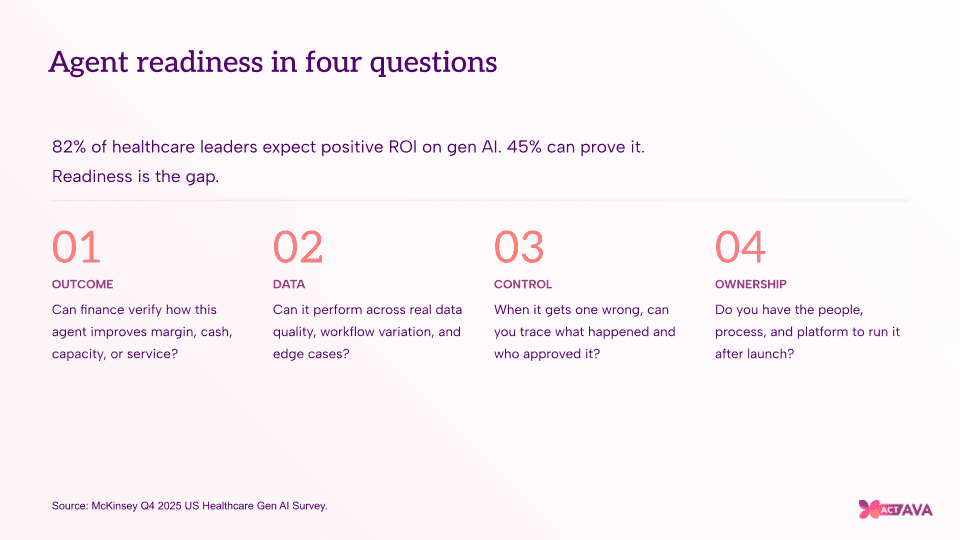
If you run infrastructure or lead an AI function, the frustrating part of evaluating vendors is the black box. You're asked to trust a system you can't inspect, then wire it into workflows where a wrong answer has a patient on the other end.
Open docs change the order of operations. Your team can read the reference, map it against your stack, and pressure-test our claims before a single meeting gets scheduled. ACTAVA is healthcare-native and model-independent, so you can also confirm for yourself that you aren't locked into one mega-vendor's roadmap. The docs show how we connect across frontier models.
Evaluation moves from sitting through a pitch to reading the manual and deciding. That's a better deal for the reviewer, and a better filter for us. Teams that show up already understanding ACTAVA are teams we can help.
Why executives and clinicians should care
You're not going to read a model reference, and you shouldn't have to. The reason this matters at your level is simpler.
Governance you can't see isn't governance you can defend. When a board asks how your AI makes decisions, or a regulator asks how you validate a clinical workflow, "the vendor assured us" is a weak answer. "Here's the published documentation for how every agent is validated and monitored" is a strong one.
We build for the places where that question gets asked in earnest. ACTAVA works with 20-plus hospitals and top universities to evaluate agents across prior authorization, utilization management, and care management. Those are workflows where a denial or a delay lands on a real person. Documentation a compliance officer can hand to an auditor isn't a nice-to-have in that setting. It's the price of being taken seriously.
The bet we're making
Opening our docs is a bet that transparency compounds. The more of how ACTAVA works that we put in writing, the harder we have to work to keep it true, and the easier it gets for a careful buyer to say yes.
Healthcare has been burned by AI that demos well and governs poorly. The antidote is specific and a little boring. Show your work, write it down, let people check it. Our docs are the first big installment of that.
Go read them. Push on them. If something's unclear or wrong, tell us, and we'll fix the documentation in public where you can watch it happen. That's the whole point.