Blog
Meet Emma Wang
Emma Wang joins ACTAVA. After helping DoorDash move from StatsD to Prometheus across pipelines handling more than 10 million metrics per second, she has joined ACTAVA as Sr. AI Platform Engineer. Emma talks about what breaks when AI agents run at real concurrency, why observability and evaluation decide healthcare adoption, and why 2026 is the year agents get treated as production systems.
Meet Emma (Qixuan) Wang, Sr. AI Platform Engineer at ACTAVA.ai
We are thrilled to welcome Emma to the team as our newest Infrastructure Engineer!
Based in the San Francisco Bay Area, Emma specializes in observability, distributed systems, and scaling cloud-native architectures. She brings a wealth of experience from her time as an Infrastructure Engineer at DoorDash, where she helped manage and optimize their massive observability pipelines. Notably, Emma helped engineer DoorDash’s transition from StatsD to Prometheus, building robust systems that handled over 10 million metrics per second.
We took this Friday to interview Emma about her new role at ACTAVA and his vision for the future of agentic AI in healthcare.
Question 1: Why did you decide to join ACTAVA.AI now?
I have always enjoyed working in startup environments because I like being close to the product, moving quickly, and seeing the direct impact of what I build.
I am especially interested in building systems that people rely on every day. Healthcare stood out to me because many important workflows still involve significant manual coordination across people, systems, and organizations. Automation offers a real opportunity to make those processes more efficient.
What attracted me to ACTAVA was the chance to work on technology that is both technically challenging and practically useful. I also joined at a stage where the company is growing quickly, and many important infrastructure decisions are still being made. That is the kind of environment I enjoy, because the systems we build now can have a large impact on how well the platform scales in the future.
Question 2: What does your work focus on at ACTAVA?
My work focuses on making our AI agents and platform reliable and scalable in production. That includes performance and load testing, observability, release automation, traffic management, and improving how we operate the system as usage grows.
AI workloads can behave very differently from traditional services. A single workflow may involve multiple model calls, tools, external services, and long-running tasks. What works well with a small number of agents can behave very differently when many workflows run at the same time.
Much of my work is understanding those limits before they become customer-facing problems. I use performance testing to identify bottlenecks, understand resource usage, and see how latency and reliability change as concurrency increases.
Observability is another important area. When an agent slows down, or a workflow starts failing, we need to quickly understand whether the issue comes from our services, a model provider, an external dependency, or how the workload is being executed.
I also work on release and operational automation so that we can ship changes quickly and operate the platform with less manual effort.
Overall, my goal is to make sure that as ACTAVA runs more agents, more complex workflows, and more customer traffic, the underlying platform remains reliable, observable, and efficient.
Question 3: What are some of the challenges healthcare companies face in their AI transformation journey?
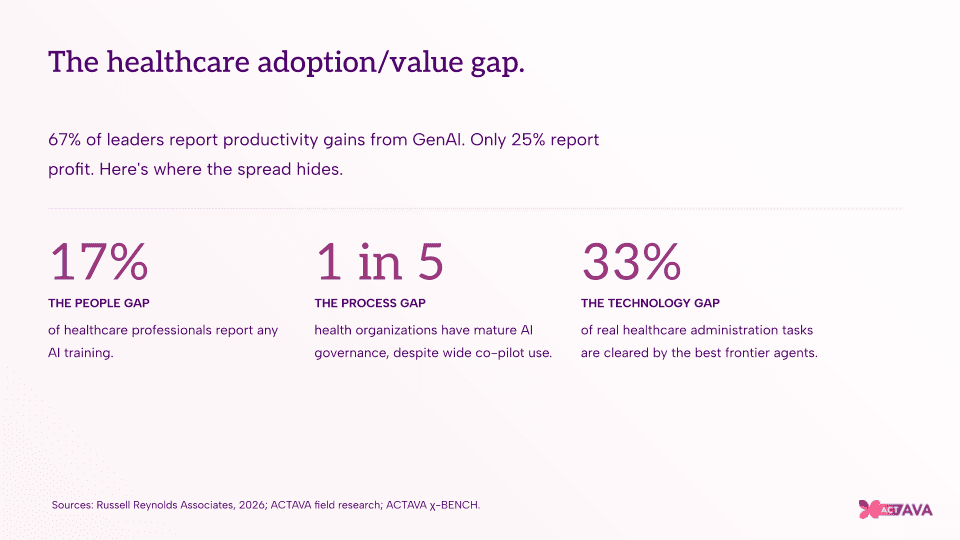
One of the biggest challenges is the complexity of healthcare workflows.
A single process can involve multiple systems, different teams, approvals, documents, phone calls, and many exceptions. Automating an individual task is relatively straightforward. Building automation that reliably supports an entire workflow is much more difficult.
Compliance and data privacy create another important layer of complexity. Healthcare organizations work with sensitive patient information, including PHI, so every system has to be designed carefully around data access, storage, logging, and auditability. As AI systems begin to take actions rather than simply provide information, it becomes even more important to understand who can access data, what actions were taken, and how those actions can be reviewed later.
Another challenge is evaluation. A system may perform well in a limited demonstration, but healthcare organizations need confidence that it can behave consistently across a much broader range of real-world scenarios. That includes normal cases, edge cases, incomplete information, failures, and situations requiring human review.
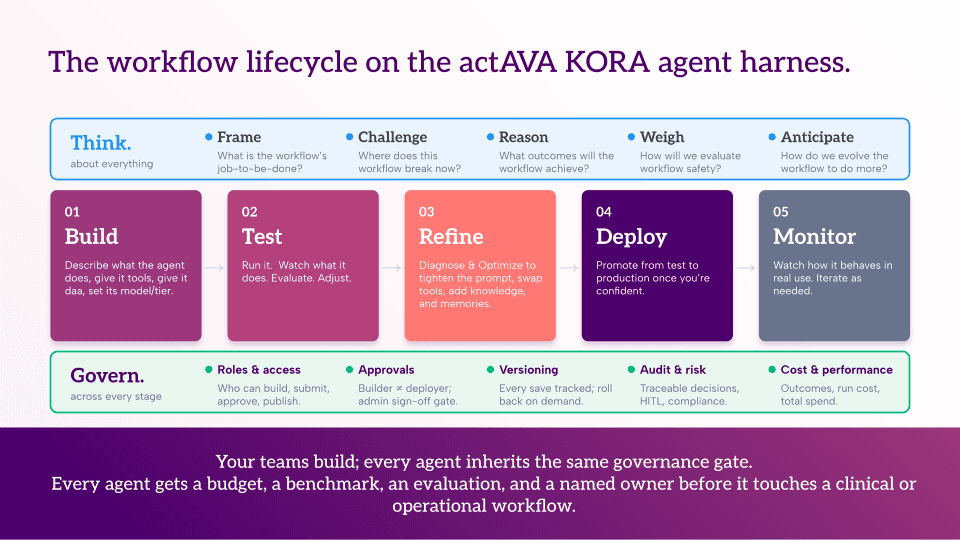
This is where I think the ACTAVA platform is especially valuable. The goal is not only to help teams build AI agents, but also to provide the infrastructure needed to test them, monitor their performance, manage access to sensitive information, and maintain visibility into what happens after deployment.
For healthcare companies, successful AI adoption requires more than capable models. It requires a platform that supports reliability, compliance, evaluation, and operational control from the start.
Bonus Round: What is your prediction for the biggest AI trend impacting your customers in 2026?
I think one of the biggest changes in 2026 will be that companies start treating AI agents as production systems rather than experiments.
As more agents become part of daily operations, the questions will become much more operational. Companies will want to know whether the system is reliable under higher traffic, how much each workflow costs, how quickly it can detect failures, and how well it recovers when a dependency has a problem.
That also means observability, performance, capacity planning, and operational controls will matter much more. It will no longer be enough for an agent to work well in a demo. Customers will expect it to behave consistently across thousands of workflows and to remain understandable when something goes wrong.
For healthcare companies in particular, I think this shift will be significant. Once AI becomes part of real operational workflows, reliability, security, compliance, and visibility matter as much as model capability.
The next stage of AI adoption will be less about whether an agent can do something once, and more about whether it can do it reliably every day at scale.

Thanks for your time today, Emma.
Beyond her day-to-day engineering work, Emma is an active voice and thought leader in the open-source and cloud-native communities. She has taken the stage at major industry conferences—including KubeCon + CloudNative North America and PromCon EU—to share her expertise on telemetry, centralized vs. decentralized metrics collection, and large-scale infrastructure optimization.
When she isn't building high-throughput monitoring pipelines or contributing to the tech community, Emma enjoys taking advantage of everything the vibrant Bay Area has to offer.
We're incredibly lucky to have her expertise on board. Welcome to the team, Emma!
Visit us at https://ACTAVA.ai/ to learn more.
Meet Emma: View LinkedIn Profile