AI for Health Insurance: Point Solution, Platform, or DIY?
Every point-solution vendor and their "AI add-ons," like chatbots, wizards, connectors, etc., are just notes on a soloist's instrument. Buy 4 of them, and you don't have an orchestra. You have a rehearsal room where nobody can hear each other.
"Hat on a hat" is a writers' room term. You already have the joke, then somebody piles another one on top, and now neither one lands. It's the shape of most payer AI stacks right now. A core admin system. A workflow tool bolted to it. An AI add-on bolted to the workflow tool. A chatbot bolted to the add-on.
Every layer got sold as the thing that would finally tie it together. None of them did, because each one was designed to sit on top of the last one rather than replace the seam between them.
Point solutions play notes. The score is what a health plan actually runs: claims, prior auth, appeals and grievances, provider data, member service. None of those happen in isolation. A denial today is an appeal in 30 days. Bad provider data breaks claims and member service in the same week.
So the question isn't which instrument is best. It's who shows up with every section and the concert hall.
What a soloist stack costs you
A single-instrument vendor sounds great in a demo. Payer work breaks it in 4 predictable places.
The glue shows up on your invoice
The instrument arrives. The systems integrator arrives. The gap between them becomes a statement of work. Every capability the platform doesn't ship becomes a follow-on project with its own timeline, its own budget, and its own way of drifting out of sync with the thing it was supposed to extend.
You find out on opening night
Most agent tooling has no way to run your workflow at production volume before you turn it on. A pilot that handled 200 prior auth requests tells you very little about the same workflow at 40,000 a month, with real edge cases and a real queue behind it. The first genuine load test happens in front of members.
Static after go-live
Ship it and the thing you launched is the thing you have. Meanwhile your production runs are generating the most valuable training signal your organization will ever produce: real claims, real appeals, real adjudication decisions, thousands of them a day. Most stacks throw all of it away.
Audit-ready by spreadsheet
Policy adherence that lives outside the solution is policy adherence that gets checked quarterly, by a human, after the fact. That's a reporting exercise, not a control. When a regulator asks which agent touched which member record under which policy version, "we'll pull that together" is the wrong answer.
The surround story is no longer around the platform. It is the platform.
Every section, one stage
Here's the full score, and what each section does in a payer environment.
Skill Factory
The reusable agent skills your workflows are assembled from. Built once, versioned, governed, and shared across claims, enrollment and service instead of rebuilt per project.
Payer-Verse Connectors
Native links into claims, enrollment, EDI, CRM and care management. You plug into the systems you already run rather than paying someone to invent the seam.
Performance and Stress-Test Agents
Your workflow, at production volume, before go-live. Where it slows down, where it breaks, and what the failure looks like when it does.
Policy Management and Adherence
The rules that constrain what an agent may do, enforced in-line and logged as they run. Not a control document that describes intentions.
Embedded KPI Tracking
Outcome measurement inside the solution. Touchless rate, turnaround time, overturn rate, cost per transaction, visible continuously rather than exported at quarter end.
χ-BENCH
Simulation and benchmarking, so "it got better" is a number you can put in front of a committee and a model swap is something you verify instead of hope about.
Self-Learning and Hydration
Every production run feeds the next release. The workflow you run in January is measurably better in June because of what it did in between.
Custom Models from Workflow Trajectories
Models shaped by how your organization actually adjudicates, appeals and serves. That's differentiation you own, not differentiation you rent.
ACTAVA KORA
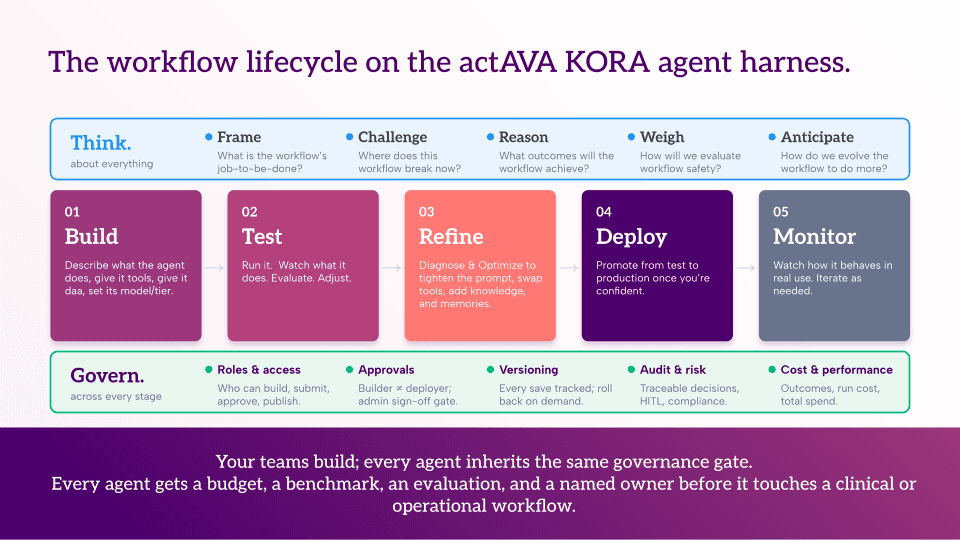
Orchestration across all of it. One place where agents are built, tested, deployed, monitored and retired, so the sections start together and stay together. The conductor is the part nobody sells you, and it's the part that decides whether the rest is music or noise.
What better music actually buys you
The metaphor is fun. The operational difference is the point.
Faster time to value. Surround capabilities ship inside the platform, not as follow-on projects.
Compounding quality. Every trajectory from production feeds the next release.
Built-in trust. Policy adherence and KPIs tracked inside the solution. Audit-ready, always on.
Payer-native fit. Skill factory and connectors built for claims, enrollment, EDI, CRM and care management.
Proven before go-live. Stress-tested agents and benchmarks. Rehearsal at production volume.
Your own sound. Custom models trained on your workflow runs.
The payer-verse, heard in full
Claims. Prior auth. Appeals and grievances. Provider data. Member service. Run those on 5 separate point solutions and you've recreated the exact problem agentic AI was supposed to fix: 5 systems that each know part of the story and none of which can finish a sentence.
An agent working an appeal should already know what the claim did, which policy version applied, and whether the provider record was clean at the time of service. That isn't an integration requirement you satisfy later. It's the reason to put the sections on one stage in the first place.
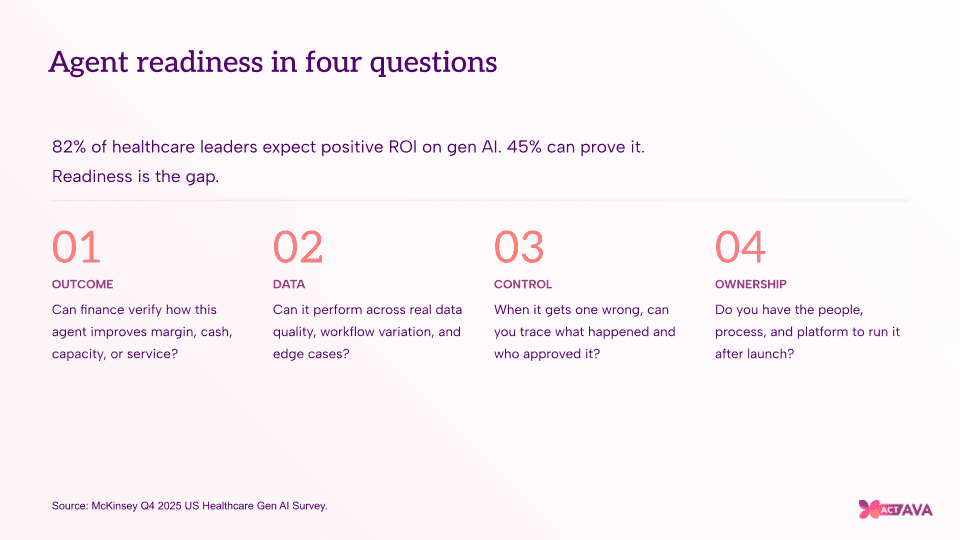
The uncomfortable part for most plans: the AI budget is already committed. 61% of healthcare leaders are building agentic AI or have budgeted for it, and 85% plan to increase investment over the next 2 to 3 years. Only about 25% of enterprises report getting the return they expected. That gap isn't usually a model problem. It's an arrangement problem.
So we built the whole payer-verse
That's the part where a positioning post usually ends. Ours doesn't, because the thing is shipped.
The Payerverse Workflow Library is our map of the workflows health plans actually care about, and the agents that run them. 12 departments across the payer enterprise, arranged in 3 rings.
The operations core carries claims and payment integrity, appeals and grievances, provider management, product and actuarial, IT and data and finance, and marketing and sales. The member experience ring carries member services, customer relationships, channels and distribution, care and utilization management, and compliance and regulatory. The innovation ring carries the tail workflows, the specific ones that never show up in somebody else's product catalog because they're too particular to your plan to package.
Roughly 25 library agents are ready today. Provider management, care and utilization management, appeals and grievances and claims are the deepest. They aren't demos. They're a starting score your team edits.
AI sovereignty is a build decision
Health plans keep telling us the same thing in different words. They don't want to rent their agentic future from a vendor whose roadmap they don't control, whose model choices they can't see, and whose pricing changes when their volume does.
That instinct is right, and acting on it takes 3 things most plans don't have yet.
Build safely. Policy adherence enforced in-line, a record of which agent ran on which data under which policy version, and a human review path that's part of the workflow rather than a promise.
Build at scale. A skill factory and payer-native connectors, so agent 2 through agent 40 aren't 39 more implementation projects.
Manage cost. Per-task model choice, benchmarking to prove a cheaper configuration still holds, and KPI tracking inside the solution so unit economics are visible while they're still fixable.
The prize is worth the discipline. Industry estimates put roughly $21 billion still recoverable through full automation of manual transactions, and $150 to $300 million in administrative savings for every $10 billion of payer revenue.
That spread survives only if you control what each step costs to run. Stack enough hats and you'll spend it on integration before a single claim moves faster.
Where ACTAVA sits
ACTAVA KORA is the conductor. Agent build, test, deployment and lifecycle in one place, with the skill factory and payer connectors inside the platform rather than around it.
χ-BENCH is the metronome. Simulation and benchmarking at production volume, so you know what the workflow does before members do.
ACTAVA Compliance is the section that keeps everyone honest. Policy adherence enforced in-line and a record of which agent ran, on which data, under which policy version, approved by whom.
CURA is the healthcare domain model underneath all of it, so an agent doesn't have to be re-taught what an NPI, a taxonomy code or a medical necessity criterion is on every call.
3 questions for your next vendor call
Take these into the next demo, whoever it's with, including us.
What ships inside the platform, and what becomes a project? Ask for the list in writing. The difference between those 2 columns is your real implementation cost.
Can I run this workflow at production volume before go-live, and see the results? If the answer involves the word "pilot," it's a no.
What happens to the data my production runs generate? If it's discarded, you're renting a capability that will never get better. If it improves a shared model you don't control, ask who else benefits.
The plans that get this right stop stitching instruments together and start hearing the whole score. From day one, and better with every performance.
Bring us one workflow
Pick the payer workflow you'd most like to hand to agents and are least willing to get wrong. We'll map it across the full stage: which skills it needs, which systems it touches, what stress testing it takes to trust it, and what the governance record looks like when it runs.
Start at actava.ai, or request a demo.
Sources and further reading
- The ACTAVA Payerverse Workflow Library (12 departments, 3 rings, and the agents ready today)
- ACTAVA KORA, ACTAVA Compliance, χ-BENCH and CURA
- Healthcare Wants to Own Its Agentic Future (Deloitte adoption figures)
- Measuring AI Return Is the Next Stage of the Enterprise AI Maturity Curve
- The Flywheel Only Spins Where You Can Check the Work
- Own Your Long-Tail Workflows, Own Some of Your Inference