Healthcare keeps debating models, copilots, and "AI scribes." The thing you can actually inspect, govern, and improve is smaller than any of them. It's the workflow.
Walk into any health system and ask where AI is being used. You'll get a list of tools. A scribe here, a chatbot there, a coding assistant somebody's piloting in one department. What you won't get is a clear answer to the question that matters: what work does AI do here, how often, and who checks it.
That's the wrong unit of measurement. A model isn't a decision. An agent isn't a process. The place work actually happens, where a referral becomes a scheduled visit or a claim becomes a payment, is the workflow.
A workflow is a repeating sequence of decisions and actions that turns an input into an output, with points along the way where a human uses judgment. Strip the judgment out and you have a pipeline: a script, a cron job, plumbing. Keep it in and you have something worth governing.
The real question is never "should we use AI?" It's: which judgment points can an agent handle, which ones still need a clinician, and how does that person know when to step in?
Most healthcare workflows have never been written down. The prior auth coordinator who knows which payer wants which attachment. The coder who remembers that one plan bundles a fuel surcharge differently. The nurse who catches the lab value that's technically in range but wrong for this patient. That knowledge lives in people, and it moves work through the building in spite of the systems, not because of them.
The first step in real AI adoption is making those workflows legible. Once you can see them, the next question is which ones to build.
Seven things an agent actually does
Strip away the invoices, the charts, the auth requests, and what an agent does in any single step reduces to seven actions. This is the vocabulary.
| Primitive | What it does | Healthcare example |
|---|---|---|
| Watch | Waits for a trigger. | A new referral fax lands. A lab result crosses a threshold. |
| Validate | Checks against known criteria. | Does the auth request meet the payer's medical-necessity rules? |
| Classify | Assigns a category or route. | Billing question vs. clinical question. Urgent vs. routine. |
| Enrich | Adds useful information. | Pull the last three notes, the problem list, the relevant guideline. |
| Generate | Produces a new artifact. | Draft the appeal letter, the discharge summary, the visit note. |
| Execute | Takes a real-world action. | Submit the auth. Post the charge. Send the patient message. |
| Elicit | Asks a human to reduce ambiguity. | "This diagnosis code doesn't match the note. Which did you mean?" |
None of these is a workflow on its own. A single validate call isn't much. Chain a few together with branching logic and a human checkpoint or two, and you have something that runs.
Eight patterns that keep showing up
The same compositions recur across departments. Each one is a specific arrangement of primitives with a specific shape of human involvement. Here they are, mapped to healthcare.
1. Triage
classify → routeAn item arrives and the agent decides what kind it is, then sends it down the right path. No artifact, no action, just the routing call. Think inbound patient messages sorted into billing, scheduling, refill, or clinical. Or referral faxes read and routed to the correct specialty queue.
Human: usually none. A misroute is cheap. The next step catches it.
2. Investigation and recommendation
validate + enrich → recommendThe agent gathers context from the chart, the payer policy, and the guidelines, then hands a clinician a recommendation backed by evidence. Prior authorization is the clearest case: the agent pulls the clinical documentation, checks it against the plan's medical-necessity criteria, and flags exactly what's missing. It did 30 minutes of cross-referencing in two. The decision to submit is still human.
Human: reviews the evidence and makes the call.
3. Draft and review
generate → reviewThe agent produces a complete artifact and a clinician reviews it before it goes anywhere. Discharge summaries, appeal letters, visit notes, patient instructions. The clinician starts from something built in minutes instead of a blank page, then applies taste, emphasis, and clinical judgment.
Human: edits or approves, and decides when it ships.
4. Execution with approval
propose → executeThe agent is ready to take an action with real consequences and waits for a human to say go. Submitting the claim, sending the auth to the payer, releasing results to a portal. The design question is how granular the gate is: per item, per batch, or per parameter. The agent does all the prep. The human owns the button.
Human: gates the action.
5. Monitoring and escalation
watch → escalateThe agent watches on a schedule. If everything's normal, nothing happens. If something drifts out of bounds, it surfaces the problem with enough context to act. Eligibility lapses before a scheduled procedure. A denial rate that spikes for one payer. A census or staffing threshold. Nobody watches the dashboard when it's green. The value is the alert at 2 AM that names the problem and links to the fix.
Human: handles the exception, not the happy path.
6. Elicitation
ask → refineThe agent and the human build a spec together, one question at a time, and the agent refuses to act until it understands enough. Patient intake that adapts to the answers. Capturing a coder's rules for how this organization handles edge cases. The human isn't reviewing an output here. They're the source material. By the time the draft exists, it's right, because the ambiguity got resolved before any work was done.
Human: supplies the context only they hold.
7. Sync and transform
transform → loadData moves from system A to system B, reshaped along the way, with no human judgment on the happy path. HL7 and FHIR feeds into a registry. Claims files normalized across payers. Lab results mapped into a research warehouse. The agent's job is doing it reliably, catching schema drift, and handling the edge cases that used to mean a manual fix. This one runs unattended for weeks.
Human: steps in when the format changes or a test fails.
8. Curation and scheduled delivery
collect → synthesize → deliverOn a schedule, the agent collects material, synthesizes it, and delivers a finished product. A morning briefing for the care team on which panel patients need outreach. A population-health digest by risk tier. Nobody triggers it, nobody reviews each one. Quality is built into the pipeline through the sources, the prompt, and the filtering, not through per-item review.
Human: is the audience, not the operator.
Which workflow to build first
Not every workflow is worth automating. Some are too rare, some too consequential, some too messy to run without a human in every step, which defeats the point. Four variables tell you where to start. In healthcare, the second one carries extra weight.
Frequency
How often does it run? A workflow that fires once a quarter won't earn back the build. One that fires 60 times a week will, and the volume is what lets the agent get good. Start with weekly. Daily is better. Hourly is where full automation pays off.
Reversibility
What happens if the agent gets it wrong? A misrouted message costs someone 10 minutes. A wrong dose, a mislabeled result, a claim that shouldn't have gone out costs a great deal more. Reversibility decides where the human checkpoints go. High-reversibility work (a draft, a classification, a recommendation) runs with lighter oversight. Low-reversibility work needs an explicit gate or a narrow blast radius. This is the clinical-safety dial, and it's the one you set most carefully.
Verifiability
Can you check whether it was done right? A reconciliation either matches or it doesn't. A code either maps to the note or it doesn't. Those are easy to trust fast. "Is this the right tone for this patient?" is not, so the human stays in the loop longer. Start with workflows where "good" is defined before the agent runs, not after.
Exception rate
What share of inputs are weird? If 95% of auth requests follow a standard shape and 5% are handwritten notes, the agent handles the 95 and escalates the 5. That's a good candidate. If half your inputs are exceptions, the agent spends more time escalating than working. Measure it before you build. Above 30%, the honest answer is usually that the workflow needs redesigning before any agent touches it.
Real workflows are chains
Most production workflows aren't a single pattern. They're two to four patterns composed in sequence, the output of one feeding the next. A revenue-cycle flow might sync the claims file, triage each claim by payer, enrich and score denial risk, then draft the appeals for a biller to review. The human sets the parameters at the start and reviews exceptions at the end. Everything in the middle runs on its own.
That's what maturity looks like: the human migrates from the middle of the workflow to the edges. The repetitive cross-referencing, formatting, classifying, and loading is where the agent lives. The clinician or specialist defines the bounds and catches the ones that look wrong.
The agent changes when the person shows up and what they see when they get there. Instead of "something's broken, go find it," the coordinator gets "here's what's broken, here's what I checked, and here are the three requests that don't match." That's a different starting point.
Find yours, name the pattern, build
This is the work we do at ACTAVA, the AI factory for healthcare. ACTAVA KORA builds the agents a workflow needs. χ-BENCH tests them against benchmarks and regulatory controls before production. Real outcomes feed back as auditable improvements, and ACTAVA CHRYSO governs what ships: role-based access, audit trails, and a human in the loop wherever the decision warrants one. Build, Test, Learn, Guide. The checkpoints in this piece are the Guide pillar, made concrete.
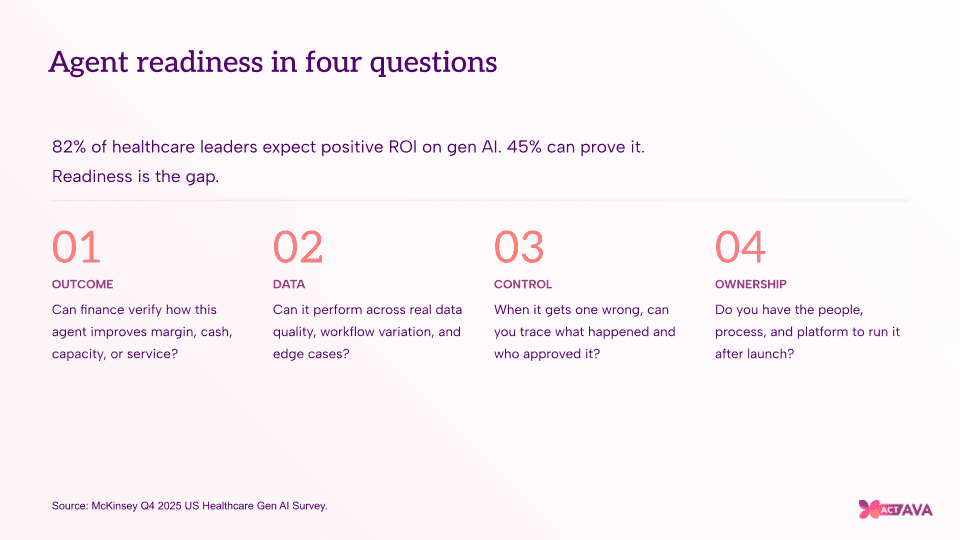
But you don't need us to start. Pick one department. Write down a workflow that runs every day and eats hours. Name the pattern. Mark the primitives. Decide where a human has to enter and why. Score it on frequency, reversibility, verifiability, and exception rate.
Do that for your five highest-volume workflows and you'll know more about your AI readiness than any tool demo will tell you. The workflow is where organizational knowledge becomes operational. Find yours.
Framework inspired by "The Org Age of AI" series from Turing Post (Will Schenk, TheFocus.AI, and Ksenia Se), reworked here for healthcare.