Blog
You Still Need Your System of Record. You Just Can't Let It Own Your Jobs to Be Done.
Epic, Veeva, Salesforce, and Workday are all shipping agents into the seat your staff already occupies, and inside their own four walls they'll win. Appeals, denials, credentialing, and site activation cross systems the incumbent can't see. Buy the record, rent the models, own the job layer where your policy, precedent, and expert corrections live.
By Steve Brown
There's an argument moving through enterprise software right now that should stop every health system, payer, and life sciences CIO cold: AI makes systems of record get more important, not less.
It's correct. And most of the healthcare AI pitch deck circuit, ours included on a bad day, is built on the opposite assumption.
So let's take it seriously, then finish it for healthcare and life sciences, because the second half of that argument is where your strategy actually lives.
The incumbents really are coming
The incumbent owns three things you can't wish away. The record itself. The permissions and workflow already wired around it. And the distribution, because your people are already logged in.
Epic, Veeva, Salesforce, ServiceNow, Workday: every one of them is shipping agents into the seat your staff already occupies. Not chatbots bolted onto a sidebar. Agents that take action inside the record.
That's a real advantage and it isn't going away. Which is why the honest version of this conversation starts with a concession most vendors won't make.
You still need your system of record. You probably need fewer of them than you have. And you should absolutely let the incumbent automate the work that lives entirely inside its own four walls.
Chart-to-chart summarization in the EHR. Document routing in the eTMF. Case updates in the CRM. If the whole job starts and finishes inside one record, buy it from the vendor who owns that record. You will not out-build them, and you shouldn't try.
The problem is that in healthcare and life sciences, almost nothing you actually care about starts and finishes inside one record.
The job is bigger than the record
Incumbents build local systems of work. The record is local. The job is not.
Look at what that means in practice.
An appeal is not a claim
The claims platform holds the claim. It doesn't hold the medical policy PDF the denial turned on, the clinical records that came back from three different provider portals, the state turnaround clock that's different in every market you serve, or the precedent your medical director set on a nearly identical case 6 weeks ago.
Your core admin vendor can automate the claim. Nobody but you can automate the appeal, because the appeal is made of your policy, your precedent, and your regulator.
A denial is not a chart
The EHR holds the chart. The payer portal holds the rule. A fax holds the peer-to-peer. And the actual expertise, which payer denies which CPT code in which month and what language reverses it, lives in the heads of 4 people in your revenue cycle department.
That knowledge is the most valuable asset in the building and it is currently stored nowhere.
Site activation is not a document
Veeva holds the document. The CTMS holds the milestone. The IRB is a third party with its own calendar. The site coordinator answers email, not your workflow tool.
Same story in safety case intake, where a single adverse event arrives through a call center, an inbox, a literature feed, and a partner's portal, against regulatory clocks that differ by jurisdiction. Same story in MLR review, where the asset sits in one system and the argument that decides it happens between medical, legal, and regulatory.
In every one of these, the record is necessary and insufficient. The incumbent's agent can only reason over what the incumbent can see, and it cannot see most of the job.
You'll run 3 labs, not 1
Second concession. You're going to be a customer of the frontier labs, and not just one of them.
Most healthcare organizations we work with land on 3 or so in production, and that's the correct number. Different tasks have genuinely different requirements. A clinical reasoning step and a high-volume document classification step should not run on the same model at the same price, and a data class that can't leave your tenancy shouldn't run in the same place as one that can.
Running several also keeps you honest about lock-in. Pricing moves. Versions get deprecated. A model that leads on your evaluation set in March is second best by September. We wrote about why running many models beats betting on one, and nothing since has argued the other way.
But here's the part that gets lost. The lab is a component, not a foundation. The evidence on that is uncomfortable and public: on the GAIA benchmark, the same frontier model scored roughly 75% in one configuration and 31% in another. Same model. A 44-point swing that came entirely from the software wrapped around it.
You are not buying intelligence. You're buying a component whose value depends almost entirely on the part you build around it.
Three layers, and you only own one
Put it together and the stack settles into three layers.
Systems of record. Bought. Fewer than you have now. Still essential.
Frontier models. Rented. Probably 3 of them. Swappable by design.
The job layer. Yours. Where the work actually happens.
Layer 3 is where the agent that spans systems lives. It holds your policy, your escalation rules, your approval gates, your audit trail, and the accumulated corrections your experts make every day.
That layer is the only one you can own, and it's the only one that compounds. Owning it is what we mean by AI sovereignty. Not building your own models. Not running your own data centers. Owning the jobs to be done.
Six tests for whether you actually own it
Sovereignty sounds abstract until you turn it into procurement questions. Ask these of any agent platform, including ours.
1. The export test
Can I take the agent out? Not the outputs. The agent. Its prompts, tools, policy bindings, approval gates, and configuration, in a format an engineer can read. If the answer involves a services engagement, you're renting.
2. The policy test
Whose policy is running? Your medical policy, your specialty carve-outs, your escalation thresholds, editable by your people without a vendor ticket. A generic policy that approximates yours is a compliance exposure, not a shortcut.
3. The model test
Can I change the model per task without a rebuild? Per task, per data class, per cost ceiling. If switching models means re-implementing the workflow, the workflow was never yours.
4. The evidence test
Can I prove behavior to a regulator without calling the vendor? Every action, every input, every human approval, every version, on demand. If your audit story depends on a vendor's support queue, you have a dependency where your license should be.
5. The learning test
When my nurse reviewer corrects the agent, where does that correction land? This is the one people skip and it's the most important. Remembering and learning are different things. Memory recalls context. Learning captures why an expert overrode the machine. If those corrections train the vendor's product instead of your institution's agent, you're funding someone else's moat with your clinicians' judgment.
6. The economics test
Who captures the spread? A long-tail administrative task that costs you $15 to $25 in labor typically costs $1 to $2 in inference. That's roughly 10 to 1. Whoever owns the workflow and the model calls captures that gap. Right now, in most organizations, it isn't you.
The learning loop is the asset
There are two kinds of learning worth paying for, and healthcare has both available.
The first is professional learning: teaching a system how good practitioners actually work. What a strong appeal letter argues. How an experienced credentialing specialist reads a 7-month gap in a work history. You can manufacture that with expert-built simulations and rubrics instead of waiting 3 years for enough historical cases to pile up.
The second is more valuable, and only you can build it. Institutional learning. Your denial patterns. Your member population. Your protocols and the 200 exceptions to them that nobody wrote down.
An agent trained on that is a moat. A rented one is a subscription.
But learning loops only spin where you can check the work. An agent that improves against a verifier you don't trust is just compounding errors at machine speed. That's why the verification layer has to be yours too, and why the flywheel only spins where you can check the work.
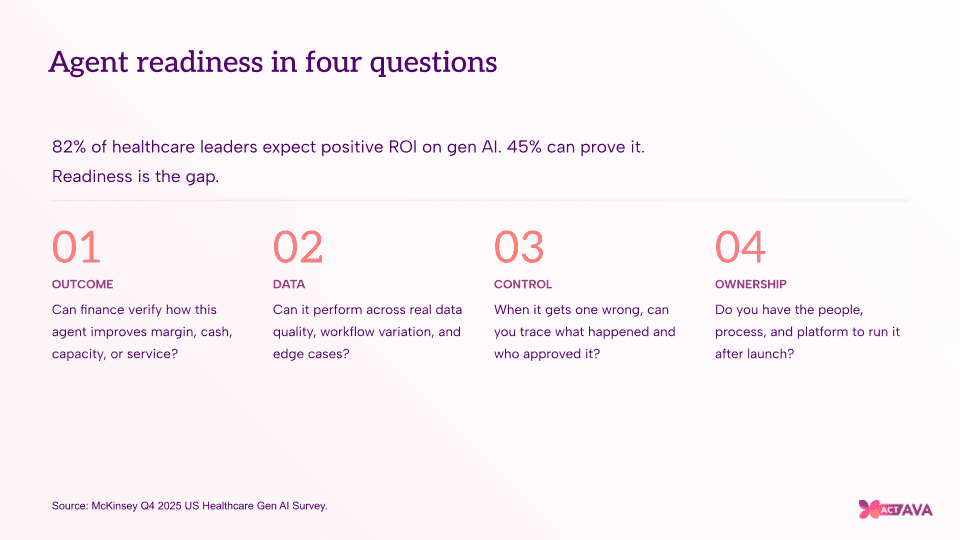
61% of healthcare leaders are already building agentic AI or have budgeted for it. 85% plan to increase investment over the next 2 to 3 years. And only about 25% of enterprises report getting the return they expected. That gap is not a model problem.
Where ACTAVA sits
We're layer 3. On purpose. We don't want to be your system of record and we're not trying to be a frontier lab.
ACTAVA KORA is where you build, test, and improve agents as owned assets with identity, versions, permission boundaries, and approval gates. Model-agnostic by design, so your 3 labs stay 3 interchangeable components.
ACTAVA Compliance is the governance and audit layer: the registry of every agent, what it's allowed to touch, who approved it, and the evidence trail you hand a regulator without asking us for help.
CURA carries the healthcare domain model, so an agent doesn't have to relearn what a taxonomy code, an NPI, or a medical necessity criterion is on every deployment.
χ-BENCH is simulation and benchmarking. It's how you prove a verifier works before you let a loop close, and how you tell whether last month's model swap actually helped.
Together they do one thing: keep the job on your side of the table while the record and the model stay useful, swappable components on theirs.
What to do about it
Start with the workflow that costs you the most and belongs to no vendor. Appeals. Denials. Credentialing. Enrollment reconciliation. Site activation. Safety intake. The ones your team describes as "we just have people for that."
Map where the job actually crosses systems, and count the crossings. Every crossing is a place your incumbent's agent has to stop and yours doesn't.
Then run the six tests on whatever you're about to sign.
The incumbents will keep shipping agents into their own records, and they should. The labs will keep getting better, and you should keep renting them. Neither of those facts decides who owns your work.
Buy the record. Rent the models. Own the job. That's the pathway to AI sovereignty, and it's available to you right now.
Bring us the workflow nobody owns
Pick the job that crosses the most systems and burns the most FTE hours. We'll map it against the six tests and show you exactly which parts your incumbent can automate, which parts a frontier model handles, and which part has to be yours.
Start at actava.ai, or request a demo.
Sources and further reading
- Healthcare Wants to Own Its Agentic Future (Deloitte adoption figures)
- The Model Gets the Headlines, the Harness Does the Work (GAIA configuration variance)
- Own Your Long-Tail Workflows, Own Some of Your Inference (labor-to-inference economics)
- Measuring AI Return Is the Next Stage of the Enterprise AI Maturity Curve
- In the Era of AI, Who Owns the IP?
- Task-Centric vs. Agent-Centric
- The Healthcare AI DIY Trap

Written by
Steve Brown
Chief Customer Officer