Blog
How to Get AI Assurance: Consultant, GRC Platform, or Build It Yourself?
Consultants, document management systems, generic GRC platforms, and in-house builds all get AI compliance done, and all four rest on a recorded claim. ACTAVA hosts the agents it governs, so ACTAVA Compliance proves a control from run history, evals, and roles.
By Deon Metelski
A CISO with a stack of new AI agents has four ways to get compliance done. They differ in cost, in timeline, and in the kind of evidence they produce.
Evidence is the part an auditor cares about. They ask one question in a dozen forms: how do you know this control works? You can answer with a record someone wrote down, or with a record the system produced.
Hire a consultant
Consultants run about $300 an hour and take 6 to 9 months to stand up an AI compliance program. A good one knows the frameworks cold and writes policies you'd happily hand an auditor.
The trouble starts on the last day of the engagement. The expertise leaves with the team, new agents keep shipping, and old ones get retrained. The posture decays when the consultants leave. A few quarters later, the binder describes a system that no longer exists.
Store policies in a document management system
These tools keep policies tidy. You get version history, approval trails, and one place to find the current copy.
They don't write the policies, and they don't map them to frameworks. Someone still drafts every page and builds the crosswalk by hand (usually in a spreadsheet that goes stale the day it's saved). You've bought a tidy filing cabinet.
Buy a generic GRC platform
A GRC platform holds what a customer types in. Risk registers, control owners, attestation reminders. It earns its keep across the rest of your risk program.
For AI agents it has two gaps. It ships without AI-specific controls, and it runs no tests against the agents. When the platform stores your answer to "was this agent evaluated before release?", it can't go check.
Build it yourself
An in-house build runs 12 to 18 months and $1M+. You need engineers who understand agent behavior, compliance staff who understand frameworks, and patience while the two groups learn each other's vocabulary.
Then comes the evidence problem. A team that builds its own tooling usually doesn't host the agents either, so it collects proof from outside the system.
What all four have in common
Each option watches the agents from the outside. Someone fills in a form, uploads a screenshot, or writes a policy statement. The control exists as a claim.
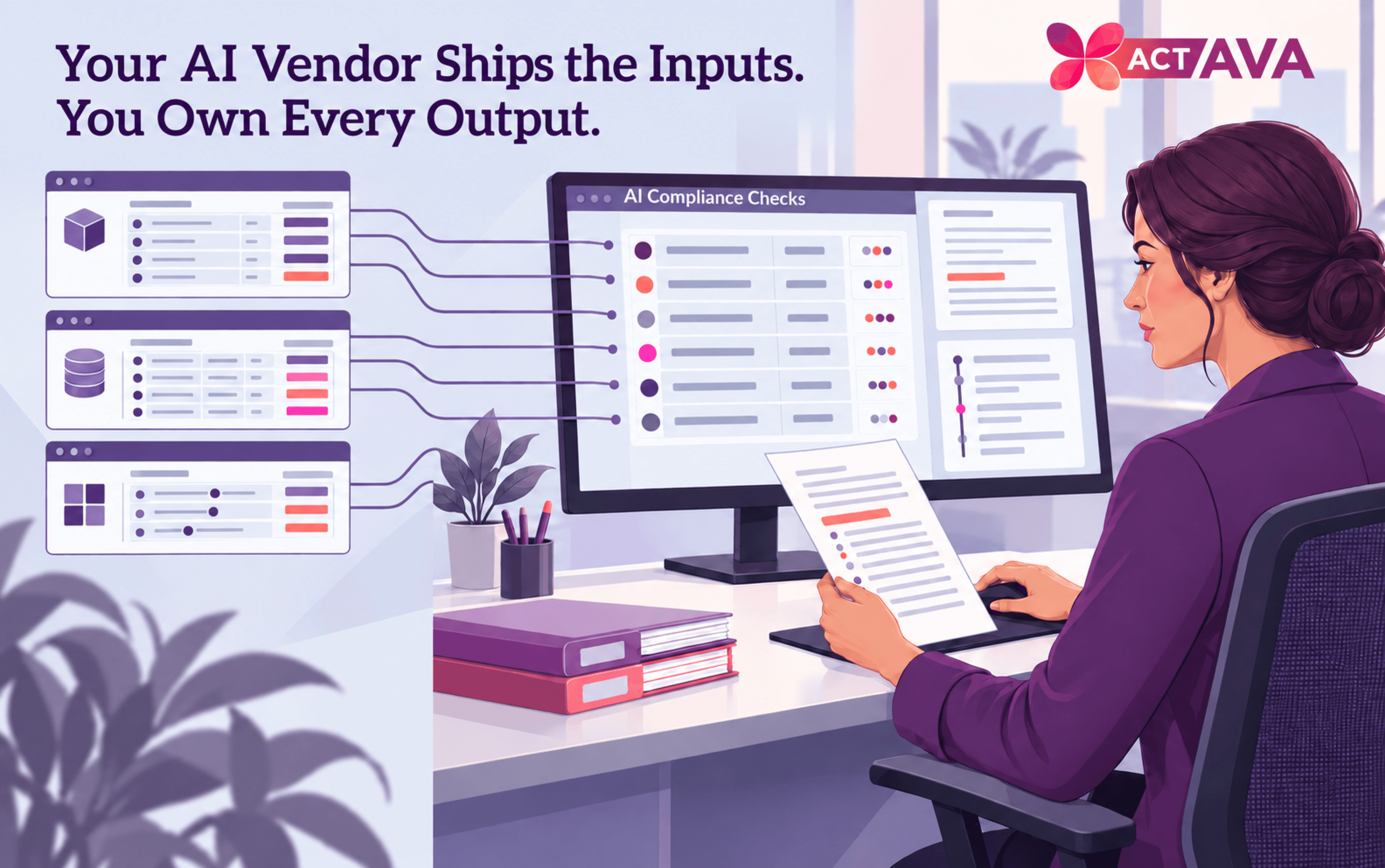
ACTAVA hosts the agents it governs. That lets ACTAVA Compliance prove a control from platform data, which means run history, evals, and roles, instead of recording a claim.
Take the evaluation question again. In a GRC platform, an owner ticks a box. In ACTAVA Compliance, the eval results sit next to the run history of the agent they tested. Ask who can change an agent, and the role assignments are in the platform too.
An auditor gets a record produced by the system that ran the work. Nobody has to reconstruct it from memory.
Registration happens at go-live
An agent registers with ACTAVA Compliance when it goes live. The record starts on the first day the agent runs in production.
There's no gap between launch and documentation to explain later, and nobody has to remember to add the new agent to a list.
Governed without being touched
Security leaders get nervous when compliance tooling can reach into production, and they're right to ask. ACTAVA Compliance has no write path into any agent. It reads and records. It gates nothing and blocks nothing.
The agent runs the way its builders configured it. The compliance layer watches, documents, and produces the evidence.
The model depends on hosting. Agents that run on other platforms sit outside it, and for those you'll still weigh the other three options.
How the options compare
| Option | What you get | Where proof comes from |
|---|---|---|
| Consultant | Policies and framework mapping. About $300 an hour, 6 to 9 months. | Documents and interviews. Posture decays after the engagement ends. |
| Document management system | Policy storage and version history. | Stored documents. No policy writing or framework mapping. |
| Generic GRC platform | A register of what your team enters. | Customer-entered attestations. No AI-specific controls or testing. |
| Build it yourself | Tooling shaped to your needs. 12 to 18 months, $1M+. | Whatever your team can collect from outside the agents. |
| ACTAVA Compliance | Governance for agents ACTAVA hosts, registered at go-live. | Platform data: run history, evals, and roles. |
Three questions to ask any vendor
- Where does the evidence for each control come from, the system or a person?
- Can the tool read the agent's run history and eval results directly?
- Can the tool change the agent, and if it can, who approves that?
A GRC platform still makes sense for the rest of your risk program, and a consultant still makes sense for a one-time assessment. For the agents themselves, ask which answers come from data and which come from a form.
See how ACTAVA Compliance proves a control
Run history, evals, and roles, read from the platform that hosts the agent.
Explore ACTAVA ComplianceSources: ACTAVA Compliance, ACTAVA KORA, χ-BENCH, CURA

Written by
Deon Metelski
Chief Product Officer
Product leader shaping agentic healthcare AI that feels human and interoperates across every clinical ecosystem. Previously a healthcare product leader at Zyter|TruCare, Deon has spent his career turning complex clinical and operational work into products clinicians trust. At ACTAVA he leads distributed teams to orchestrate safe, explainable AI agents across EHRs and connected ecosystems, translating clinical and operational needs into intuitive, dependable experiences. His work blends empathy with data, advancing healthcare AI through a product lens, and is driven by a commitment to access, interoperability, and measurable outcomes across the care continuum.